


Saffron production decreased by 15% in Rashtkhar city according to a local agricultural estimate made after a dry crop year. The official actually gave a range of 10–15 percent, so both the headline and the underlying uncertainty matter.
Lower rainfall was blamed for the decline
Hamid Reza Rezaei, identified in the source as the director of Agriculture Jihad in Rashtkhar, linked the expected fall in production to lower rainfall in the preceding crop year. He said the city’s saffron harvest would not exceed 22 tonnes.
This was a seasonal forecast, not a permanent description of the county. Rainfall can affect soil moisture and irrigation pressure, but a year-to-year harvest also depends on field age, corm health, temperature, irrigation timing, labour and how quickly flowers are picked and processed.
The area, yield and tonnage do not reconcile
Rezaei said harvesting had begun across 6,300 hectares and that each hectare would yield 1.5 kilograms. Taken literally, those figures produce about 9.45 tonnes, not a total approaching 22 tonnes. The English report gives no table or original Persian sentence that can resolve the difference.
An earlier United Nations Industrial Development Organization study described Rashtkhar as one of Khorasan Razavi’s main saffron centres. Its saffron value-chain diagnostic recorded about 5,800 hectares, annual production of 16,500 kilograms and average yield around 3.5 kilograms per hectare for the county at that time. Those older figures cannot replace Rezaei’s later forecast, but they show that a mistranslated 3.5 as 1.5 kilograms is one possible explanation. It remains a possibility, not a correction we can prove.
The safe historical record therefore retains all three figures: 6,300 hectares, 1.5 kilograms per hectare as translated, and no more than 22 tonnes. They should not be combined as if they came from a fully consistent dataset.
Where Rashtkhar’s saffron was concentrated
The report placed the largest cultivated area around Fatehabad and a second locality rendered in English as “Rashtkharmi.” The name appears damaged in translation. The earlier UNIDO study names Fath Abad and Brakooh as important production districts, but that is not enough to declare that Brakooh was the missing word in this later statement.
Rezaei said the harvest would continue until the first half of December. That timing belongs to the season he was describing. Flowering dates shift with altitude, autumn temperatures, irrigation and the weather in a particular year.
Flower picking created the largest labour demand
The official said the flower-harvest stage required the most labour and gave a figure of about 100 workers per hectare “per day for the stage.” The wording is ambiguous. It may refer to roughly 100 worker-days over the picking period rather than 100 people working on every hectare each day.
What is certain is the reason for the pressure. Saffron flowers open over a short period, and growers need to pick them promptly before separating and drying the stigmas. Labour availability can therefore influence how much of a field’s potential crop becomes saleable saffron.
Officials described the local saffron as good quality
Rezaei said agricultural experts considered Rashtkhar saffron good quality because of the local climate. Climate and established growing knowledge can help, but origin alone cannot verify an individual lot.
A buyer still needs evidence from the product itself: clean threads, controlled drying and storage, representative sampling, traceability and suitable laboratory results. The local quality statement should remain an attributed assessment, not an automatic guarantee for every harvest.
Corm selection and field visits
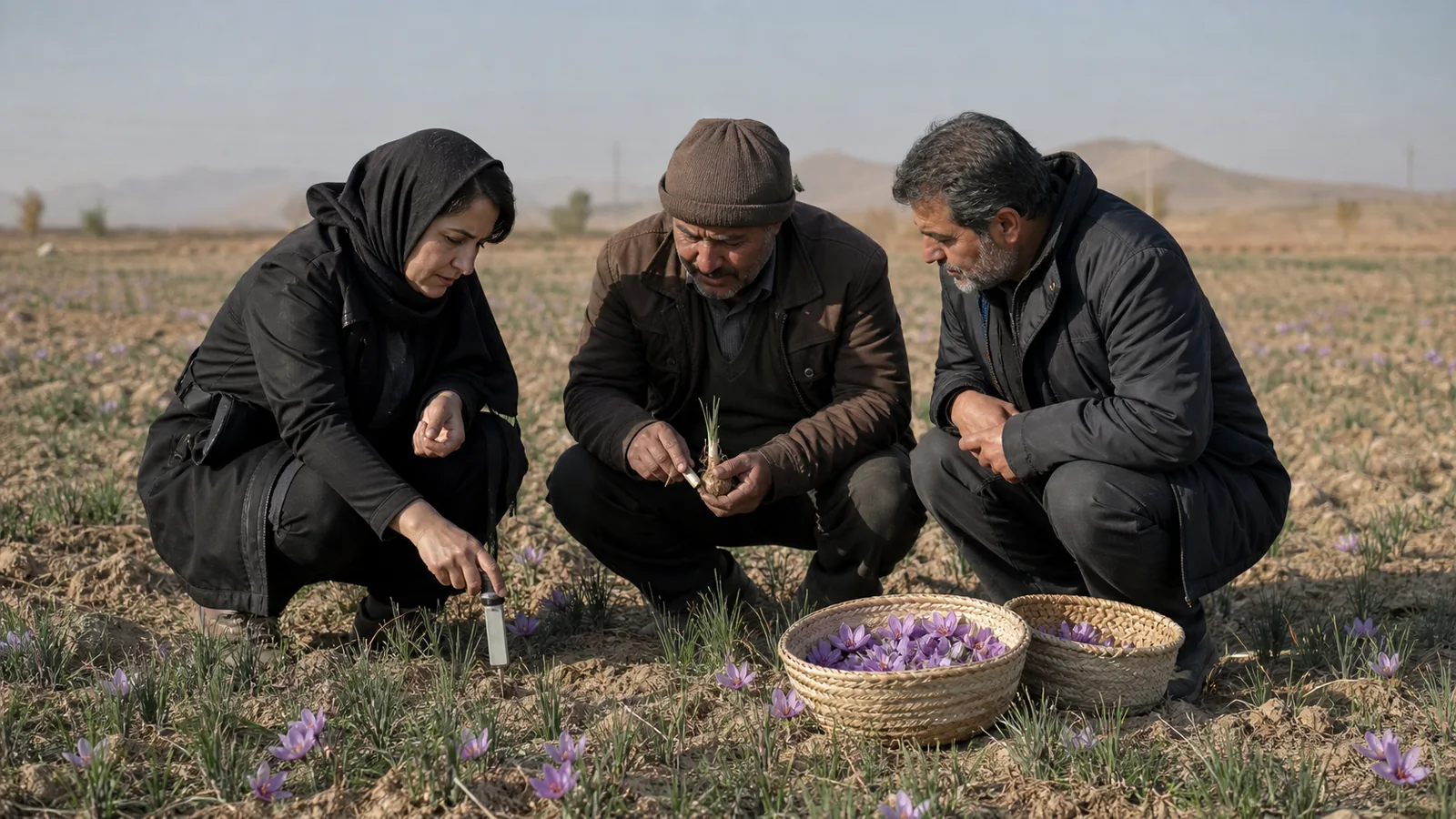
The Agriculture Jihad department and village agricultural centres were said to make continuing visits to saffron farms. Their advice focused on productivity, selecting large healthy corms and disinfecting planting material where needed.
Larger sound corms can support establishment, while damaged or diseased planting stock can spread problems through a field. “Disinfection,” however, is not a universal home recipe. The appropriate product, concentration, handling and legal use depend on the diagnosed risk and local rules. Growers should use a current local extension recommendation rather than copy a treatment from an undated report.
Water scarcity shaped the crop-planning argument
Rezaei connected Rashtkhar’s water shortage with the need to use water carefully and to develop crops suited to dry conditions. He referred to medicinal plants and what the translation calls “dehydrated plants,” likely meaning low-water-demand crops. He also placed this planning within Iran’s “resistance economy” policy language.
Saffron can be attractive in a water-scarce district, but it is not water-free. A suitable plan still needs to consider the aquifer or irrigation source, soil salinity, field drainage, the timing of autumn and spring water, and whether the crop is economically practical for the grower.
Fertiliser advice must remain field-specific
The translated report tells growers to apply urea and potassium chloride with irrigation after the flowers were harvested, on the advice of Agriculture Jihad experts. It also mentions timely irrigation, weed control and the use of chemical fertilisers and micronutrients. No rate, soil analysis or field condition is supplied.
That omission makes the passage unsuitable as a stand-alone fertiliser instruction. A two-year field study on saffron found that fertiliser effects changed with soil salinity, organic matter and season; some treatments reduced first-year stigma yield in one soil while helping later yield in another. The 2024 open-access field research reinforces the need for soil- and field-specific nutrient decisions. More fertiliser is not automatically better, and potassium or nitrogen should not be applied simply because an old news translation names it.
Why farmers continued to grow saffron
Rezaei listed economic viability, resilience to local environmental conditions, profitability and job creation among the reasons saffron cultivation had expanded. These were regional development arguments, not a promise that every farm would make a profit.
Costs vary with corms, labour, water, fertiliser, land, flower processing, storage, quality loss and market price. The same 15 percent production decline can affect farms differently depending on their yield and sale terms.
Government purchases from the previous season
The report closes by saying the government had bought more than seven tonnes of saffron from local growers in the previous year. It does not give grades, prices, purchase dates or the name of the buying programme.
That purchase figure, like the 22-tonne forecast, belongs to the season under discussion. The lasting value of the account is its picture of a dry year in Rashtkhar: lower expected production, intense harvest labour, concern about water and field management, and public purchasing intended to support growers. It should not be used as a current forecast or a universal cultivation guide.

![Exporting Saffron to Turkey + Price Guide [Complete 0 to 100]](https://img.rowhanisaffron.com/20260827003933/saffron-export-turkey-quality-inspection.webp)



