


“Saffron is the most important export commodity of Khorasan Razavi” was a customs official’s description of the province’s leading export items in the first half of 2018. It is a historical ranking, not a claim about today’s market.
The period behind the headline
Omid Jahankhah, then identified as the supervisor of Khorasan Razavi customs, said saffron packed in units of more than 30 grams led the province’s export list during the first half of the year. The report compares those results with the first half of 2017, which places the statement in the first half of 2018.
That date is essential. Export rankings change with each crop, price cycle and reporting period. The headline does not mean saffron has remained the province’s single largest export in every later year, nor does it say that saffron accounted for all of the trade totals quoted below.
A later account of Jahankhah’s comments, carried by Trend from IRNA, confirms his customs role and again lists saffron among Razavi Khorasan’s main exports. That full-year 2018–19 customs report uses a different time window and different totals, so it provides context rather than a substitute for the half-year figures.
Exports reached 1.378 million tonnes
Jahankhah reported that Khorasan Razavi customs handled 1.378 million tonnes of exported goods worth $1.116 billion in the first half of 2018. The original English text calls these “unprofessional statistics,” wording that appears to be a translation problem. It gives no methodology beyond attributing the figures to the provincial customs supervisor.
Compared with the first half of 2017, he said export weight increased by 33 percent and dollar value by 32 percent. The earlier period was reported at 1.036 million tonnes and $843 million. Those pairs are broadly consistent with the stated growth rates after rounding:
- Export volume: 1.036 million tonnes in the first half of 2017, rising to 1.378 million tonnes.
- Export value: $843 million in the first half of 2017, rising to $1.116 billion.
These are totals for goods moving through the province’s customs system, not tonnes or dollars of saffron. Saffron is a high-value, low-weight product; the total cargo weight necessarily includes much heavier commodities.
The reported trade balance was $940 million
The customs statement described the province’s trade balance as positive by $940 million in the same half-year. The translated sentence omits the import total, but the balance can be understood as the difference between reported exports and imports.
A positive customs trade balance is useful regional context, yet it is not a measure of farm income or business profit. It covers many commodities and records border values. It does not deduct production costs, transport, finance or the amount retained by different businesses in the supply chain.
Why the package size was specified
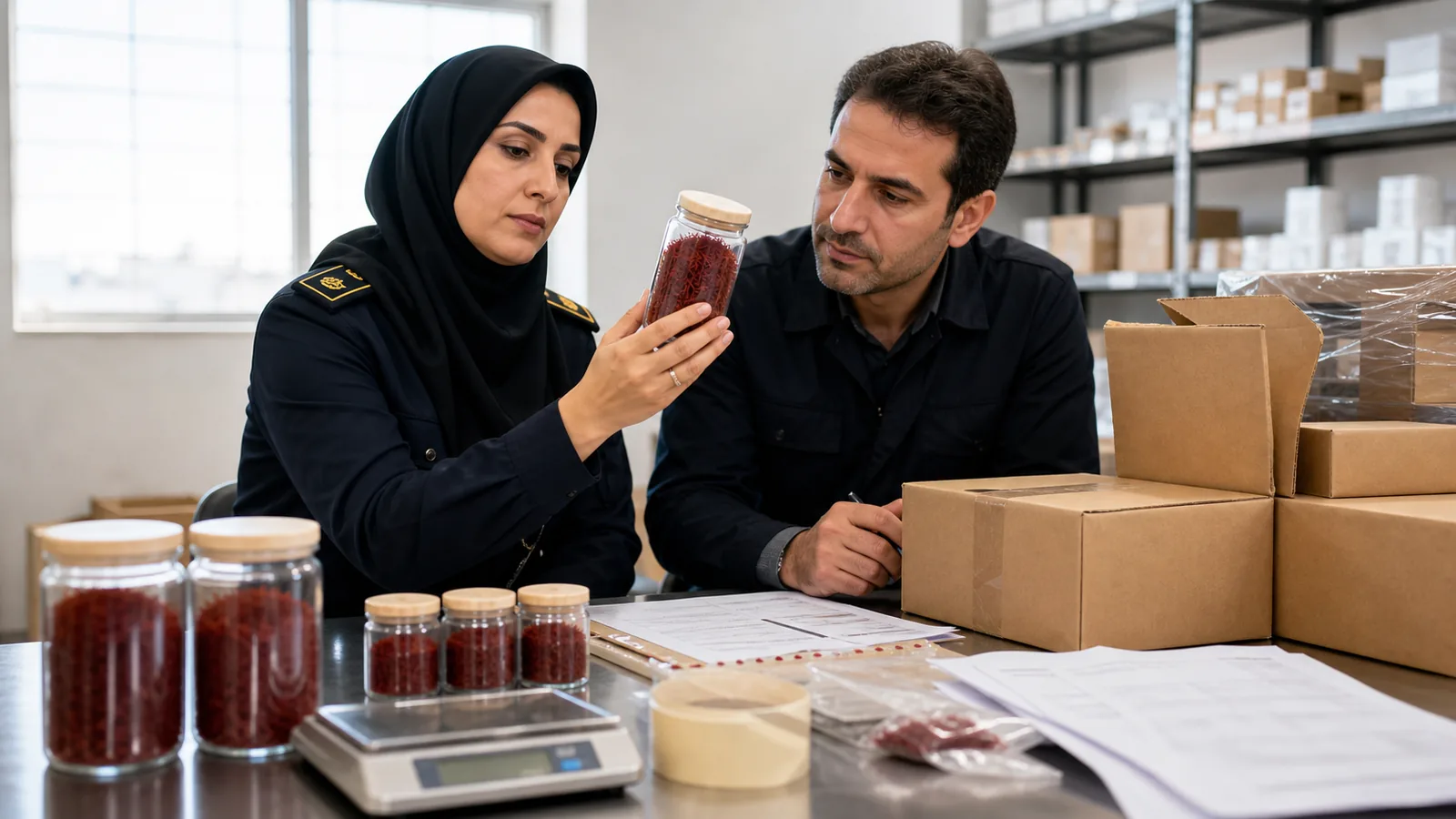
The report separated saffron into packages above 30 grams and retail packages below 30 grams. Larger packs were named first among the main export items, while packs under 30 grams also appeared on the list.
This distinction likely reflects customs product classifications and commercial presentation. It should not be read as a quality grade. Package size alone does not establish origin, purity, colour strength, aroma, moisture, traceability or whether a shipment meets a buyer’s specification.
The split does reveal two different routes to market. Larger packs may move to importers, packers, food manufacturers or distributors for onward use. Smaller units are closer to retail presentation. The value added by branding and final packaging may therefore occur at different points, depending on the contract and destination.
Other leading exports in the customs statement
Jahankhah’s list did not contain saffron alone. The translation also names “tassel-woven flooring” and “light oils and their products except gasoline.” The first phrase appears to describe a type of textile or floor covering, but the underlying customs term is not supplied. The petroleum wording is also too imprecise to assign a modern tariff code safely.
Keeping those items in the record matters because it prevents a false inference: saffron led a mixed export portfolio, rather than representing the whole of Khorasan Razavi’s customs trade.
Suitcase trade and border markets
Of the province’s non-oil export total, the report attributed $4.326 million to suitcase trade and $34.201 million to the Dogharun and Bajgiran border markets. These figures describe channels within the wider total and should not be added to it again.
Dogharun serves trade toward Afghanistan, while Bajgiran sits on the route toward Turkmenistan. Their inclusion helps explain why nearby land markets were prominent destinations for the province’s goods. A 2019 briefing from the Republic of Türkiye Ministry of Trade also lists Dogharun and Bajgiran among Razavi Khorasan’s customs and border-market network and identifies saffron as a key regional export. Its figures cover the full 2018–19 year, so they should not be merged with this post’s half-year numbers.
Four principal destination countries
The customs supervisor named Afghanistan, Turkmenistan, Iraq and the United Arab Emirates as the most important destination countries for goods exported through Khorasan Razavi in the first half-year.
The wording refers to all provincial exports, not necessarily to the final consumer market for every saffron shipment. A country can be the customs destination, a wholesale hub, a place of repacking, or the final market. The source does not provide a country-by-country saffron breakdown, and it would be unsafe to derive one from the overall list.
What the report says about Khorasan Razavi saffron exports
The durable point is narrower than the headline first appears. In the first half of 2018, customs officials placed saffron in packs over 30 grams at the top of Khorasan Razavi’s main export-item list and also recorded smaller retail packs among the leading goods. At the same time, the province reported rising overall export weight and value, a positive trade balance, active border markets and strong trade with neighbouring countries and the UAE.
The figures remain useful as a dated snapshot. They should not be presented as current saffron production, current export value or a current country ranking. For any present-day decision, the same fields would need fresh data: reporting dates, customs classification, pack size, shipment weight, declared value, destination and whether the destination is a final market or an intermediary hub.

![Exporting Saffron to Turkey + Price Guide [Complete 0 to 100]](https://img.rowhanisaffron.com/20260827003933/saffron-export-turkey-quality-inspection.webp)



