


Iran ranks first in saffron production in the world, but the size of that lead depends on the year and on whether a source is measuring harvest, exports or final retail trade. This article preserves one detailed industry statement from the 1397 Iranian crop year and puts its figures in the right frame.
Iran’s production lead is real, while percentages vary
Hossein Shirzad, then chief executive of Iran’s Central Organization for Rural Cooperation, said Iran held 96 percent of the global saffron export market in the previous year. That is a historical, attributed figure. The source does not show the dataset or explain whether it counted physical exports, origin of production or saffron later re-exported through another country.
More recent official language supports the broader ranking without repeating 96 percent. In November 2025, the Food and Agriculture Organization described Iran as the global leader, producing about 85–90 percent of the world’s saffron. The FAO value-chain account also stresses authenticity, quality assurance and post-harvest handling. Production share and export-market share are not interchangeable, which explains why credible percentages can differ.
What Shirzad said about Super Negin saffron
Shirzad called Iranian Super Negin the best export type and described it as red stigma material without yellow or white style portions. He also referred to safranal content below one percent. The statement is useful as a description of the commercial grade he favoured, but it is not enough to certify a lot.
“Super Negin” is a trade name, not proof of origin, purity or laboratory performance. Colour, aroma and flavour depend on the actual material and its processing. Modern specifications examine sampling, moisture, extraneous matter and chemical characteristics under defined methods. The current BS ISO 3632-1:2025 saffron specification is a better reference for a testable product claim than an isolated percentage translated without its analytical method.
Altitude was part of the production argument
Shirzad said much Iranian saffron was cultivated at roughly 1,350 to 2,200 metres above sea level, an altitude range he considered favourable. Elevation can influence temperature, flowering conditions and the local growing calendar, but it cannot establish quality by itself.
A field still depends on suitable soil, healthy corms, irrigation timing, weather, plant density, harvest speed and careful drying. The historical altitude range should therefore be read as one feature of established Iranian growing areas rather than a universal prescription for every farm.
Why saffron pricing was described as sensitive
The central concern in Shirzad’s statement was balance. If saffron fell below what he considered a normal and fair price, growers could lose income and eventually leave the crop. If it rose too far above competing offers, overseas buyers could turn to other origins and cultivation could expand elsewhere.
He specifically named Afghanistan and India as potential competitors. That did not mean either country was about to replace Iran; it was an argument for taking a long view of pricing and market development.
Shirzad said the process needed experience, planning and participation across the chain: growers, processors, packaging businesses and exporters. Those groups face different costs and time horizons. A workable market cannot be built from one price alone; it also needs agreed grades, transparent weights, reliable testing, payment terms, storage and dependable delivery.
The 1397 market-modernisation programme
For the Iranian crop year 1397, roughly March 2018 to March 2019, the Central Organization for Rural Cooperation said it was modernising the saffron market and standardising the product. Shirzad named three mechanisms: a physical market, commodity deposit certificates and a futures market.
A physical market concerns the underlying saffron. A deposit or warehouse certificate can represent a documented quantity held under stated conditions. A futures contract concerns delivery or settlement at a later date. They solve different problems, and their mention does not prove that every grower used them or received the same result.
The reported export figures do not fully reconcile
The organisation’s commercial office was said to estimate exports at more than 250 tonnes with a value above $352 million. The same passage gives an average price range of at least $970 and at most $1,300 per kilogram.
Taken literally, 250,000 kilograms at $1,300 per kilogram equals $325 million, below the stated value of more than $352 million. The figures may use different cut-off dates, rounded quantities, different averages or a mistranslated price measure. The source does not resolve the gap. For that reason, all four numbers belong in the historical record, but they should not be combined into a new calculation or presented as audited customs totals.
Why the state bought 67 tonnes in 1396
Shirzad said saffron prices fell sharply in crop year 1396, roughly March 2017 to March 2018, dropping below 3 million tomans per kilogram. He said the rural cooperative organisation, acting for the Ministry of Agriculture Jihad, then bought about 67 tonnes to support producers.
The translation lists the purchased grades as Negin, “Shabe Negin,” high-quality “straw” and ordinary “straw.” The last terms appear to be literal renderings of Iranian commercial categories, commonly translated in different ways. Without the original Persian labels and purchase specification, they should not be silently converted into modern grade names.
This was a market intervention, not a claim that the purchased stock was all identical. Grade, moisture, thread composition, test results and storage condition would still matter for any later sale.
Commodity-exchange sales and a reference price
For the following season, Shirzad said officials monitored global prices and saffron’s value relative to other products when setting purchase prices. He said the acquired saffron was offered transparently on a commodity-exchange board for domestic sale and export.
The stated aim was to establish a reasonable base for farmers’ new crop. The report linked continuing prices with storage capacity, farmers’ gradual release of new saffron and continued market demand. It also says prices had risen significantly from the previous year and that the market was “on its way,” a vague translated phrase that does not establish stability or future direction.
Flower-purchase centres were meant to calm harvest pressure
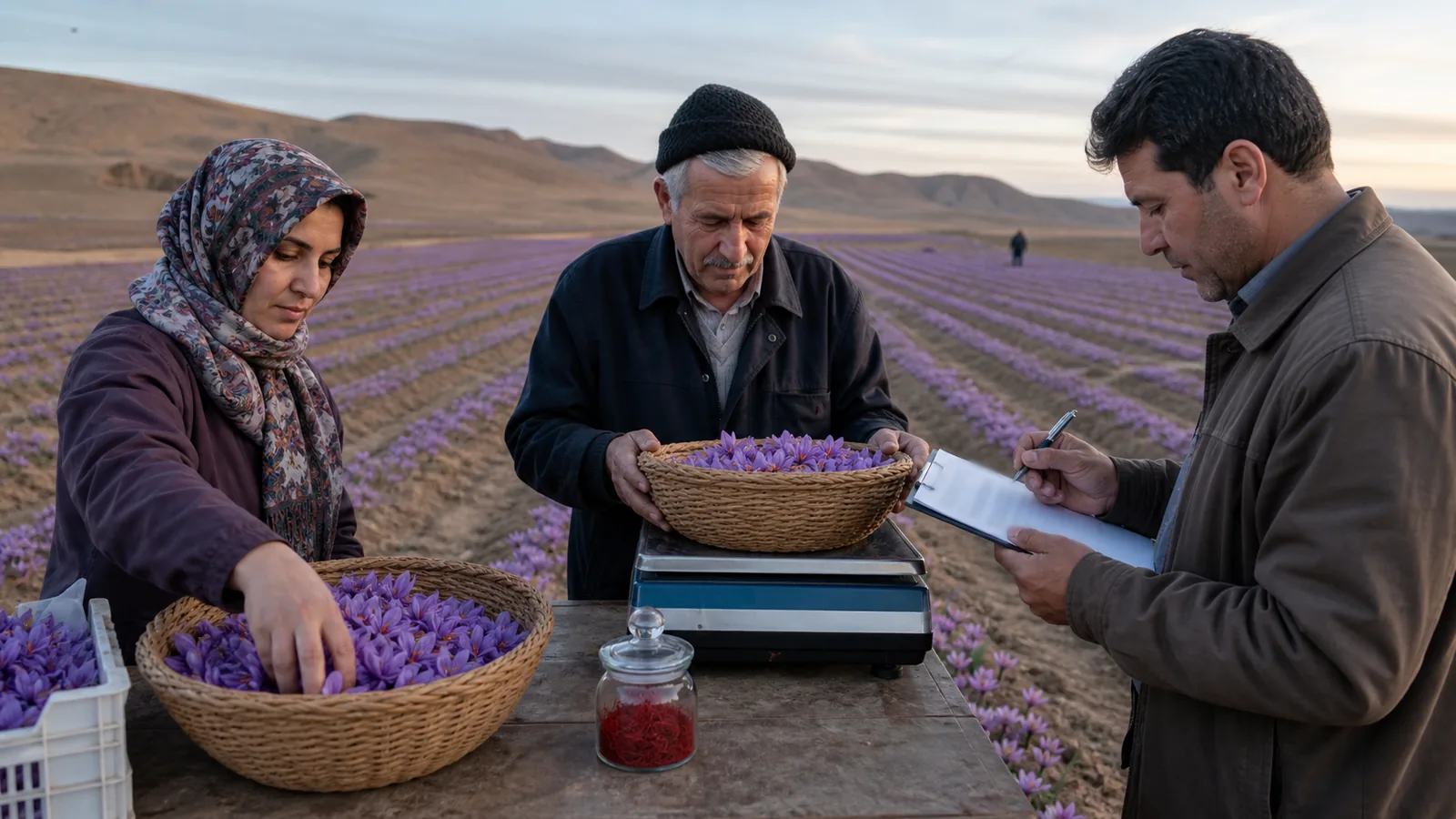
At the beginning of the harvest, the rural cooperative network activated agreed purchase centres for saffron flowers. Shirzad said 25 centres had been established and that the number could rise to 120 if necessary. Their purpose was targeted intervention: buying fresh flowers at daily agreed prices, supporting growers and moderating extreme market pressure during the short picking period.
The account says monitoring began on “October 6,” but it does not make clear whether that is a converted Gregorian date or an imprecise translation of the Iranian calendar. It reported a daily purchase range of 850,000 to 1.2 million rials per kilogram of flowers.
The buyers named were rural cooperative unions in Khorasan Razavi, South Khorasan, the Production Cooperative Union of Khorasan Razavi and the National Union of Gardeners. Together they were reported to have purchased more than 1,540 tonnes of saffron flowers.
The final sentence says that 100 kilograms of flowers produce an average of 1 kilogram of “saffron flowers,” which is internally impossible. In context, it appears to mean about 1 kilogram of dried saffron from 100 kilograms of fresh flowers. Because the original-language sentence is unavailable, that interpretation should remain qualified rather than converted into a firm yield rule.
What this historical record tells us today
Iran’s position as the leading producer is supported by current FAO guidance. The detailed percentages, prices, tonnages and intervention measures in this post, however, belong to the 1396–1397 period and to Shirzad’s account.
The deeper lesson still holds. A dominant harvest does not automatically guarantee strong returns to growers or lasting market share. Quality has to be measurable, saffron has to be handled and stored well, and prices must work for farmers without making the product needlessly difficult for buyers to plan around. Transparent lots and evidence are more durable than any single superlative.

![Exporting Saffron to Turkey + Price Guide [Complete 0 to 100]](https://img.rowhanisaffron.com/20260827003933/saffron-export-turkey-quality-inspection.webp)



