


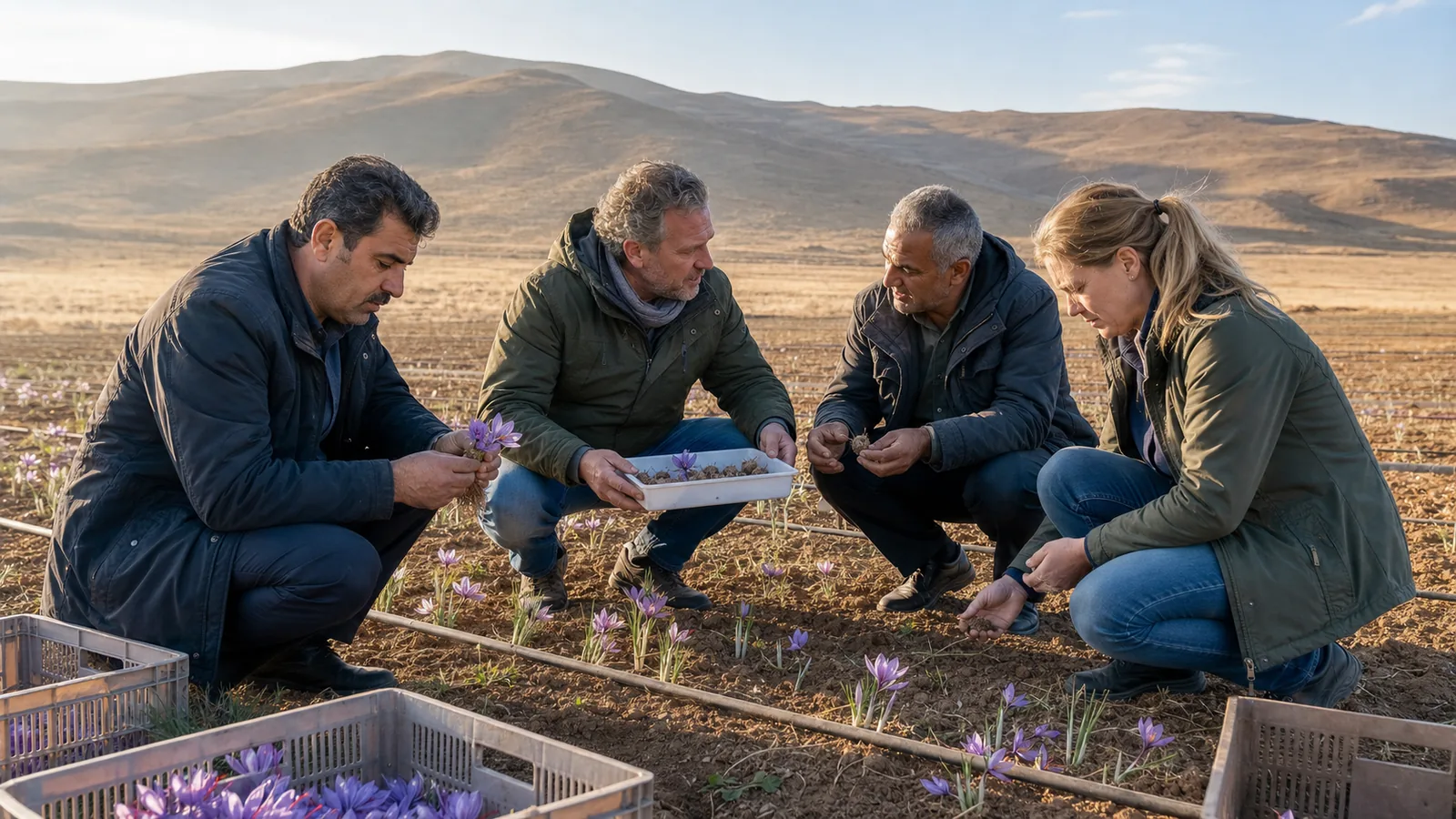
A five-person Dutch delegation visited Marand, Iran, in 2016 to discuss participation in saffron production and other low-water crops. The proposal was exploratory: local officials described land, corm propagation, processing, export and technical cooperation, while the delegation inspected saffron and Damask rose farms. The meeting did not establish that a Dutch investment agreement or production project had already been completed.
The story matters because Marand was developing into a saffron centre in north-west Iran, outside the better-known Khorasan growing region. It also shows what foreign technical cooperation would have needed to solve: efficient corm multiplication, repeatable quality, water management, processing and a market identity that retained the name of Marand.
What the Dutch delegation proposed in Marand
Taqi Karami, governor of Marand County, met the delegation and described the area’s climate as suitable for crops with relatively low water demand, especially saffron. At the time, he said 115 hectares of agricultural land in the county were planted with saffron. A local plan aimed to increase that area to 300 hectares by Iranian year 1399, roughly March 2020 to March 2021.
Karami also reported that 198 saffron growers had produced 400 kilograms in the previous year. The original English version reversed those two numbers, making the sentence unreadable; the Persian report identifies 198 farmers and 400 kilograms of production. Officials used that result to describe Marand as a saffron-production hub for north-west Iran.
The cooperation covered more than growing flowers
According to Karami, Marand was prepared to discuss several forms of cooperation with the Netherlands:
- purchasing saffron cormlets from Dutch suppliers;
- allocating land for saffron cultivation;
- processing under Dutch technical licence or know-how;
- exporting the finished product under the name of Marand; and
- sharing agricultural information and production methods.
The reference to cormlets is important. Cultivated saffron, Crocus sativus, is sterile and is propagated from corms rather than ordinary seed. A project can therefore expand only as quickly as it can obtain and multiply healthy planting material while controlling disease and preserving a reliable plant line.
Robert van der Tang led the visiting group
Robert van der Tang, identified as head of the Dutch investor delegation, said the group had travelled to Marand to explore greater cooperation on low-water crops such as saffron and Damask rose. After reviewing prior research and seeing Marand’s fields, he praised the quality of the saffron and said the Dutch side was ready to cooperate on expanding cultivation.
Van der Tang referred to Dutch technology for bulb and corm production and suggested that cooperation could produce a threefold increase in saffron cultivation in Marand. This was a forecast, not a measured result from the meeting. It should not be translated into a promise of three times the stigma yield per hectare.
The seven-year and one-year claims need context
The report contrasts traditional saffron corm development in Marand, described as taking seven years, with an industrial method said to produce planting material in less than one year. Read literally, this comparison is misleading because it mixes different stages and outcomes.
A saffron field may remain in production for several years, and daughter corms multiply during that period. A controlled propagation programme can generate usable cormlets faster, but a small cormlet is not the same thing as a mature flowering corm or a profitable spice harvest. Any claimed acceleration needs to specify the starting material, final corm size, survival rate, disease status and number of flowering plants obtained in the next cycle.
For the standard biological and field cycle, see our saffron planting guide. A technical partnership should be judged against those crop requirements, not only by how quickly it can multiply plant material.
Why Dutch horticultural knowledge was relevant
The Netherlands has deep expertise in flower-bulb handling, controlled environments, storage and international horticultural logistics. Those capabilities are relevant to saffron because corm temperature history, sanitation and storage affect sprouting and flowering.
Van der Tang said continuous rainfall made saffron production difficult in the Netherlands, yet Dutch saffron-related trade reached 23 countries. The 2016 report does not provide customs records or explain how much of that trade was grown domestically, processed, re-exported or connected with planting material. The figure should therefore be treated as the delegation leader’s market statement, not proof of large Dutch field production.
Marand’s climate and water argument
Officials promoted saffron as a crop suited to the drier conditions of East Azerbaijan. Saffron can use less irrigation than many alternative crops, but “low water” does not mean “no water.” Establishment, root growth and daughter-corm development still depend on correctly timed moisture, while wet soil during dormancy can increase rot risk.
A local investment plan needs field-specific evidence: soil texture and drainage, water quality, seasonal rainfall, frost exposure, planting depth, corm health and historical yield. Marand’s successful farms supplied useful evidence of local adaptation, but an expansion from 115 to 300 hectares would also have required enough clean corms, trained labour and drying capacity.
Production scale is not the same as export readiness
The reported 400 kilograms from 198 growers averages about 2 kilograms per grower, although farm areas were not supplied and individual output would have varied. That fragmented production pattern makes aggregation and quality control important.
Export buyers need lots that are consistent in moisture, cleanliness, style, colour strength, aroma and traceability. If saffron from many small farms is pooled without representative sampling and controlled drying, a single weak or contaminated lot can reduce the value of the entire shipment. Cooperation on processing and testing could therefore be more valuable than simply adding hectares.
What “export under the name of Marand” would require
Karami wanted saffron to be exported under Marand’s name. That goal requires a clear relationship between the place and the product. Packages should not use the regional identity unless the saffron is traceable to eligible farms and processed under defined rules.
A practical system would record grower, plot, harvest date, drying method, batch transfers and laboratory results. It would also define who can use the Marand name and how mixed-origin lots are handled. A Dutch processing licence, by itself, would not create geographical credibility; the origin evidence has to stay attached to the product.
The delegation inspected farms before discussing expansion
The visitors toured saffron farms in Bonab-e Marand and Damask rose cultivation in the county. They rated the products highly and asked for deeper exchange of agricultural information between Iran and the Netherlands. That sequence was sensible: a partner should inspect the crop, talk with growers and understand local constraints before choosing equipment or setting production targets.
Marand was described in the report as a county of about 240,000 people, approximately 71 kilometres from Tabriz, the capital of East Azerbaijan Province. These are period details from the 2016 account rather than current demographic measurements.
A later Dutch-Iranian saffron proposal
Dutch interest did not disappear after the Marand visit. In 2018, van der Tang was reported as leading a separate project called Symbiosis, associated with Flowerbulbs-online, to study higher saffron yields near Mashhad. He said preliminary studies, experimental crops and feasibility work had been conducted and again forecast an increase of up to 300%.
The later report concerned north-east Iran and should not be treated as proof that the Marand proposal proceeded. It does, however, clarify the type of expertise van der Tang was offering: programmed planting-material and flower-bulb methods, feasibility trials and controlled production rather than simply buying Iranian saffron.
How the 2016 proposal should be evaluated
The Dutch delegation’s application to participate in saffron production in Iran was a statement of intent. A safe assessment would look for a signed agreement, identified companies and farms, legal terms for land and plant material, quarantine approval, trial design, actual yield, quality tests and export records. None of those completion documents appears in the source article.
The useful idea was an integrated partnership: Marand supplied experienced growers, a suitable crop area and a regional identity; the Dutch side offered bulb-sector knowledge and access to wider horticultural networks. The risk was allowing ambitious claims—300 hectares, threefold expansion or sub-one-year corm production—to outrun the evidence.
For Marand, success would have meant more than producing extra saffron. The final measure would be healthy corm stocks, higher repeatable yield, verified quality, fair returns to growers and exports that kept Marand’s origin visible. Until those outcomes are documented, the 2016 meeting remains a promising proposal rather than a completed Dutch saffron-production project in Iran.

![Exporting Saffron to Turkey + Price Guide [Complete 0 to 100]](https://img.rowhanisaffron.com/20260827003933/saffron-export-turkey-quality-inspection.webp)



