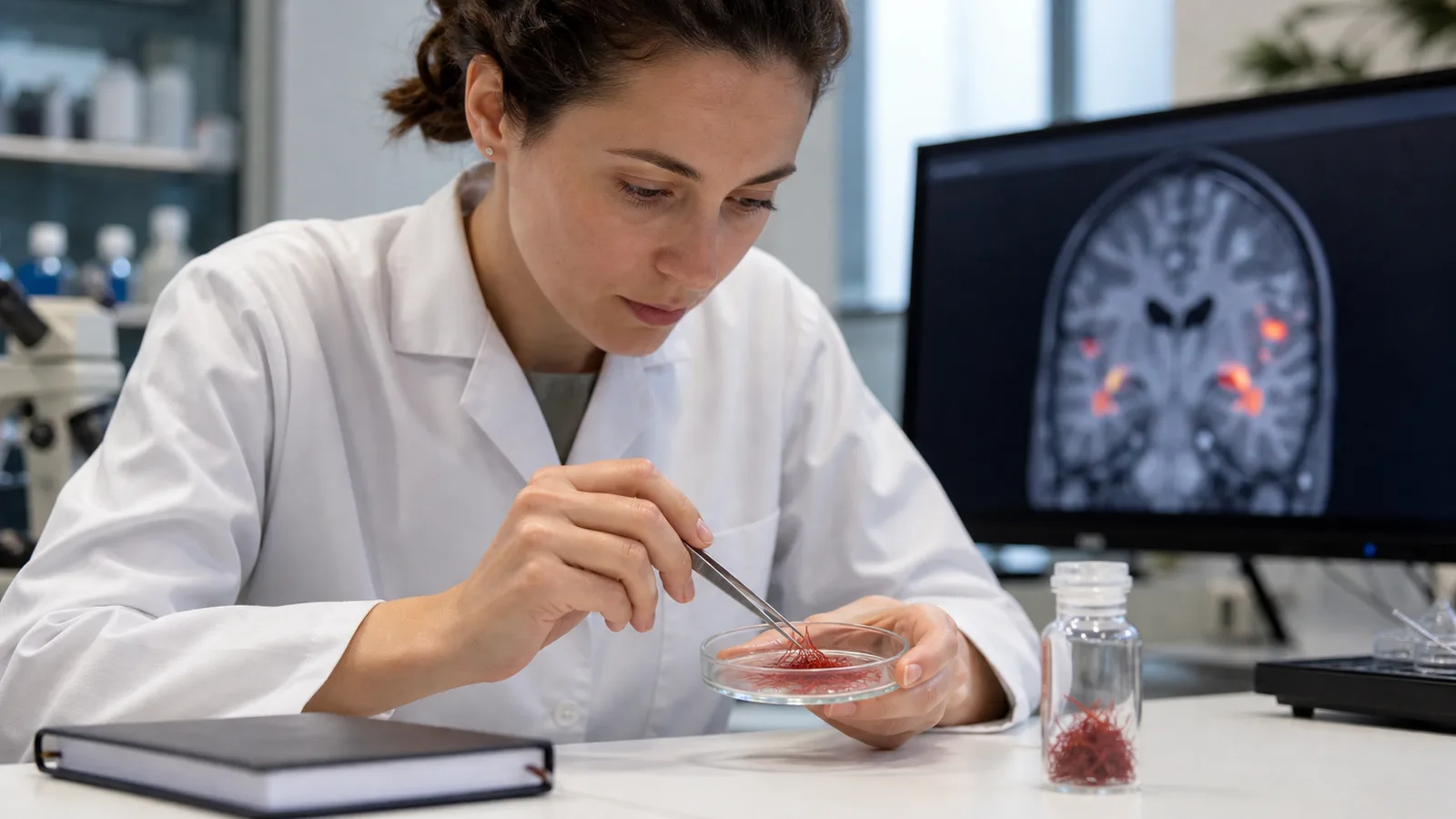
Human studies have not shown that saffron directly raises dopamine levels in the brain. Laboratory and animal research suggests that crocin, safranal, or saffron extracts can interact with dopaminergic pathways, but “interacts with” is not the same as “boosts.” Clinical trials on mood, cognition, sleep, or ADHD generally measure symptoms and functioning; they do not demonstrate a direct increase in a person’s brain dopamine.
Saffron may still have interesting mental-health research behind it. The careful conclusion is that any clinical effect cannot yet be explained as a proven dopamine increase, and saffron should not be used to self-treat a suspected neurotransmitter deficiency.
Does saffron raise dopamine?
We do not know that it does in humans. A 2026 preclinical study measured dopamine, its metabolites, and related receptors after giving crocins or safranal to mice. The researchers reported modulation of dopaminergic function, with different effects from the two compounds. That experiment helps scientists investigate a possible mechanism, but it cannot establish what happens in a human brain after saffron tea, food, or a supplement.
The distinction matters because “dopamine level” is not one simple number. Dopamine signaling differs by brain region and moment, and it participates in movement, motivation, learning, reward prediction, sleep, mood, and cognition. Raising it everywhere would not automatically be beneficial. NIH-funded research, for example, describes dopamine as influencing how people weigh the effort and benefit of a task rather than as a simple happiness chemical.
Saffron and dopamine: where the claim comes from
Saffron contains several bioactive compounds, including crocins and safranal. Experiments in cells and animals have examined how these compounds affect neurotransmitter systems, receptors, oxidative stress, and behavior. Reviews then discuss dopaminergic and serotonergic pathways as possible explanations for observed effects.
This sequence is useful for generating hypotheses:
- A compound produces a measurable change in a laboratory or animal model.
- Researchers propose a pathway that might explain it.
- A human trial tests whether a defined product improves a clinical outcome.
- Separate research is still needed to show whether that proposed mechanism actually caused the human outcome.
Skipping from the first step to “saffron boosts dopamine in people” overstates the evidence. The latest mouse research itself uses the more precise word modulated, not a universal claim that dopamine simply rose.
Does saffron increase serotonin or dopamine?
Neither increase has been directly established as the explanation for saffron’s effects in people. Serotonin and dopamine are often mentioned in discussions of depression, but mood disorders are not diagnosed as a simple shortage of one chemical. Human saffron trials generally use symptom scales rather than direct measurements of neurotransmitter signaling in the brain.
A 2026 meta-analysis of 34 randomized trials found improvements on some self-reported depression and anxiety scales, while clinician-rated measures did not show the same clear effect. The certainty was rated moderate and results varied substantially among studies. That supports continued research on saffron as a complementary intervention; it does not prove a dopamine or serotonin mechanism and does not justify stopping prescribed treatment.
Mood improvement is not a dopamine test
Feeling better after any intervention does not reveal which neurotransmitter changed. Expectations, sleep, stress, the natural course of symptoms, accompanying care, and many biological systems can influence a mood score. A controlled trial can reduce some of those uncertainties, but even a real symptom improvement does not identify the mechanism by itself.
This is why “saffron worked as well as an antidepressant in a small trial” cannot be rewritten as “saffron raised dopamine.” The outcome, comparator, duration, preparation, and limitations must stay attached to the finding.
What about focus, attention, and ADHD?
Dopamine has important roles in motivation and attention, but it does not follow that every product proposed to affect dopamine will improve focus. A 2024 saffron review located four small ADHD studies with 118 participants and described the findings as promising. That evidence base is far too small to prove a dopamine mechanism, long-term effectiveness, or a standard dose.
Saffron should not be described as a natural dopamine remedy for ADHD. Established care depends on age and individual needs and can include behavioral interventions, school or workplace support, medication, and monitoring. Our review of the evidence for herbs and ADHD explains why early supplement trials do not replace that care.
Does saffron protect dopamine-producing neurons?
Antioxidant and neuroprotection findings are common in cell and animal research. Crocin and related compounds can affect oxidative-stress markers in experimental settings, and researchers are exploring whether that matters for neurological conditions. However, no good human evidence shows that eating saffron preserves dopamine-producing neurons or prevents Parkinson’s disease, cognitive decline, or another neurological disorder.
The phrase “rich in antioxidants” describes chemistry, not a demonstrated long-term brain outcome. Prevention and treatment claims need clinical evidence in the relevant population.
Can you tell whether your dopamine is low?
There is no useful home symptom checklist that can diagnose a low brain-dopamine state. Low motivation, poor concentration, fatigue, sleep problems, a lower mood, or loss of pleasure can arise from many medical, psychological, medication-related, and situational causes. They deserve assessment when persistent or disruptive.
Commercial quizzes and supplement marketing often map common feelings onto one neurotransmitter, then sell a product said to correct it. That shortcut can delay the right diagnosis. It can also be risky for someone taking psychiatric, neurological, blood-pressure, blood-sugar, or other regular medicine.
Food, tea, and extracts are different exposures
A few threads used in rice or steeped for flavor are not equivalent to a standardized capsule. Extract trials use a defined preparation for a limited period. Results cannot be transferred automatically to an unknown powder, gummy, mixed “brain” formula, or stronger homemade drink.
There is no evidence-based saffron dose for “boosting dopamine.” Thirty milligrams appears in many clinical trials, but that is a study dose for a particular product and outcome—not a general daily recommendation. Multi-gram amounts are far outside normal culinary use and most clinical research.
Safety and medication considerations
Saffron preparations are generally well tolerated in short human trials, but digestive upset, nausea, dry mouth, reduced appetite, headache, dizziness, and allergic reactions have been reported. Pregnancy, breastfeeding, an upcoming procedure, regular medication use, or a prior spice allergy calls for professional product-specific advice before concentrated use.
Research into saffron’s effects on drug-metabolizing enzymes is developing, and the clinical importance is not yet clear. That uncertainty is a reason for a pharmacist to review a supplement—not evidence that an interaction will or will not occur. Our guide to saffron side effects covers extracts, gummies, tea, topical use, and warning signs in detail.
A practical way to read dopamine claims
- Check whether the study involved people, animals, or isolated cells.
- Look for the actual measurement: brain chemistry, a blood marker, behavior, or a symptom questionnaire.
- Do not treat blood dopamine as a simple proxy for signaling in every brain region.
- Match the tested extract and duration before applying a result to another product.
- Separate a possible mechanism from a demonstrated clinical outcome.
- Be wary of a product that promises motivation, pleasure, focus, and depression relief through one “dopamine boost.”
The current answer remains straightforward: saffron may influence dopaminergic pathways in preclinical research, but it has not been shown to raise human brain dopamine. Enjoy culinary saffron for what it contributes to food, and treat concentrated mental-health use as a clinical question rather than a neurotransmitter shortcut.
Evidence reviewed
- 2026 preclinical study of crocins, safranal, and dopaminergic function in mice
- Review of saffron compounds, antidepressant activity, and proposed mechanisms
- 2026 meta-analysis of randomized saffron trials for mood, depression, and anxiety
- Systematic review of saffron in neurological and psychiatric research
- Systematic review of saffron clinical studies in ADHD
- NIH explanation of dopamine, motivation, and cognitive effort