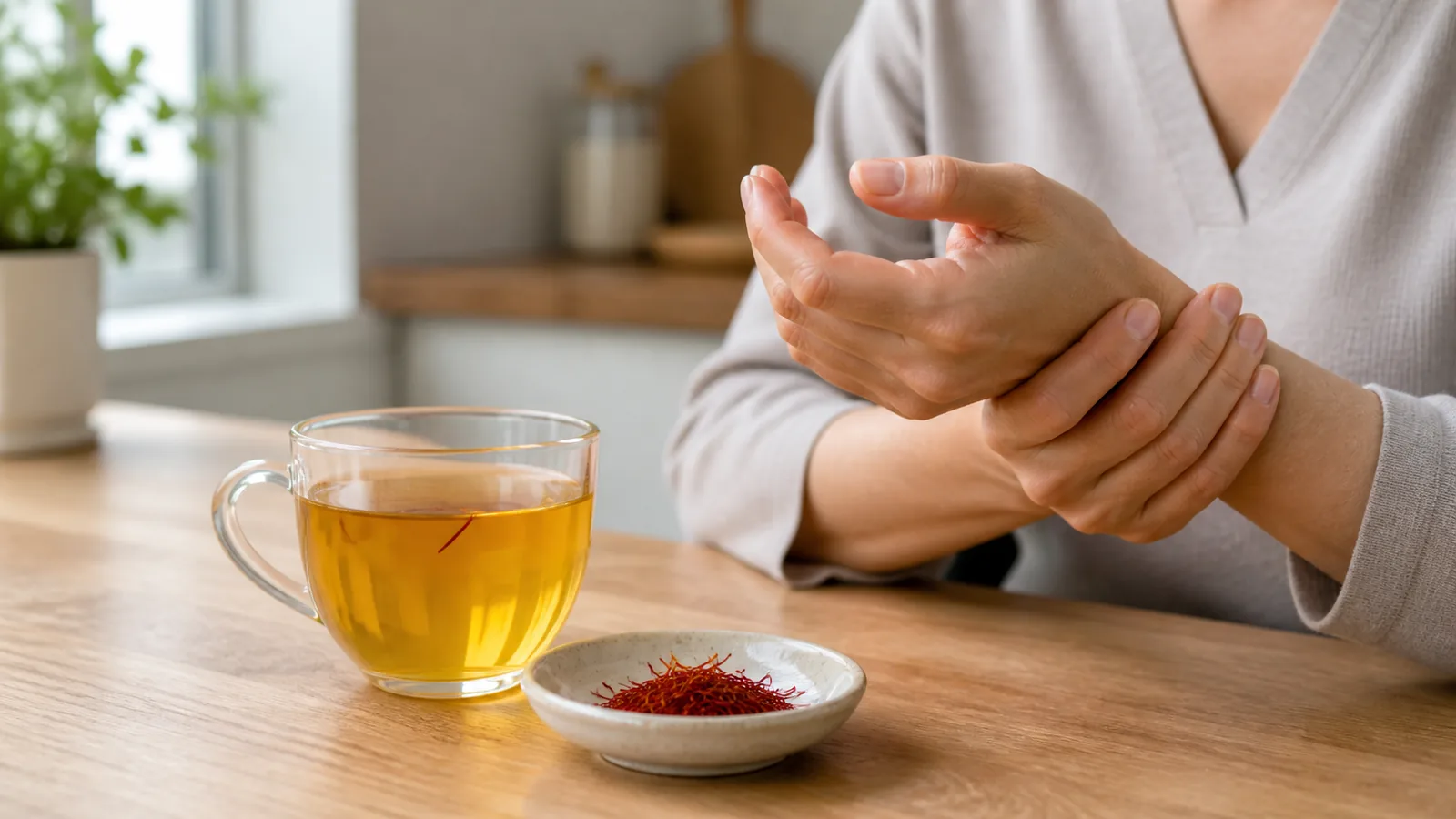
Does Saffron Increase Testosterone?
Current human evidence does not show that saffron reliably raises testosterone in men or women. Small trials have studied erectile function, sexual desire and semen measures, but those outcomes are not the same as a measured increase in testosterone. Saffron should not be described or used as a proven testosterone booster.
The distinction matters because the two visible clicked queries for this page are “saffron and testosterone” and “saffron testosterone.” A reader arriving for either answer should not have to infer it from research on libido or fertility. Those are related topics, not substitutes for a hormone test.
Saffron and Testosterone: What Does Research Say?
The saffron testosterone claim is often built from indirect evidence. Laboratory or animal work may examine oxidative stress, reproductive tissue or hormones. Human studies may measure a sexual-function questionnaire or semen sample. None of those results automatically answers whether blood testosterone rises.
The saffron effect on testosterone has not been established in a suitable body of controlled human trials. That gap cannot be filled by combining unlike outcomes or by treating an animal mechanism as a clinical result.
A 2018 systematic review and meta-analysis included six small clinical trials on erectile dysfunction and semen parameters. Pooled questionnaire results favoured saffron for several dimensions of erectile function, while semen findings were contradictory. The authors warned about methodological flaws and substantial heterogeneity. The review did not establish saffron as a testosterone treatment.
There is also no sound basis for converting a result in one sex into a universal hormone effect. A query such as “does saffron increase testosterone in women?” needs direct evidence in women, with an appropriate hormone measurement and clinical context. Saffron is not a dependable way to alter testosterone or oestrogen in either direction.
Does kesar increase testosterone?
Kesar is another name for saffron, so the evidence does not change with the word. No reliable human research shows that kesar consistently raises testosterone. Milk, honey or another ingredient added to a kesar drink also does not turn it into a validated hormone treatment.
Testosterone, libido, erections and fertility are different
Testosterone contributes to sexual development, libido, bone and muscle health, red-blood-cell production and other functions. Yet desire and erections are also influenced by blood vessels, nerves, sleep, mood, relationships, medicines, alcohol, diabetes and cardiovascular health. A change in one of those outcomes cannot diagnose a hormone change.
Fertility adds another distinction. Sperm count, motility and morphology can be affected by many factors, and a semen analysis does not directly measure serum testosterone. The 2018 review found mixed semen evidence; it does not support telling a person with infertility to rely on saffron.
Likewise, “is saffron estrogenic?” is not answered by its colour, traditional use or a cell experiment. Clinically meaningful hormone effects require appropriately designed human studies rather than mechanism language alone.
How Does Saffron Impact Testosterone Production?
No reliable human mechanism has been demonstrated. Crocin, crocetin and safranal are studied for antioxidant and other biological activity, and researchers have proposed that reducing oxidative stress could affect reproductive tissue. A proposed pathway is not proof that saffron increases testosterone, prevents low testosterone or restores testicular function in a person.
Hormone production is regulated through the hypothalamus, pituitary gland and gonads. Illness, energy intake, sleep, weight, medicines and pituitary or testicular conditions can all affect results. A spice cannot be assumed to correct that system simply because it contains an antioxidant compound.
How low testosterone is actually assessed
Symptoms such as lower libido, erectile difficulty, tiredness, low mood, reduced strength or fertility problems are not specific to testosterone deficiency. The Endocrine Society’s patient guidance on hypogonadism explains that diagnosis involves symptoms together with blood testing and evaluation of the cause. A single symptom, online quiz or response to a supplement is not a diagnosis.
If a result is low, a clinician may confirm it under appropriate conditions and review medicines, sleep, weight, chronic illness and pituitary or testicular causes. Do not take testosterone, stop a medicine or add multiple “boosters” on the strength of a saffron article.
Additional Benefits for Men’s Health
Can men take saffron? Many do as a normal food spice. That simple answer should not be expanded into a list of guaranteed men’s health benefits. Evidence on erectile function is preliminary, evidence on semen parameters is contradictory, and neither establishes a testosterone increase.
Search results often group this topic under “saffron benefits for male health” or “saffron benefits for men.” The wording can hide important differences. What does saffron do for men? In food, it provides the same colour, aroma and flavour it provides to anyone; proposed sexual or reproductive effects belong to small, product-specific studies.
Sexual desire has also appeared in small clinical studies, including work involving antidepressant-related sexual difficulties. Product, population and cause matter. An effect in people taking a particular medicine cannot be promised to healthy adults, and a libido questionnaire is still not a testosterone assay.
Persistent erectile difficulty can be an early sign of vascular or metabolic disease as well as a medication, psychological or hormonal issue. Infertility and new sexual symptoms deserve an assessment rather than a sequence of supplements. Saffron is not an approved treatment for erectile dysfunction, infertility or hypogonadism.
Saffron versus other “testosterone boosters”
Comparisons such as ashwagandha versus saffron often place unlike extracts and unlike studies side by side. A positive trial for one product does not validate a blend or establish that either raises testosterone for a particular person. Marketing categories are not evidence categories.
Review every ingredient in a men’s supplement. A product sold under saffron’s name may include vitamins, stimulants, other botanicals or undeclared compounds. A precise-looking amount such as 100 or 250 mg still needs the plant part, extract information, serving size and full formula before it can be interpreted.
A saffron supplement for men is not automatically formulated or tested for testosterone simply because the label targets men. The evidence has to match the exact product and claimed outcome.
How to Safely Use Saffron for Testosterone Boost
The heading reflects the original question, but the safe recommendation is not to use saffron as a testosterone boost. Enjoy a modest amount in food if you like it. If you are considering an extract for a sexual-health concern, take the actual label to a pharmacist or clinician and discuss the reason first.
Do not copy the 20-to-30-milligram amounts used in some trials as a universal daily dose. Those numbers refer to particular products, populations and study periods. Higher exposure is not proven to work better and may increase adverse effects.
A 2026 systematic review of saffron adverse events found single-ingredient preparations generally tolerated in clinical studies, with adverse effects still occurring and most often involving the gastrointestinal system. The FDA also advises consumers to review supplements alongside medicines because combinations can change intended or unwanted effects.
Seek advice before concentrated use if you take medicines, use other supplements, have a chronic condition, are preparing for surgery, or are trying to conceive. Stop and obtain help for a persistent or marked reaction. Trouble breathing, swelling, fainting or severe bleeding needs urgent care.
Conclusion
Does saffron boost testosterone? Human studies do not currently provide a reliable yes. Research on erections, desire, semen or antioxidant mechanisms may be worth following, but it cannot stand in for direct evidence of a sustained testosterone increase.
Use saffron as food for its flavour and aroma. If symptoms raise a concern about hormones, sexual function or fertility, pursue the appropriate assessment and judge any supplement by its exact product evidence—not by a broad “men’s health” promise.