


Iran’s saffron market cannot be protected by one price announcement or one trading instrument. The debate behind saffron certificates brought together several connected problems: growers selling during a brief harvest, uneven grading and storage, opaque price discovery, exchange-rate pressure on established exporters, and weak development of demand abroad. A certificate can help with some of those problems, but only when the saffron behind it is real, consistently graded and available for delivery.
The discussion recorded here came from two period reports, not a description of current Iranian market rules. One concerned a meeting of the Iran Chamber’s Agricultural Commission about commodity certificates and capital-market participation. The other recorded remarks by Mohsen Ehtesham, then head of the National Saffron Council, at the start of a Khorasan harvest. Their proposals make more sense when read together.
What a saffron certificate is meant to represent
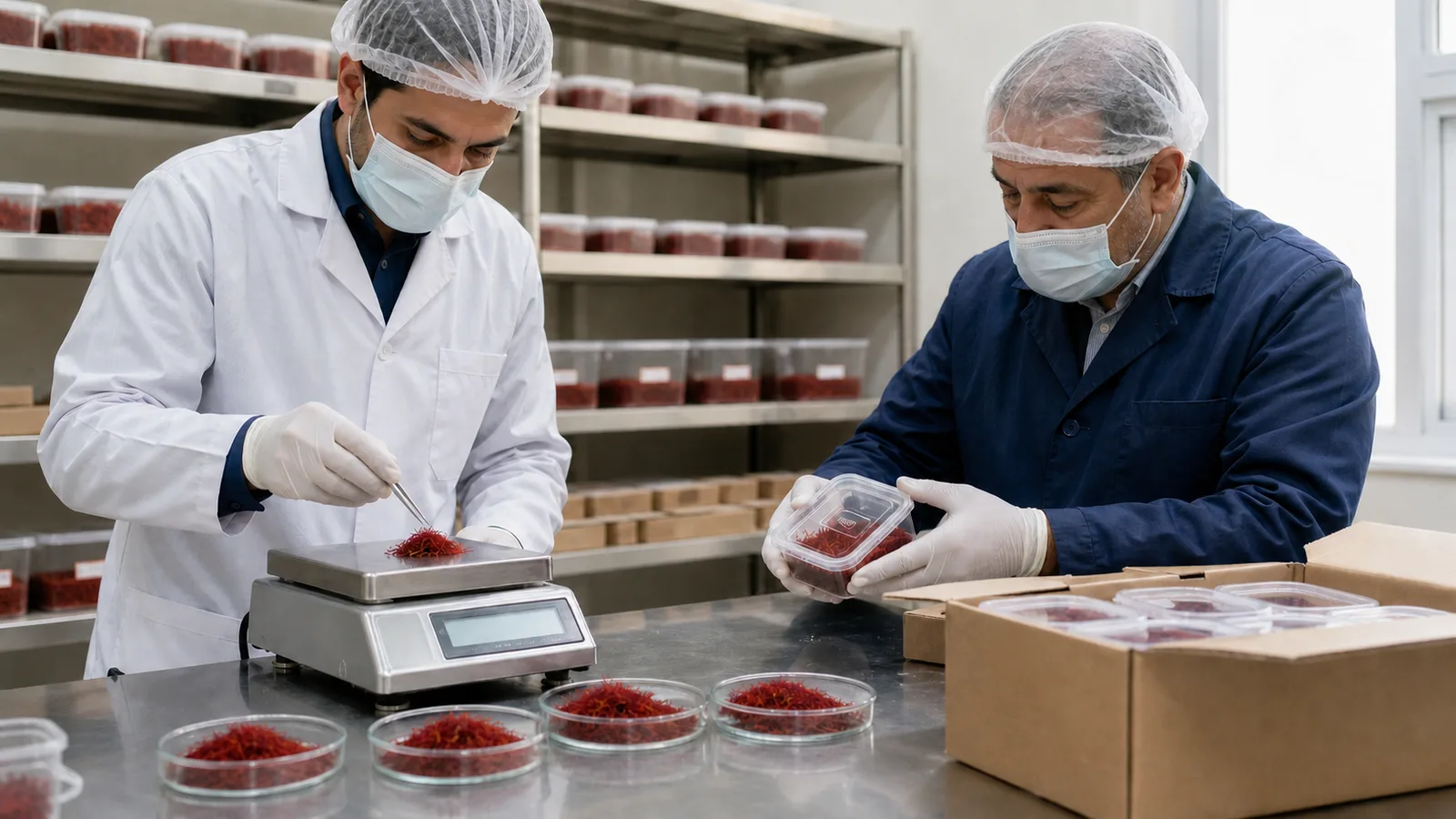
In the proposed model, a grower or owner delivers saffron to an approved warehouse. The lot is identified, weighed and assessed against the scheme’s grade and packaging rules. A warehouse certificate then represents a defined quantity and quality of stored saffron. Instead of moving the physical product every time ownership changes, eligible participants can trade the certificate, while the saffron remains under controlled storage until redemption.
That structure can make stock and prices more visible. It may also give a grower an alternative to selling immediately when many farms harvest at once. Yet the certificate is only as trustworthy as the system underneath it:
- grading has to be repeatable and open to challenge;
- the warehouse must protect identity, weight and quality;
- fees, insurance and storage losses must be clear;
- buyers need confidence that they can take delivery of the stated lot;
- records must prevent the same saffron from supporting more than one claim.
Mohsen Zanganeh, identified in the meeting report as a member of parliament, argued that bringing saffron certificates into the capital market could support farmers, improve valuation and attract investment. He also stressed public awareness and coordinated participation. The proposal was presented as a way to reduce harvest-season turbulence, not as a guarantee that prices would only rise.
Storage, quality and competition
Capital-market expert Hossein Abdeh Tabrizi linked a healthier saffron market to competition and resistance to monopoly. Transparent bids can reveal what qualified buyers will pay for a defined grade, but exchange trading does not create competition by itself. Access rules, warehouse capacity, transaction costs and concentration among buyers still matter.
Frashid Shokrokhodaei, described as head of the Investment Commission, proposed third-party storage and quality-assurance insurance. Those ideas address two different risks. Independent custody helps separate ownership from possession; insurance can cover specified losses. Neither substitutes for sampling, grading, traceability or a clear process when the delivered lot fails to match its certificate.
Base prices and the currency gap
Ehtesham’s harvest-season remarks focused on two prices that he believed needed attention. First, he called for the Agriculture Ministry to set a base purchase price for each recognized saffron grade. Second, he asked Iranian Customs to revise its base export valuation to reflect changes in the currency. These were policy requests from an industry representative, not neutral findings and not current prices.
The distinction between the numbers matters:
- a farmgate base price is intended to protect the grower at purchase;
- a customs export base value is used for administrative valuation and export reporting;
- the warehouse-certificate price is formed by trades for a specified stored grade;
- the buyer’s commercial price reflects the actual contract, packaging, terms and destination;
- the exporter’s domestic return depends on the applicable foreign-exchange rules and conversion rate.
Treating these as one “saffron price” hides the pressure points. A support price can be above what buyers will pay. A customs value can be out of step with a real contract. A certificate price may cover bulk material while an export order includes testing, retail packing, freight and credit risk.
Why the exchange-rate complaint mattered
Ehtesham said the gap between Iran’s Nima foreign-exchange rate and the free-market rate had made it difficult for established exporters to compete with traders operating under different incentives. He warned that companies with investments in processing, packing and export staff could be displaced, putting hundreds of jobs at risk. The report supplies no payroll or firm-level evidence, so the job number remains an attributed warning rather than a measured outcome.
Nima and the associated rules belong to that policy period. Exchange systems and settlement obligations change; a business making a decision today must use current Central Bank, customs and banking instructions rather than this historical account.
Supply increased faster than demand
Ehtesham attributed the previous year’s price decline to expanded cultivation and supply without matching development of demand, particularly under sanctions. That diagnosis is economically plausible but incomplete without time-series evidence. Carry-over inventory, crop quality, buyer concentration, currency conditions and export access can all affect the price received by growers.
His proposed response went beyond withholding supply. He called for matching quantity and quality to market needs, fairer pricing for farmers and buyers, more scientific distribution, clearer presentation of Iranian saffron, suitable packaging and incentives for major purchasers. In other words, storage could manage timing, but demand still had to be earned.
When government purchase intervention becomes unnecessary
The source records Ehtesham’s view that if exporters and other saffron businesses respected the announced base prices, the Rural Cooperative Organization would not need to enter the purchase cycle as it had before. That is a conditional policy argument. It assumes the base price is credible, buyers have liquidity, grades are enforced and enough demand exists to clear the crop.
A warehouse-certificate market can support that approach by showing bids and carrying stock beyond the harvest rush. It cannot fix a base price that is detached from buyer demand, nor can it replace a buyer when the market does not clear.
What would show that saffron certificates are working?
Success should be measured through outcomes rather than trading volume alone:
- the share of deposited lots that pass grading without dispute;
- storage loss, insurance claims and delivery failures;
- participation by growers as well as financial intermediaries;
- the spread between certificate, farmgate and export prices for comparable grades;
- how quickly owners can redeem and move physical saffron;
- whether processors and exporters gain stable, traceable supply.
The original meeting described Iran as producing more than 300 tonnes and roughly 80% of world saffron. Those figures were not dated or sourced in the post, so they should not be used as current market shares. The durable point does not require them: a large producer can still lose value when grading, storage, price signals, exchange policy and overseas demand do not work together.
Saffron certificates can make ownership and price discovery clearer. Realistic administrative values can reduce distortions. Neither replaces product quality, competitive export channels or sustained demand. Protecting the global market position requires all of those pieces to meet in the same system.

![Exporting Saffron to Turkey + Price Guide [Complete 0 to 100]](https://img.rowhanisaffron.com/20260827003933/saffron-export-turkey-quality-inspection.webp)



