


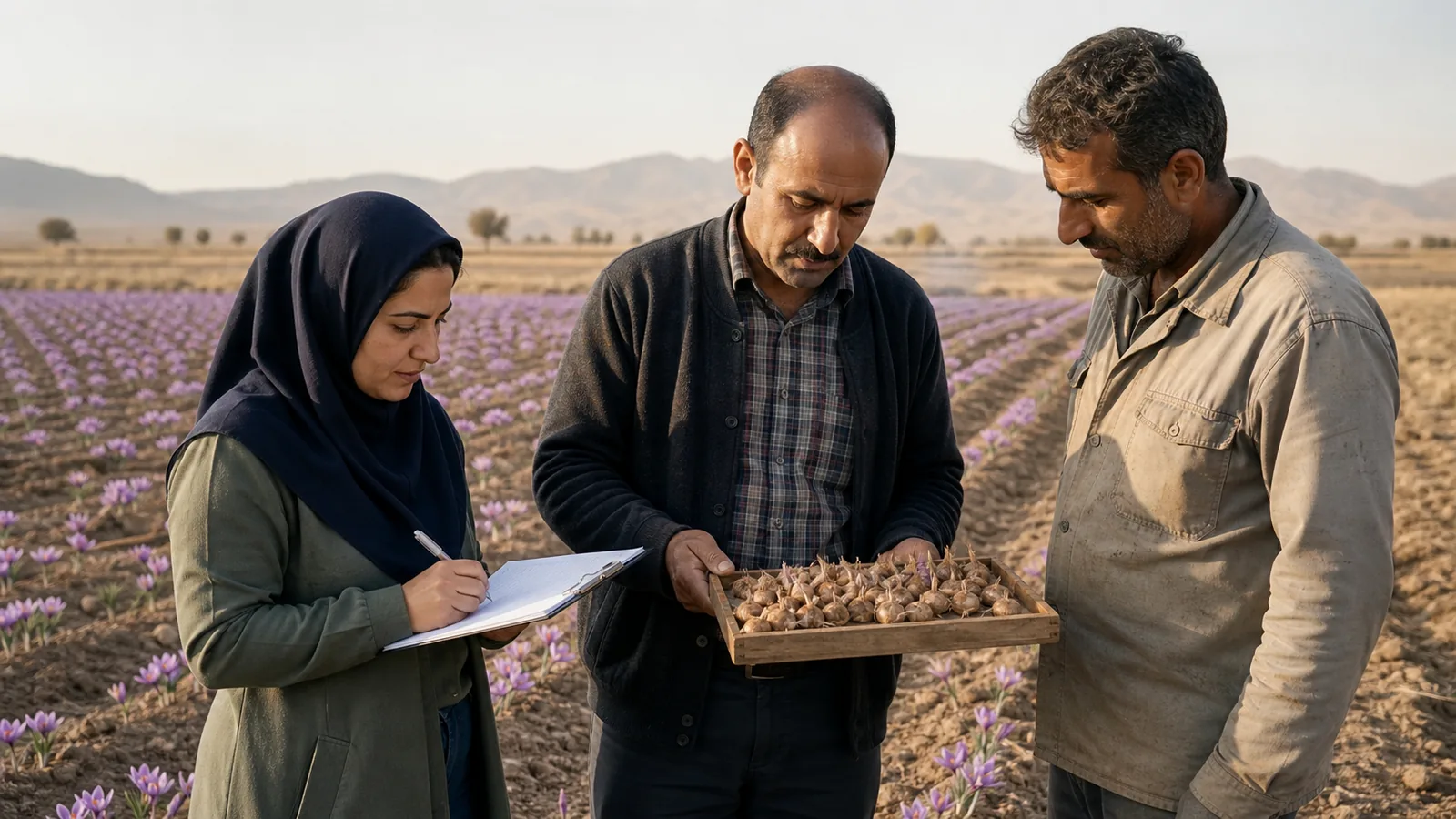
The historical Khorasan Razavi saffron programme covered a reported 57,000 hectares and directed provincial development funding toward farms, planting material, irrigation and processing. A smaller but economically detailed report from Azadshahr recorded 220 hectares, a one-tonne harvest forecast and projected grower income.
These figures came from different provinces and reporting periods. They should not be added into one current acreage total. Read together, they show how officials described saffron at two scales: an established production system in Khorasan Razavi and an emerging local industry in Azadshahr.
The 57,000-hectare Khorasan Razavi baseline
Dr Tabatabai, identified in the archived account as head of the Khorasan Razavi Agricultural Jihad organisation, described saffron as a strategic export crop. He said 10% of provincial asset-acquisition credits had been allocated to a comprehensive saffron programme.
The source does not give the total credit budget, currency amount, financial year or disbursement record. Ten percent is therefore a historical allocation share, not a current fund that growers can apply for. It indicates policy priority without showing how much money reached an individual farm.
The 57,000 hectares is also a dated baseline. A separate later account on this site reported roughly 69,000 to 70,000 hectares in Khorasan Razavi. The later figure does not make the earlier report wrong; it means the two numbers need their own dates and programme contexts.
What the comprehensive programme included
Tabatabai listed a set of connected activities rather than one area-expansion target:
- developing and promoting demonstration or “ideal” saffron farms;
- supporting farms that propagated saffron corms;
- improving growers’ knowledge of mechanisation;
- creating corm distribution and sales terminals;
- improving irrigation methods;
- producing standard planting corms;
- planning improvements in processing; and
- carrying out research projects.
The value of this list is its whole-system view. A weak corm, unsuitable planting density or poor irrigation can limit the field before harvest. Delayed separation, uncontrolled drying or weak storage can then reduce the value of a crop that grew well.
“Saffron onions” means corms
The translated source repeatedly calls the planting material onions. Cultivated saffron is propagated through corms, underground storage organs that form daughter corms. The plant is sterile and does not produce a normal commercial seed crop; a peer-reviewed botanical review explains that vegetative cycle.
The programme reportedly multiplied corms weighing more than eight grams. Corm size can affect establishment and flowering potential, but weight alone is not a complete quality standard. Health, identity, damage, disease status, storage and traceable source also matter.
A distribution terminal can improve transparency only when those attributes are documented. Moving larger but diseased or poorly handled corms through a formal market would not solve the underlying production risk.
The genetic-reserve and corm-transfer concern
Tabatabai also referred to measures intended to prevent unauthorised transfer or smuggling of saffron corms, describing them as a valuable genetic resource. The source names cooperation with law enforcement and the provincial anti-smuggling headquarters but its sentence is incomplete.
The historical concern is clear; the exact rule, legal authority, enforcement period and prohibited movement are not. This article does not turn that fragment into current legal advice. Anyone moving planting material needs current plant-health and trade requirements from the relevant authorities.
What 220 person-days per hectare means
The Khorasan Razavi report assigned 220 person-days of work to each hectare of saffron. Across 57,000 hectares, that equals 12.54 million person-days.
The source then equates the total with 62,700 permanent jobs. That number is exactly what results when 12.54 million person-days are divided by 200 working days per person. It is best understood as a full-time-equivalent calculation, not evidence that 62,700 named people held year-round permanent positions.
Saffron labour is also seasonal. Flower picking and stigma separation create a sharp peak, while field care and processing occur at other times. Converting person-days to annual equivalents is useful for scale, but local planning still needs the number of workers required on the busiest mornings.
Mechanisation has a defined role
The programme included mechanisation training. That does not mean every task can or should be mechanised. Land preparation, irrigation, weeding, corm handling and some post-harvest steps may benefit from equipment. Delicate flower collection and stigma separation remain difficult to automate without quality or selectivity trade-offs.
A machine is useful when it reduces a measured bottleneck at an acceptable cost. Small farms also need shared access, maintenance and operator training; owning equipment that is used briefly each year can increase rather than reduce unit cost.
Azadshahr’s 220-hectare saffron economy
Seyyed Abdullah Hosseini, identified as director of Agricultural Jihad in Azadshahr, reported about 220 hectares under saffron. Azadshahr is in Golestan province, outside Khorasan Razavi, so its figures represent a separate regional development case.
Hosseini forecast that growers would collect about one tonne of dry stigmas that year. If the full 220 hectares produced the forecast tonne, the implied average would be about 4.55 kilograms per hectare. That is a useful consistency check, not a recorded yield result; the source does not distinguish planted and bearing area.
The 12-to-14-billion-toman income forecast
Azadshahr growers were projected to receive 12 to 14 billion tomans. Applied to the forecast 1,000 kilograms, the implied average gross revenue would be 12 to 14 million tomans per kilogram on the same basis.
Both the crop and income figures were forecasts. The source gives no year-specific price sheet, grade mix, sales record or costs. It also predates major changes in prices and currency value, so the nominal amount is not a current valuation.
Gross revenue is not farmer profit. Corms, field work, picking, separation, drying, testing, packaging, finance and selling costs must be deducted before income can be compared with another crop.
The 60,000 seasonal-jobs figure is ambiguous
Hosseini said saffron created employment for 60,000 people on a seasonal basis. The source does not define whether that means unique individuals, work shifts or person-days.
For comparison, applying Khorasan Razavi’s 220-person-day assumption to Azadshahr’s 220 hectares gives 48,400 person-days, which is in the same order of magnitude as 60,000. This suggests the Azadshahr figure may describe seasonal work-days rather than 60,000 separate workers, but that is an inference, not a correction supported by the source.
The safe conclusion is that saffron created substantial seasonal labour demand. A reliable employment count would report unique workers, total person-days, work period and full-time-equivalent method separately.
The planned 15% area increase
Azadshahr officials expected cultivated area to rise 15% in the following year. Starting from 220 hectares, that would mean an additional 33 hectares and a total near 253 hectares.
This was a plan, not a confirmed later area. The source provides no follow-up register, so the calculated 253 hectares should not be cited as achieved cultivation.
Quality and “organic” production need evidence
Hosseini described Azadshahr saffron as among the country’s highest-quality products and urged growers to improve quality, safety and organic production while expanding. No laboratory values, sample count, comparison protocol or certification record accompanies that statement.
Quality must be demonstrated at batch level. “Organic” has an additional requirement: it should refer to production and certification under a named standard, not simply low chemical use or an official aspiration. Expansion can make control harder if traceability, training and testing do not grow with the area.
What the two regions show together
Khorasan Razavi’s 57,000-hectare programme focused on system infrastructure: corms, demonstration farms, irrigation, mechanisation, processing and research. Azadshahr’s 220-hectare report focused on forecast harvest, grower revenue, seasonal work and planned expansion.
Those perspectives complement each other. Infrastructure is valuable when it improves measured farm and processing outcomes. Revenue and job forecasts are credible when they can be traced back to actual area, dry yield, price, cost and person-days.
The broader production and export-value challenges for Iranian saffron begin at exactly this junction: expanding the crop is not enough if quality, data and the route to the buyer remain weak.
A dated baseline, not a current market report
The 57,000-hectare figure records an earlier stage of Khorasan Razavi’s saffron programme. The Azadshahr figures record a smaller emerging region’s expectations: 220 hectares, about one tonne, 12–14 billion tomans, 60,000 units of seasonal employment and 15% planned growth.
None should be treated as a current acreage, price or job count without a newer common-year source. Their lasting value is more practical: they show which parts of a saffron economy must be measured together, from corm and water management to harvest labour, batch quality and the revenue that actually reaches growers.

![Exporting Saffron to Turkey + Price Guide [Complete 0 to 100]](https://img.rowhanisaffron.com/20260827003933/saffron-export-turkey-quality-inspection.webp)



