


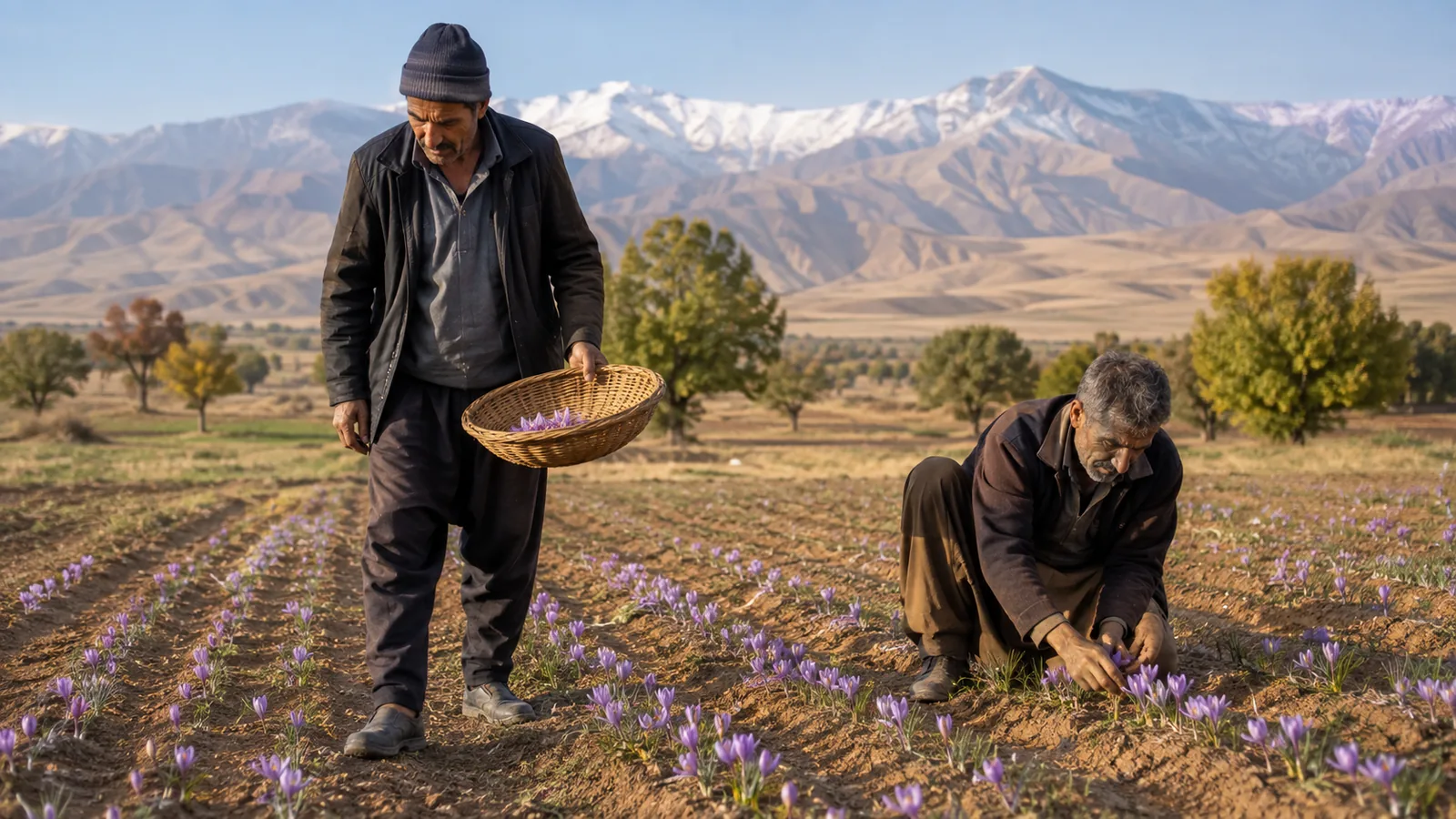
The beginning of saffron harvest from 10 hectares of Golpayegan farms was announced with an expected yield of 5 to 8 kilograms per hectare. Later reporting shows that those early fields became part of a larger local crop, but the two snapshots belong to different seasons.
What the 10-hectare announcement reported
Haidar Ali Golmohammadi, identified as director of Golpayegan Agricultural Jihad, said picking had begun on 10 hectares planted with saffron. He forecast a yield between 5 and 8 kilograms per hectare.
If every hectare reached that range, the implied harvest would be roughly 50 to 80 kilograms. That calculation explains the forecast; it does not turn it into a confirmed final total. The source did not give the crop year, field age, number of growers, final dried weight or quality test results.
Yield depends on more than planted area
A per-hectare range is more useful than a single headline figure, but it still needs context. Saffron yield changes with corm size and health, planting density, soil condition, irrigation timing, field age, flower-picking speed and losses during stigma separation and drying.
Research surveying saffron growers in the Khorasan provinces found clear differences in farm characteristics and corm-size practices. The saffron-farmer study was conducted elsewhere, so it does not supply a Golpayegan yield. It does show why a local 5-to-8-kilogram forecast should not be treated as a fixed biological rate.
Harvest work extends beyond flower picking
Harvest begins when flowers are picked, preferably before heat and handling reduce their condition. The red stigmas must then be separated cleanly, dried in a controlled way and protected from moisture, light, contamination and strong odours.
The weight that matters for the report is dried saffron, not fresh flowers. Without a stated drying method or final weigh-in, the early announcement can describe the expected scale of the season but cannot establish a commercial grade. The Codex standards register provides the international dried-saffron framework against which representative lots can be assessed.
Golpayegan’s setting helps explain the crop choice
Golpayegan lies in western Isfahan Province on a broad plain framed by mountains. The old article described an ancient city approached through snow-capped high country, with gardens, greenery and colourful flowers beyond more sparsely vegetated land. That landscape description is relevant when it is connected to farming rather than presented as travel decoration.
Cold-season conditions, dry summers and available agricultural land can suit saffron, but fields on one plain are not identical. Drainage, frost pockets, irrigation access and soil structure still need checking. A mountain view does not by itself establish that a particular parcel is suitable.
The saffron harvest shared a wider farm calendar
Golmohammadi’s announcement also said barley planting was under way and improved seed had been supplied to applicants. Potato harvesting had started in mid-October. The potato varieties named were Agria, Diamon, Nilva and Ramos.
Those details are not evidence about saffron yield, but they show the seasonal workload around the same farms. Labour, machinery, transport and storage may be needed by several crops at once. Saffron’s short, concentrated flower harvest makes advance staffing and drying capacity especially important.
A later report recorded a much larger saffron area
An official IANA report from Golpayegan, dated to Iranian year 1399, recorded 60 hectares under saffron. It said 50 hectares were productive and 10 hectares had been planted that year. Harvesting from the productive fields was scheduled from late Mehr to mid-Aban.
The later report stated that yield exceeded 10 kilograms per hectare and forecast about 500 kilograms of saffron. It also estimated 200 person-days of work per harvested hectare. These are later official figures, not corrections to the undated 10-hectare announcement.
The two 10-hectare figures should not be confused
The earlier article described harvest beginning across 10 hectares. The 1399 report described 10 newly planted hectares within a 60-hectare total, while harvest took place on 50 productive hectares. The matching number does not prove they refer to the same land or year.
New fields and mature fields should also be kept separate when performance is compared. A young stand may flower, but its output is not a sound proxy for a developed field. That distinction helps reconcile the early 5-to-8-kilogram forecast with the later claim of more than 10 kilograms per productive hectare without assuming a simple like-for-like increase.
What would make the harvest record stronger
A complete seasonal account would name the crop year, productive and newly planted area, farm count, final dry weight and yield by field age. It would record flower-picking dates, drying method, labour used, tested grade and any weather event that affected flowering.
For comparison across years, the same definitions need to be used each time. Forecasts should be kept apart from final totals, planted area from productive area, and person-days from permanent jobs. That turns an announcement into a useful local production series.
How to read the Golpayegan milestone
The original report captures the start of harvest on 10 hectares and an expected yield of 5 to 8 kilograms per hectare. It also places saffron within Golpayegan’s wider autumn farm calendar of barley planting and potato harvest, against the plain and mountain setting of western Isfahan.
The later 60-hectare report shows that saffron cultivation expanded, with 50 productive hectares and a 500-kilogram forecast in 1399. Read separately and in date order, the two accounts show development without turning either forecast into a guaranteed result.

![Exporting Saffron to Turkey + Price Guide [Complete 0 to 100]](https://img.rowhanisaffron.com/20260827003933/saffron-export-turkey-quality-inspection.webp)



