


Harvesting 18 kg of saffron from six hectares in Kermanshah marked an early stage in the province’s cultivation programme. The announcement also made an unusually strong quality claim, so its harvest figures and its missing laboratory evidence need to be read separately.
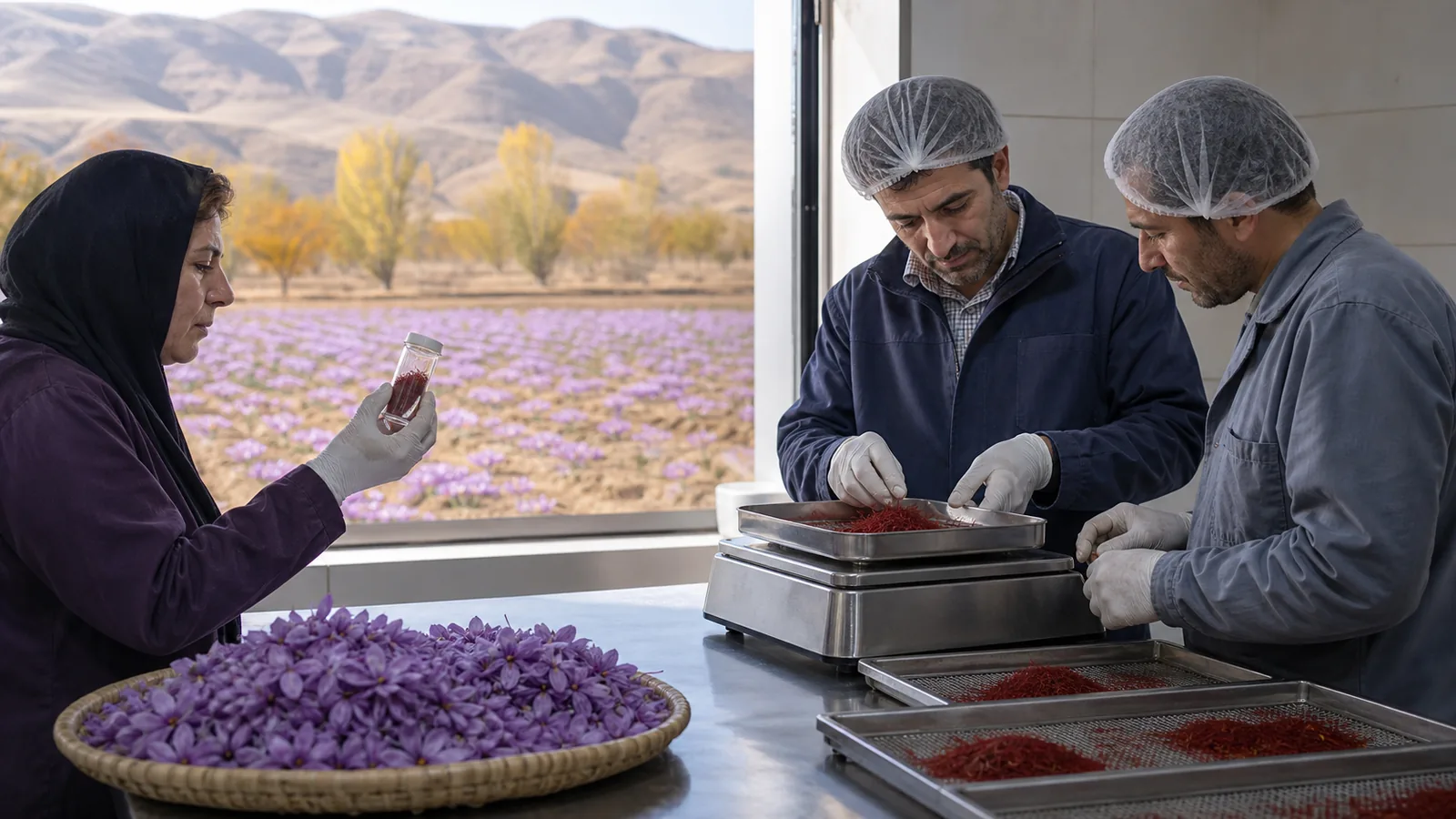
What the six-hectare harvest figure means
Mansour Ahmadi, identified as horticulture director of the Kermanshah Agricultural Jihad Organization, reported that 18 kilograms of dried saffron had been harvested from six hectares. The stated crop value was 720 million rials.
Dividing the reported harvest by the reported area gives an implied average of 3 kilograms per hectare. That is useful for understanding the scale of this particular announcement, but it is not a guaranteed farm yield. The source did not name the crop year, field ages, district allocation, number of farms or method used to aggregate the result.
The value figure belongs to its original season
The 720-million-rial figure implies 40 million rials per kilogram when divided by 18 kilograms. It should not be converted into a current saffron price. The announcement did not say whether the amount was farm-gate value, gross sales or a valuation based on an assumed grade, and it did not list production costs.
A historical value can show how officials framed the crop’s local economic potential. It cannot show present-day profit without the date, labour cost, corm and input costs, tested grade, packaging and actual sale terms.
What was claimed about the French tests
Ahmadi said saffron from Kermanshah had recently been tested in France and that its safranal and picrocrocin readings were about 10 percent higher than those of the “best” saffron produced in Khorasan. He attributed that result to the province’s climate and to post-harvest practices, including drying and storage.
The claim is preserved because it was central to the report, but it cannot be independently verified from the information supplied. No laboratory, report number, sample count, sampling locations, harvest year, analytical method or Khorasan comparison batch was named. Nor did the source report crocin, moisture, foreign matter or microbiological results.
More of one compound does not automatically mean better saffron
Safranal contributes to saffron’s aroma, while picrocrocin is associated with its characteristic taste. Their measured values matter, but “10 percent more” is not by itself a complete quality verdict. Results can change with sample preparation, drying, storage and analytical conditions, and each specification has an appropriate range rather than a simple more-is-always-better rule.
The Codex standards register provides the international framework for dried saffron. A defensible comparison would test representative, traceable batches with the same method and report the full set of required characteristics. Until the referenced French report is available, the 10-percent statement remains an attributed historical claim.
Drying and storage can change the finished spice
The announcement was right to draw attention to post-harvest handling. Flowers need prompt, clean separation; the red stigmas then need controlled drying and protection from moisture, light, contamination and strong surrounding odours. Delays or inconsistent heat can leave different parts of a batch in different condition.
Good handling cannot prove that Kermanshah saffron is categorically superior to saffron from another province. It can, however, protect the qualities developed in a particular field and make results more consistent from one lot to the next.
The plan called for annual expansion
Ahmadi said the province hoped, with support from provincial officials, to develop 100 hectares of saffron cultivation each year. The stated aims were additional income and employment. Training and extension courses were intended to introduce the crop to more farmers.
This was a plan, not a completed annual increase. Expanding a perennial crop requires suitable land, healthy corms, water planning, labour for the short flower harvest and sufficient drying capacity. Training is especially important where growers are moving from trial plots to commercial fields.
Why Kermanshah was considered suitable
The original report described the provincial climate as distinctive for saffron. Later research on saffron cultivation zoning in Kermanshah used two decades of meteorological data and identified favourable areas in Kermanshah, Mahidasht, Islamabad, southern Javanrood, Rawansar, Kangavar, Gilan-e-Gharb and Sarpol-e Zahab.
That evidence supports targeted site selection, not a province-wide guarantee. Temperature, frost exposure, soil drainage, rainfall and water access vary across Kermanshah. A field still needs local assessment before corms are planted.
Autumn water timing needs local judgment
Ahmadi noted that saffron needs water in October and November, when many other crops place less demand on irrigation, and recommended it for rainfed land so irrigated acreage would not be displaced. The timing can reduce competition with summer crops, but rainfed does not mean risk-free or irrigation-free.
Flower emergence depends on adequate soil moisture after summer dormancy. Rainfall timing, depth and soil texture determine whether autumn rain is enough or supplementary water is required. The practical decision belongs at field level rather than being inferred from the province’s annual rainfall alone.
Later figures put the six hectares in context
A later IANA report on Kermanshah cultivation recorded 417 hectares and forecast more than 1,700 kilograms for that season. It also reported a completed 60-hectare increase and distribution of 120 tonnes of corms, supported by 19 billion rials.
The same later report described Kermanshah saffron as competitive based on laboratory evaluations, but again did not publish the underlying results. These figures show that the early six-hectare base changed substantially; they should not be merged into the old harvest as though both came from one season.
How to read the 18-kilogram milestone
The early report records six hectares, 18 kilograms of saffron and a stated value of 720 million rials, alongside a proposed 100-hectare annual expansion and farmer training. Its implied 3-kilogram-per-hectare yield is a historical reference point.
Its strongest quality statement needs more caution. Safranal and picrocrocin results can only support a regional comparison when the samples, methods and full report are available. The harvest milestone remains useful without turning an undocumented test claim into a proven ranking of Kermanshah against Khorasan.

![Exporting Saffron to Turkey + Price Guide [Complete 0 to 100]](https://img.rowhanisaffron.com/20260827003933/saffron-export-turkey-quality-inspection.webp)



