


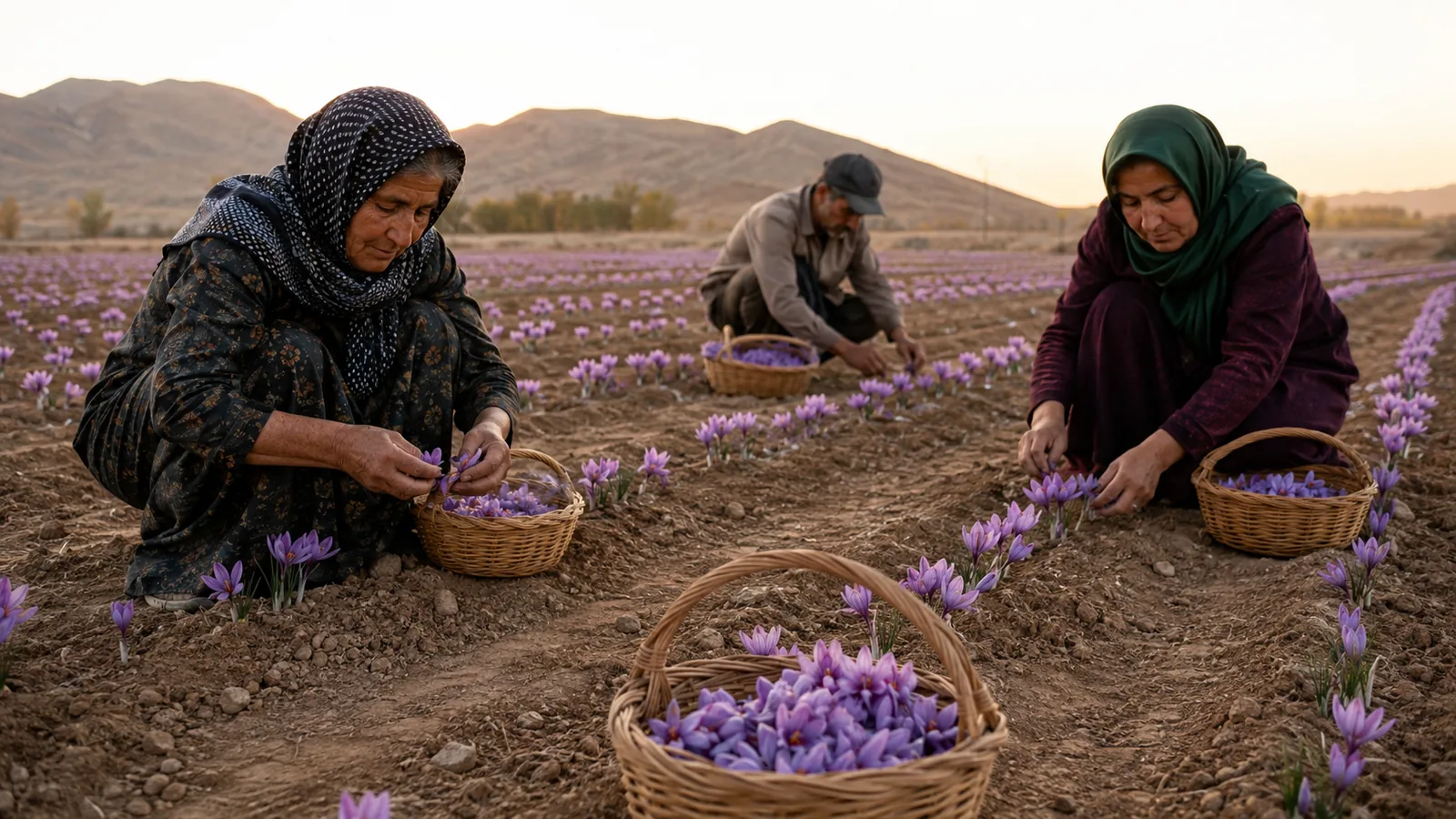
The beginning of saffron harvest from Torqroud lands of Natanz was reported across 100 hectares, with 800 kilograms of dried saffron forecast for the season. The account also captured the people, farm work and marketing problems behind that estimate.
What the Torqroud harvest forecast said
Abdolreza Mehdibadi, identified as the director of Agricultural Jihad in Natanz County, announced that saffron harvesting had begun in Torqroud and neighbouring villages. The historical report put the area at 100 hectares and forecast 800 kilograms of saffron.
That forecast is equivalent to the stated eight kilograms per hectare, but it was an expectation at the start of harvest rather than a final weigh-in. The source does not identify the crop year or publish an end-of-season result, so the 800 kilograms should not be presented as confirmed production.
Where Torqroud fits within Natanz
Torqroud, also transliterated as Tarq or Targhrud, is a city in the central part of Natanz County in Isfahan Province. The old article named Tar Abksheh, Yahya Abad, Baghistan Pa’in and Baghistan Bala among its neighbourhoods or local areas.
It also noted the local Targhi dialect and described residents as warm and hospitable. Those details give the harvest a place and community rather than treating saffron as an anonymous commodity. Transliteration varies across English records, but this article retains “Torqroud” in the title and uses it consistently.
Harvest is concentrated into a short period
Saffron flowers must be collected and their stigmas separated within a demanding seasonal window. Mehdibadi said household members and people from neighbouring towns joined the work of picking flowers and drying the stigmas.
Those are distinct stages. Pickers gather intact flowers, after which workers separate the red stigmas and dry them under controlled conditions. The dry weight reported for saffron is therefore not the weight of the harvested flowers. A useful harvest record should state clearly whether a figure refers to flowers, fresh stigmas or dried spice.
The eight-kilogram yield needs its original context
An eight-kilogram-per-hectare estimate is meaningful only alongside the season, productive field area and measurement method. New fields and mature fields may perform differently, and weather, corm density, soil, irrigation and harvest timing affect output.
The 100-hectare figure may also describe the land scheduled for harvest rather than every planted plot in Torqroud. Without a final survey, it should not be used to rank a farmer, village or county. What the article securely preserves is the official forecast: 100 hectares, 800 kilograms in total and eight kilograms per hectare.
Water shortage was the first problem named
Mehdibadi listed water shortage among the main difficulties facing Natanz saffron farmers. Saffron is suited to relatively dry conditions, but it still depends on well-timed moisture. “Low-water crop” does not mean a field can produce reliably without a secure source.
The historical report does not quantify the shortage, name the affected water systems or say whether Torqroud’s whole 100 hectares experienced it. That prevents a more precise conclusion. It does show that water security was already part of the local production discussion when the harvest began.
Price pressure affected the farm return
The director also referred to a reduction in world saffron prices. No market, currency, period or price series accompanied that statement. It is best read as a concern reported by the official, not a current global-price statistic.
Farm returns depend on more than the international headline price. Yield, picking and separation labour, drying loss, quality grade, the buyer’s terms and the point at which the product is sold all shape what a grower receives. A fall in price can be especially difficult when water or labour costs are already rising.
Packaging was seen as a missing part of the value chain
Weakness in standard packaging was the third problem in the old account. Mehdibadi argued that bulk exports allowed businesses in European countries to package Iranian saffron and sell it under their own national market identity.
The report did not provide trade or origin-labelling records to quantify that practice, so it should not be turned into a claim about every European seller. Its economic point is clearer: when a growing region sells only an undifferentiated bulk ingredient, more of the later value from testing, branding, packaging and retail distribution may be captured elsewhere.
A later official Natanz snapshot
An Agricultural News Agency report dated to Iranian year 1400 provides a later county-wide comparison. The later Natanz saffron harvest report described 350 hectares across the county and forecast 2,100 kilograms of dried saffron, with an average yield of about six to seven kilograms per hectare.
That official report named Natanz and Torqroud in the central district, as well as Badrud and Dehabad in the Emamzadeh district, among the main growing areas. It placed the harvest from early Aban in Natanz’s temperate and mountainous areas through mid-Azar in the more desert-like Badrud area.
These figures belong to a later, wider county snapshot. They do not replace the old Torqroud forecast or prove how its 100 hectares performed. They do confirm that Torqroud remained part of Natanz’s principal saffron geography.
Labour and local livelihoods
The later Natanz report estimated that the harvest created direct and indirect work for 17,000 people during the season. It again identified price fluctuation and the lack of packaging industries as problems, adding the absence of guaranteed purchasing and the share of profit captured by intermediaries.
That continuity is notable. The old Torqroud article described families and neighbours doing the immediate harvest work; the later report showed how widely those seasonal activities extended across the county. Neither figure tells us how many jobs were full-time or how long they lasted, so “17,000” should not be read as permanent employment.
What standard packaging should accomplish
Packaging alone does not improve poor saffron. Its job is to preserve a properly harvested and dried product, protect it from moisture, light and contamination, and communicate truthful origin and lot information.
For growers and processors, a stronger local value chain would connect field records with hygienic separation, controlled drying, objective quality testing, traceable lots and packaging suited to the buyer. That is more substantial than putting the same bulk product into an attractive box.
How to read the Torqroud harvest record
The most defensible interpretation keeps forecast and outcome apart. Harvesting began across a reported 100 hectares. Officials predicted 800 kilograms of dry saffron and stated an expected yield of eight kilograms per hectare. Farmers faced water shortage, price pressure and inadequate local packaging.
The article also preserves something statistical reports often miss: relatives and workers from nearby communities took part in collecting flowers and drying stigmas. That labour is part of the product’s real cost and of Torqroud’s cultural connection with saffron.
The enduring value of the Natanz story
Torqroud’s harvest was not simply the moment flowers appeared. It brought together land, water, skilled handling, family labour and a route to market. The later county report shows that the same questions remained important as Natanz’s saffron area expanded.
A complete future account should publish the final dried weight, productive hectares, yield range and a clearly dated price context. It should also show what share was tested, packaged and sold with traceable Natanz or Torqroud origin. Those details would turn a promising opening-of-harvest forecast into a record that farmers and buyers can genuinely use.

![Exporting Saffron to Turkey + Price Guide [Complete 0 to 100]](https://img.rowhanisaffron.com/20260827003933/saffron-export-turkey-quality-inspection.webp)



