


More than 12 tons of dried saffron were reported from farms in Bardaskan city in an older local account. The harvest figure matters, but the field record, water shortage and later decline in planted area explain far more about what growers were facing.
What the 12-ton Bardaskan harvest report recorded
The original report attributed the local production estimate to Hamid Hajinejad, then director of Bardaskan Agricultural Jihad. It said the dried saffron was worth 30 billion rials, although it did not identify the crop year, valuation date or method used to calculate that total.
The post’s stored meta description also referred to 3,100 hectares of saffron farms in Bardaskan. That area is useful historical context, but it is not stated in the surviving body copy. Without the underlying agricultural record, the 12-ton total and 3,100-hectare figure should not be combined to produce an assumed citywide yield.
A remarkable result from one farm
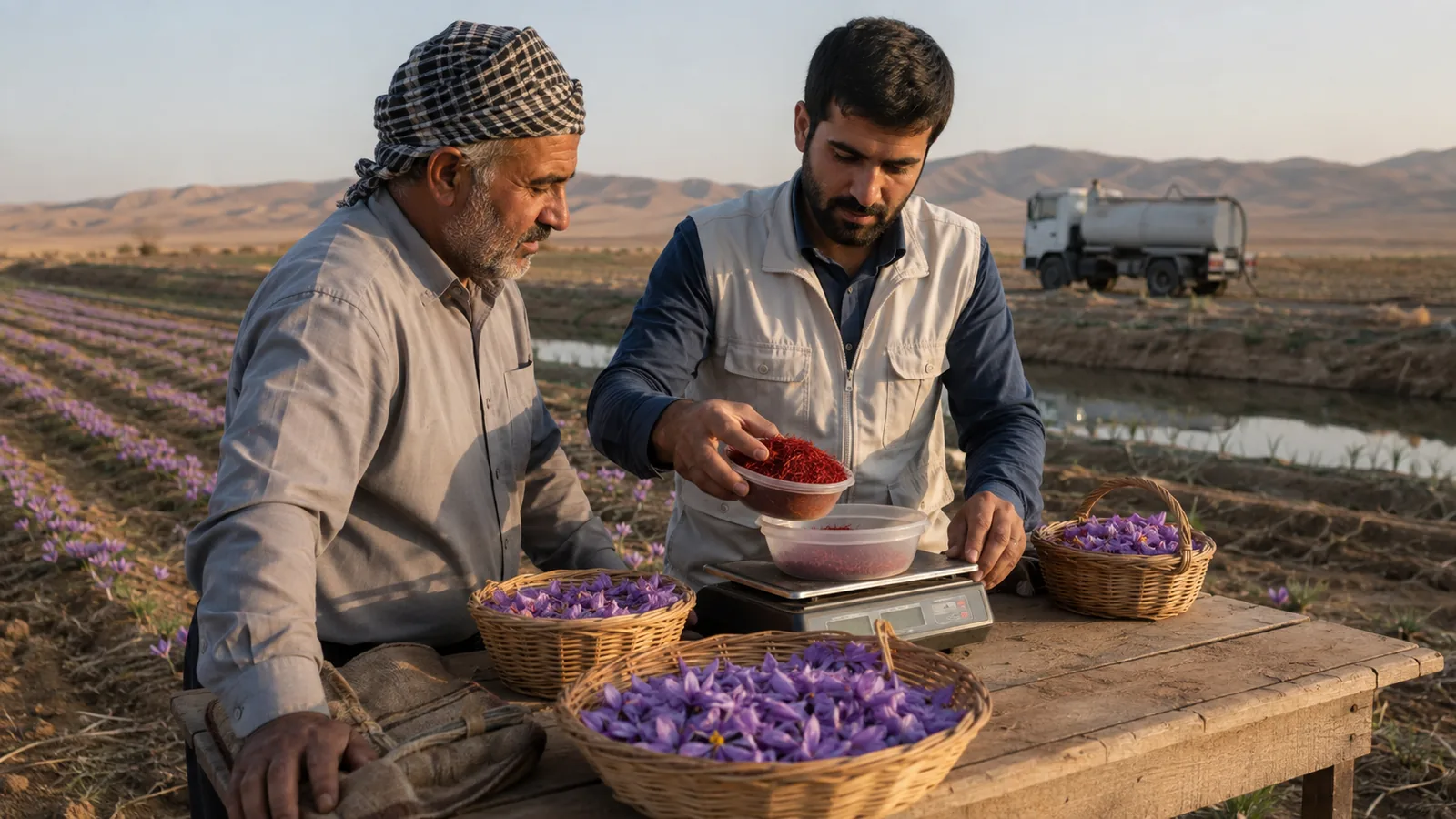
Hajinejad’s comments were made during a visit by the governor and central-district officials to a farm near Kalateh No village. The grower, Mohammad Ali Mohammadi, had been selected as an exemplary saffron producer.
According to the account, representatives from the Agricultural Jihad Organization and the Agricultural Research Organization measured a dry-saffron yield of 32 kilograms and 137 grams per hectare on Mohammadi’s farm. In decimal form, that is 32.137 kilograms per hectare.
This was presented as an exceptional plot result, not Bardaskan’s average. It cannot be multiplied across the city’s total planted area to reconstruct production. Field age, the area actually harvested, corm density, soil, water, weather and the basis of the official measurement would all be needed for a defensible comparison.
What was credited for the record yield
The translated source singled out hand weeding, the absence of herbicide use and summer irrigation. Its wording also refers broadly to avoiding “poisons,” which most likely means agricultural pesticides, but it does not provide a field-input log. It would therefore be unsafe to recast the passage as proof that no plant-protection product of any kind was used.
Manual weed control can reduce competition without applying a herbicide, but one successful field does not establish a universal recipe. Irrigation timing, water quality, soil tests, corm health, field age and local pest pressure all affect the result. The report’s strongest lesson is that close field management and access to knowledgeable agricultural advisers were associated with the documented record.
Why the result could not simply be copied citywide
Hajinejad said the record showed what was possible in Bardaskan and argued that informed, knowledge-led farmers could move closer to it. “Closer” is important. A demonstration plot can set a useful benchmark, but it does not promise that every farm will reach the same output.
The old article also made a national statement that agriculture accounted for 7% of gross income. It did not define the year, indicator or source, so that percentage should remain part of the historical speech rather than be presented as a current economic statistic.
Water shortage was already limiting Bardaskan saffron
The report described tanker deliveries to 400 hectares of saffron farms in Bardaskan’s foothills because many qanats and other mountain water sources had dried. It said the local Agricultural Jihad office had arranged the work on credit and owed private contractors 240 million tomans, prompting a request for attention from the governor.
Those details show the scale of the immediate response, but they do not say how much water each hectare received, how often tankers arrived or whether the intervention covered the crop’s needs. Tanker service should not be treated as an irrigation recommendation. It was an emergency measure in a locality where established water sources were failing.
Spring rainfall and the reported 30% production fall
Hajinejad attributed a 30% decrease in the city’s saffron production to reduced spring rainfall. The account does not state the comparison year or provide a weather series, so the percentage is best read as the local official’s season-specific estimate.
Saffron’s annual cycle makes the concern plausible without turning that single statement into a universal rule. Moisture conditions influence corm development and the following flowering period, while extreme heat, irrigation limits and field management can alter the outcome. A reliable diagnosis needs local weather and farm records rather than rainfall alone.
A later Bardaskan report shows how much conditions changed
A much later news report, published in December 2024 and based on comments from Bardaskan agricultural director Mehdi Masrouri, described a sharply smaller sector. The later Bardaskan saffron-area report said land under the crop had fallen from about 2,500 hectares over the preceding decade to 750 hectares in that season.
Masrouri gave an average of 1.5 kilograms of dried saffron per hectare for that year. He also said timely spring rain and better nutrition had lifted yield by 50%, while climate change, heat, reduced rainfall and disruption to water sources had contributed to the longer-term reduction in cultivated area.
These later numbers do not correct the undated 12-ton harvest by simple substitution. They describe a different period, a different stated area and a season-specific average. They do, however, reinforce the original article’s warning that water insecurity could reshape saffron farming in Bardaskan.
Why qanats matter in Iran’s saffron regions
Bardaskan’s local account sits within a broader agricultural tradition in dry parts of Iran. The Food and Agriculture Organization’s profile of the qanat-based saffron system in Gonabad explains how underground water channels support farming under severe water scarcity.
Gonabad is a different county, so its designation cannot be used as evidence for the condition of Bardaskan’s individual qanats. It does show why the loss of this kind of water source has consequences beyond one irrigation season: qanats are part of a locally adapted system connecting water management, knowledge, livelihoods and saffron cultivation.
How to interpret Bardaskan’s figures responsibly
The surviving numbers refer to different things. More than 12 tons is a reported city harvest. The 30 billion rials is a historical valuation. The 32.137 kilograms per hectare belongs to one exemplary farm. The 400 hectares identifies the stated tanker-service area, while 240 million tomans is the reported contractor debt. The 30% decline is a season-on-season claim whose comparison year is missing.
Keeping those measures separate prevents a record farm from being mistaken for an average and prevents old currency values from being read as present prices. It also preserves what the historical report actually contributed: named people, a named village, a measured plot result and a specific account of water stress.
What a stronger future harvest record should include
A complete Bardaskan production report would identify the crop year, planted and productive hectares, total dry harvest, average yield and the range across farms. It would state whether a plot measurement covered the whole hectare or a sample, and record field age, irrigation source, rainfall period and drying method.
For emergency water delivery, the useful details would include the number of farms, volume per delivery, dates, cost and the share of crop demand covered. That information would let growers and officials distinguish a short-term rescue from a sustainable water plan.
The enduring meaning of the Bardaskan account
The headline preserves a time when Bardaskan was reported to harvest more than 12 tons of dried saffron. Within that larger total, Mohammad Ali Mohammadi’s 32.137-kilogram-per-hectare result showed the potential of close farm management. At the same time, tanker deliveries and a 30% production decline showed how vulnerable that potential was to water and weather.
The later contraction in planted area makes the old warning more significant, not less. Bardaskan’s story is not simply about a large harvest or a record grower. It is about the connection between skilled cultivation, trustworthy measurement and the water system that keeps a saffron field productive.

![Exporting Saffron to Turkey + Price Guide [Complete 0 to 100]](https://img.rowhanisaffron.com/20260827003933/saffron-export-turkey-quality-inspection.webp)



