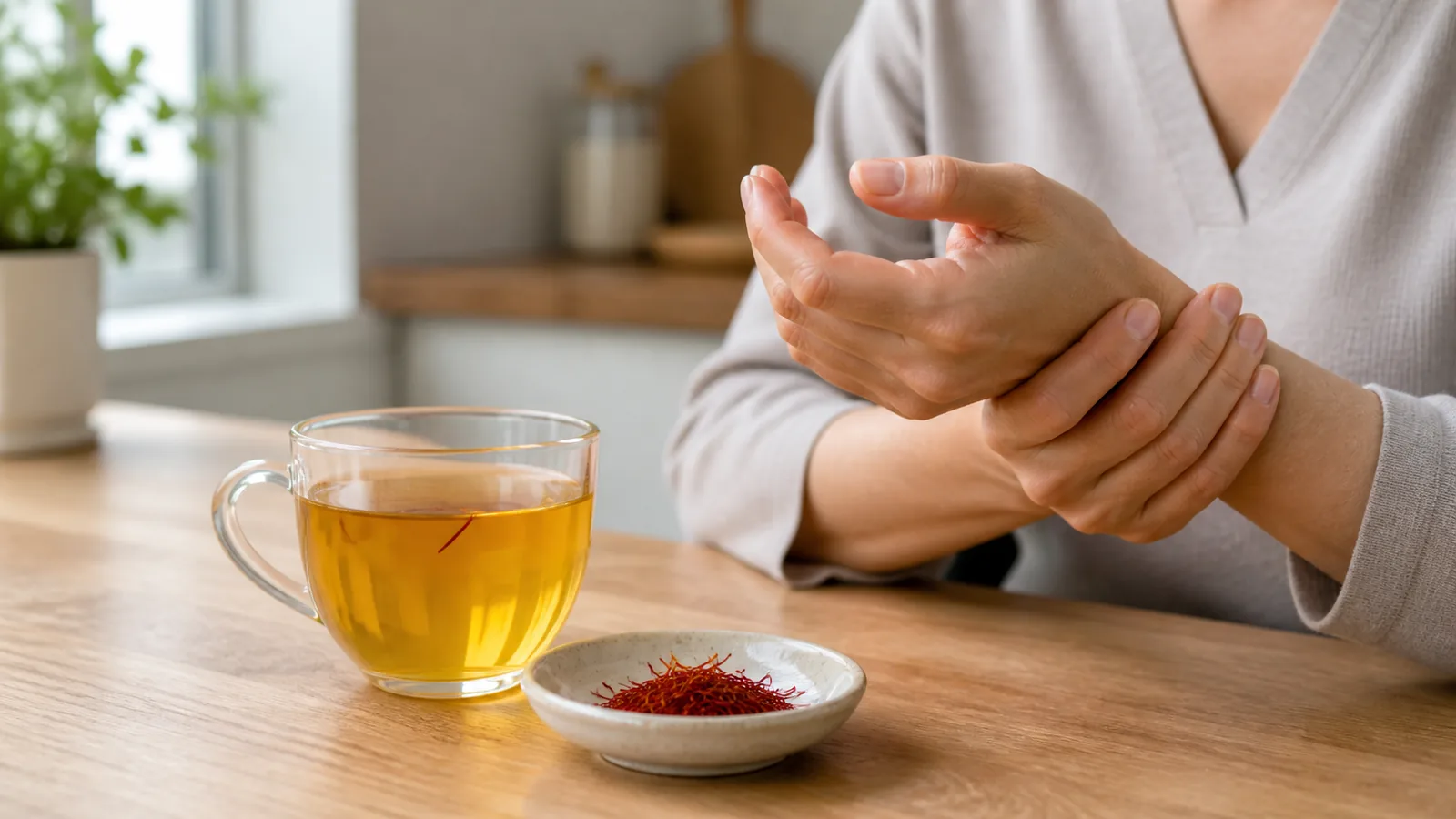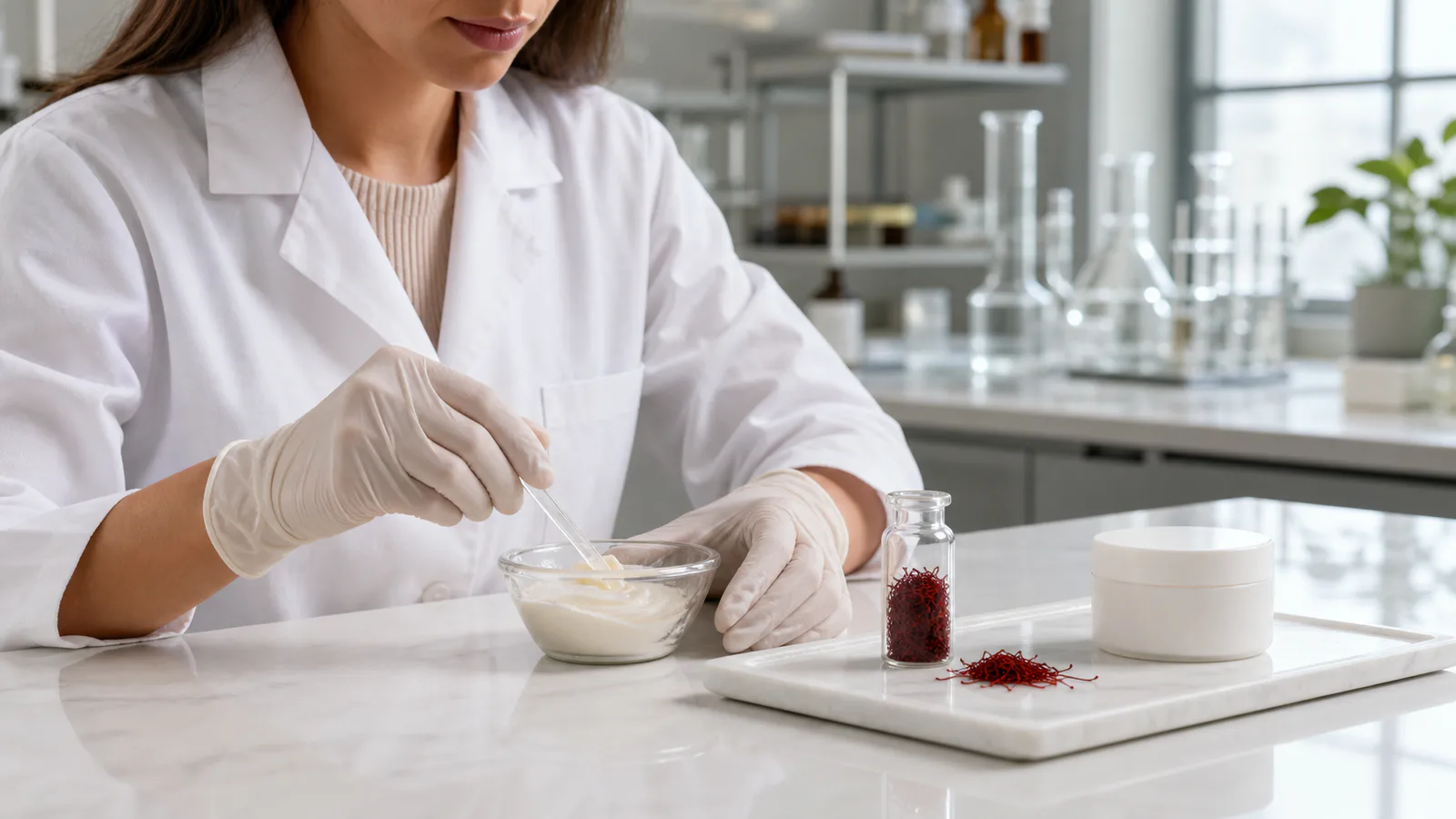
The cosmetic creams are made of saffron was the headline given to a 2016 interview with Ali Nasiri, then director of agriculture in Khalil Abad. He described saffron as an expensive ingredient used in some cosmetic and sunscreen formulations, then widened the discussion to the problems facing Iranian growers: weak international branding, competition from other producing countries, movement of saffron bulbs, inconsistent processing and the need for better quality control.
The interview contains useful historical detail, but its skincare claim needs careful limits. A cream does not become an effective sunscreen simply because it contains saffron. The performance and safety of a finished cosmetic depend on the whole formula, the amount and form of each ingredient, manufacturing controls and testing of that specific product.
Can saffron be used in cosmetic creams?
Yes. Saffron extracts and some of their constituents can be incorporated into cosmetic emulsions, and researchers have studied saffron-containing topical products. That tells us the ingredient can be formulated into a cream; it does not prove that every saffron cream delivers the same benefit.
A small 2020 study published in the Journal of Cosmetic Dermatology tested a cream containing saffron extract and avocado oil in 20 healthy volunteers over 12 weeks. The researchers reported changes in measured facial-skin and wrinkle outcomes. The sample was small, the formulation combined two active ingredients, and the findings cannot be transferred automatically to a different jar, extract or concentration.
A later review of saffron’s dermoprotective research discusses antioxidant, antimicrobial, depigmenting and repair-related findings and notes the use of saffron in lotions and cosmetic emulsions. Much of the underlying evidence is laboratory, formulation or early clinical work. It supports further study, not sweeping promises about treating skin conditions.
A saffron cream is not automatically a sunscreen
Nasiri called saffron one of the best sunscreen and cosmetic materials. The source provides no test result for that ranking, so it should remain an attributed 2016 opinion rather than a product claim. Sun protection has to be demonstrated in the final formulation.
In the United States, for example, the Food and Drug Administration requires defined SPF and broad-spectrum testing before the corresponding sunscreen claims can be used. The rule applies to moisturisers and cosmetics carrying sunscreen claims as well as products sold simply as sunscreens. Requirements differ by country, but the underlying lesson is universal: an ingredient’s reputation cannot replace finished-product evidence.
The FDA also states that cosmetic labelling must be truthful and not misleading. A product marketed as treating disease or changing the structure or function of skin may be regulated as a drug under US law. Buyers should therefore look for a complete ingredient list, clear directions and claims supported for the actual product, rather than assuming that “natural” means tested or irritation-free.
What the Khalil Abad interview actually covered
According to the Iranian Students News Agency (ISNA) report from Khorasan, Nasiri wanted more work on saffron’s health and medical applications. He said that more than a dozen properties had been discussed, while Iran continued to use most saffron as a spice. The report does not list or substantiate those properties, so the number is preserved as his statement rather than converted into health promises. Cosmetics were one example in a broader discussion about how producers could capture more value from saffron.
That distinction is important. Selling a raw spice and supplying a consistent cosmetic ingredient are different businesses. A formulator needs a defined extract or material, repeatable composition, microbiological and chemical controls, traceable batches, and information suitable for a safety assessment. The flower’s prestige cannot fill those technical gaps.
Competition was growing beyond Iran
Nasiri identified Afghanistan, India and China as competitors in saffron production. He also said Afghan producers were multiplying corms quickly and claimed that Europeans had helped with saffron-corm cultivation in Afghanistan. The interview does not name the organisations, dates or evidence behind that final statement, so it cannot be made more specific here.
His concern was that competitors could improve while Iran relied on production heritage alone. For cosmetic manufacturers, heritage may support a story, but purchasing decisions also depend on consistent specification, documentation, delivery and price. A country that produces a large crop can still lose higher-value work if extractors, laboratories and brands elsewhere make the ingredient easier to use.
Why international branding mattered
The interview referred to branding as a resolution of the National Saffron Council that had not yet been carried out. Nasiri considered the lack of international brands a major difficulty and argued that saffron’s true value was higher than the price farmers or suppliers were receiving.
A brand cannot correct a variable product, but it can make responsibility visible. For a saffron cosmetic ingredient, that means a supplier whose batches can be traced, specifications can be compared and documents can be checked. For a finished cream, it means a manufacturer accountable for formulation, safety, stability, packaging and truthful claims. Recognition comes after those systems, not before them.
The dispute over moving saffron corms
Nasiri supported controls intended to prevent saffron corms from being smuggled to rival producing countries. The translated report says that a saffron-corm consignment moving to another city required permits and could otherwise be confiscated by police. This describes a policy position reported in 2016; it is not current legal advice about moving planting material.
Corm movement also raises agricultural questions beyond competition. Planting material can carry disease or pests, and its identity and condition affect establishment. Anyone moving or exporting saffron corms needs the current agricultural, phytosanitary and customs rules for the origin and destination. A decade-old news report is not a substitute for those requirements.
Processing quality was central to the economic argument
The director said that a programme to improve saffron quality had begun in several cities under the supervision of a higher saffron council. In his account, saffron processed in designated workshops could be identified and handled more hygienically. The English source says this processing made the product sell for “up to one million dollars more,” but the unit and comparison are damaged in translation. Repeating that as a precise premium would be misleading.
He also associated the workshop approach with lower contamination, stronger colour quality and a gain of a few grams from each kilogram. The report does not describe the test method, sample size or baseline, so these remain the speaker’s claims. The practical principle is easier to defend: careful separation, drying, handling and storage can reduce avoidable contamination and loss.
Khalil Abad cultivation details need a unit warning
Nasiri said saffron could be grown across the country, with differences in planting density, corm type and timing. He recommended planting corms in Khalil Abad during May and June. Cultivation timing is local: climate, soil, irrigation, dormancy and current agricultural advice all matter, so that historical recommendation should not be copied as a universal calendar.
The report gives about 4,000 hectares of saffron land in the city and then states a performance of 16 tonnes per hectare. Those two figures are not plausible together for dried saffron and almost certainly reflect a translation or unit error. The passage may have meant 16 tonnes in total, but the source does not let us prove that correction. Both the 4,000-hectare figure and the damaged yield statement are preserved here with the uncertainty visible rather than silently repaired.
The source also discusses flower handling and seasonal employment, though the translated sentence is unclear. Nasiri appears to resist a processing change that would remove seasonal jobs while arguing for better quality. It would be unsafe to turn that fragment into a definite recommendation about a particular harvesting machine or method. The report places flower harvest in winter; growers should read that as local historical context, since flowering time varies with location and season.
From saffron threads to a credible cosmetic ingredient
A serious saffron cosmetic supply chain begins with identifiable raw material. The crop must be harvested and separated cleanly, dried under controlled conditions, protected from moisture and contamination, and kept traceable through storage. Extraction then introduces another set of variables: solvent, temperature, concentration, marker compounds, residues and stability.
For the finished cream, the manufacturer has to consider preservation, microbial quality, packaging compatibility, skin tolerance and shelf life. If the label claims sun protection, the finished formulation needs the relevant tests. If it claims a cosmetic effect, the evidence should match that wording and that product. These steps explain why a gram of well-documented material may be more useful to a formulator than a larger quantity sold only on colour or origin.
What buyers should take from the original claim
Saffron can be part of a modern cosmetic formulation, and early research gives formulators reasons to investigate it. It should not be treated as a proven stand-alone sunscreen, a cure for a skin condition or a guarantee that a cream works. The finished product matters more than the headline ingredient.
The wider point made in Khalil Abad still holds: producing saffron is only the beginning of value creation. Better handling, traceability, testing, product development and responsible branding can connect growers with uses beyond the spice shelf. The strongest saffron cosmetic creams will be the ones whose makers can explain exactly what they used, why they used it and what the completed formula has actually been shown to do.