


Remove from basket 35% of Iranian saffron was the stark message attached to a 2016 interview with MP Mohammad Esmaeil Nia. Speaking to the Iranian Students News Agency (ISNA) in Khorasan, he said that rising prices had pushed saffron out of the household shopping basket for an estimated 35% to 55% of Iranians. He also connected weaker domestic demand and lost export opportunities with adulteration, inconsistent standards, poor packaging and a failure to respond to changing customer expectations.
Those figures describe a particular claim made in 2016, not a current measurement of Iranian saffron consumption. The interview remains useful because it identified a problem that still matters to any saffron market: price alone cannot sustain demand if buyers are unsure what is in the package.
Why saffron was leaving the household basket
Esmaeil Nia attributed the decline in household purchasing primarily to sharp price increases. In the source interview, the reported share of people who had dropped saffron from their consumer basket ranged from 35% to 55%. The title preserves the lower figure, but readers should not treat either percentage as a new survey result or a current national statistic.
Affordability was only one part of his argument. He also named reduced exports in preceding years, the addition of artificial colours and changing customer needs. These issues reinforce one another. When a valuable spice becomes more expensive, consumers pay closer attention to authenticity, pack size, labelling and whether the seller can explain the product’s origin. Uncertainty makes a high price harder to accept.
Artificial colour and fake saffron damage trust
The interview warned that artificial colours were present in the saffron market and described this as one factor behind the loss of export business. That was an attributed market warning, not proof that every Iranian supplier or every saffron lot was affected. The distinction matters: a genuine concern about adulteration should lead to better verification, not a blanket accusation against producers.
Saffron is vulnerable to fraud because it is expensive and sold in very small quantities. The US Food and Drug Administration’s guidance on economically motivated adulteration gives saffron as an example of a costly ingredient that may be bulked with other plant material; it also notes that dyes can be used to change the apparent quality of spices. The FDA does not say that all saffron is adulterated. It explains why traceability and testing are reasonable safeguards.
Esmaeil Nia referred to adding bulk material and offering fake saffron to consumers. The translated source also links this conduct to higher market prices, although it does not provide evidence that allows that causal claim to be measured. What can be said safely is that adulteration distorts value: a buyer may pay for saffron but receive less saffron than the label suggests.
Quality standards give buyers a common language
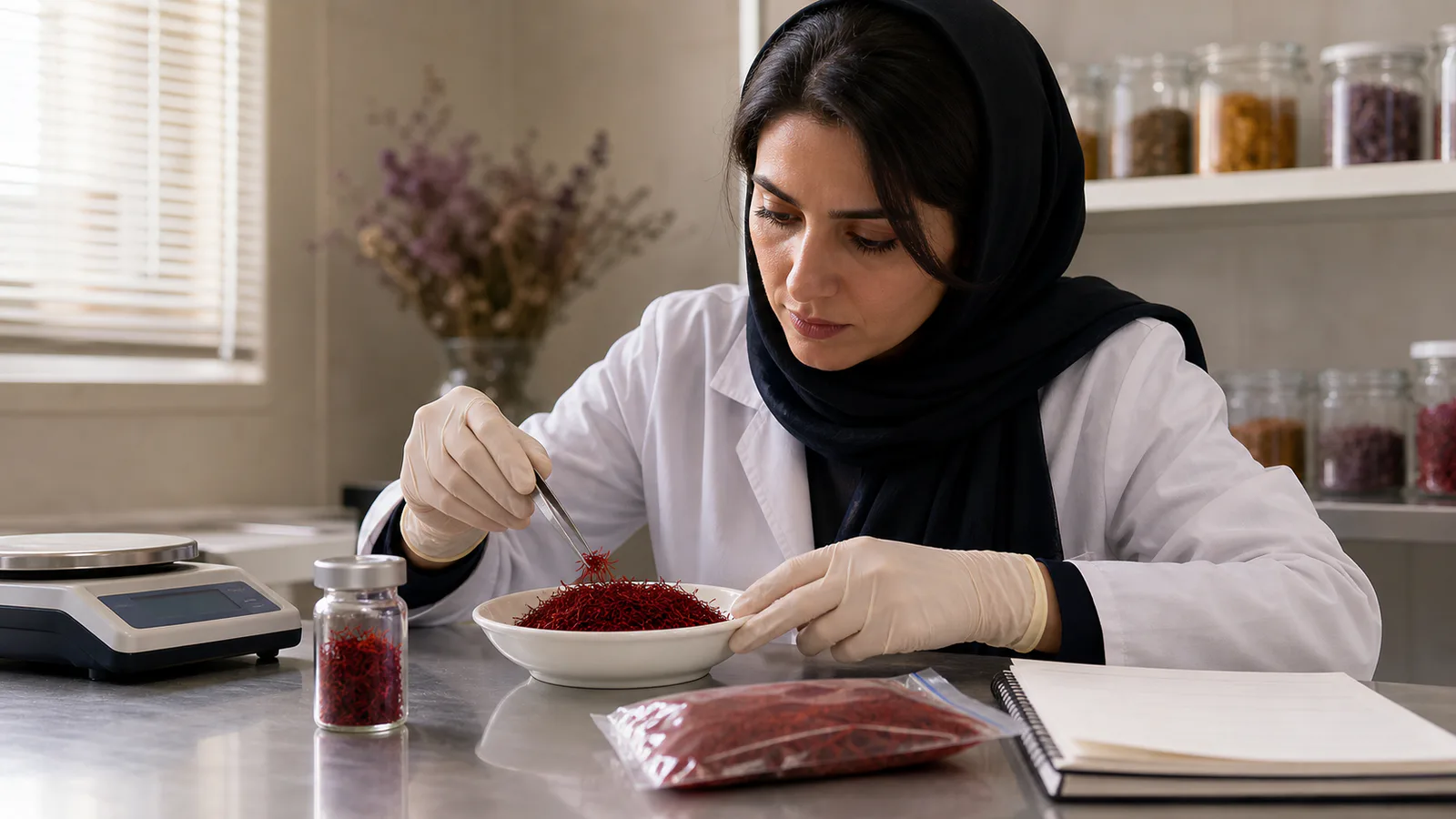
One of the interview’s proposed remedies was to establish and enforce standards. This is more useful than relying on colour or aroma alone. The International Organization for Standardization explains that ISO 3632 methods assess saffron’s colour, flavour and aroma and check for foreign matter. ISO also notes that powdered saffron is more vulnerable to adulteration than intact threads.
A standard does not replace a trustworthy supply chain, but it gives laboratories, packers and buyers a consistent basis for describing a lot. Test results should identify the sample and method, and a claim of compliance should be supported by evidence for that specific batch. A generic badge or a seller’s assurance is not the same thing.
Labels and sealed packs make the product easier to verify
The MP argued against unlabelled bulk retail and called for vendors to use standard labels. A useful pack tells the customer what the product is, who packed or supplied it, its net weight, lot or batch reference, and any storage or origin information required in the market where it is sold. Tamper-evident packaging cannot prove quality by itself, but it creates a clearer chain of responsibility than an anonymous open container.
Packaging also protects a delicate product. Saffron threads should be kept dry and protected from unnecessary light, heat, moisture and strong surrounding odours. A well-chosen pack helps preserve the product during storage while allowing the buyer to see enough of the threads to assess their general condition.
For anyone buying saffron from Rowhani Saffron, the practical questions are simple: Is the product identifiable? Is the quantity clear? Can the seller trace the lot? Are quality claims specific rather than vague? These checks do more for confidence than extravagant promises.
Laboratories are most useful close to production
The 2016 interview called for equipped quality-control laboratories in saffron-growing cities. Locating reliable testing near cultivation and processing centres can make it easier to assess lots before they are mixed, packaged or exported. It can also shorten the feedback loop when a grower or processor needs to correct a handling problem.
Testing methods continue to develop. In 2025, the Food and Agriculture Organization of the United Nations and Mashhad University of Medical Sciences announced work on saffron authenticity testing. Their project addresses adulteration and inconsistent post-harvest practices and is intended to develop stronger analytical and practical guidance. This later initiative does not validate every claim made in 2016, but it confirms that authenticity testing remains a serious technical subject.
Producers, sellers and exporters form one chain
Esmaeil Nia urged policymakers to treat the producer, seller and exporter as a connected group. That is a sound way to understand market quality. A careful farmer can still lose value if drying, storage or packing is poor. A responsible exporter cannot make an anonymous or mixed lot traceable after the fact. Equally, standards that ignore the realities of cultivation are unlikely to earn durable cooperation.
The interview also called for ethical conduct in distribution and sale. In practical terms, that means accurate weights, honest descriptions, no undeclared filler or colour, and no claims that exceed what the seller can document. These are not cosmetic improvements. They determine whether a customer can make an informed comparison.
Training and technology should solve specific problems
Farmer training in organic cultivation appeared among the proposed domestic-market policies. Organic production can be relevant where growers follow a defined standard and certification system, but the word “organic” should not be used as a loose synonym for pure or high quality. Authenticity, residue controls, sensory quality and organic certification answer different questions.
The MP also recommended equipping and encouraging companies with better technology. Useful investment could include controlled drying, clean grading and packing areas, calibrated weighing, batch records, moisture management and appropriate laboratory access. Technology earns its place when it improves consistency or traceability; buying equipment without a clear quality-control process does not solve the underlying problem.
Would a saffron exchange or stock market help?
Launching a saffron stock or exchange market was another proposal in the interview. A formal trading venue may improve price visibility and product specification when contracts define grade, delivery, storage and testing clearly. It cannot, on its own, guarantee authenticity or eliminate poor practice. The quality represented by a contract still depends on sampling, custody and enforcement.
The same caution applies to support for leading packaging companies. Better packs can protect saffron and communicate traceability, but polished presentation must not substitute for sound material inside. Packaging, laboratory evidence and accountable supply relationships need to work together.
Export recovery depends on satisfying the buyer’s intent
The closing part of the source interview called for a diagnosis of lost foreign markets and for exporters to be supported with suitable pricing and technology. The translated sentence about “offering the same price exporter” is damaged, so it would be unsafe to assign it a precise economic meaning. The broader point is clear enough: competitiveness requires more than increasing production.
Export buyers need consistent specifications, documents that match the shipment, dependable delivery and a product that meets the rules of the destination market. A supplier that protects identity and quality from field to final pack is better placed to retain a customer than one competing on headline price alone.
A note on Iran Safran and export search terms
International buyers do not always search in English. Iran Safran is a shortened German-style search, while iranischer Safran means Iranian saffron. The phrase sofrani export appears to be a non-English or misspelled search for saffron export. On this page, those searches lead to a historical Iranian market discussion, not a live export quotation or a current price list.
What the 2016 warning still teaches
The most durable lesson is not the headline percentage. It is the link between affordability and confidence. When saffron becomes costly, households and trade buyers need stronger reasons to trust its identity, weight and quality. Clear standards, batch-level testing, responsible labels, trained producers and accountable sellers all reduce uncertainty.
None of those measures should be used to imply that fraud is universal, or that a package is genuine merely because it looks professional. They are parts of a verifiable system. For the domestic market and for exports, the goal is the same: the person paying for saffron should receive the saffron described.

![Exporting Saffron to Turkey + Price Guide [Complete 0 to 100]](https://img.rowhanisaffron.com/20260827003933/saffron-export-turkey-quality-inspection.webp)



