


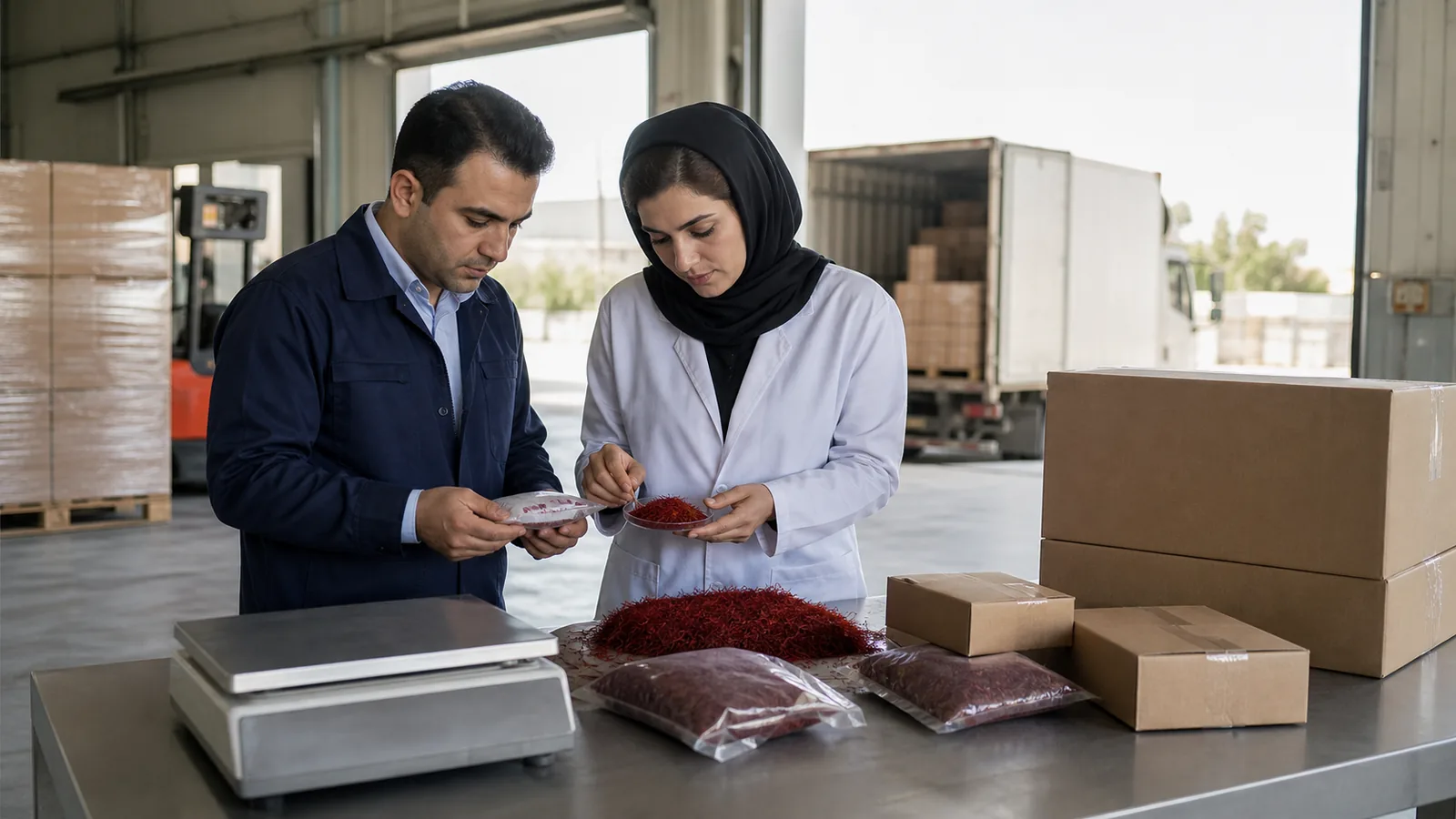
Saffron exports to 44 countries reports Iran’s trade during the first four months of the Iranian year covered by a 2016 ISNA article. Customs figures quoted in the report put exports at 42 tonnes and 22 kilograms of saffron and saffron powder, valued at US$60,800,059. The article said volume rose 19.04% and value 19.32% from the corresponding period a year earlier.
This is a dated trade snapshot, not a list of today’s leading saffron exporters or a current export price. Its value lies in the unusually detailed destination and pack-size record, together with an industry forecast that can now be read as a forecast rather than as a fact.
The four-month export figures
According to the Iranian Students News Agency (ISNA), 42,022 kg went to 44 export destinations during the first 120 days of the reporting year. The translated copy says growth was measured “over the past four years,” but its opening and percentages compare the period with the same four months of the previous year. The one-year comparison is the internally consistent reading.
The reported changes were close in volume and value: 19.04% more by weight and 19.32% more by declared value. That similarity does not prove that every grade or package had the same price. An aggregate export value combines different product forms, grades, destinations, pack sizes and contracts.
Dividing US$60,800,059 by 42,022 kg gives an average declared value of roughly US$1,447 per kilogram for the period. This is a calculation from the historical aggregate, not a quoted market price and not the amount received by every producer or exporter.
Which 44 countries received Iranian saffron?
The source lists 45 country names because Canada appears twice. Removing that duplicate leaves the stated 44 destinations:
China, Japan, Argentina, South Africa, Germany, Austria, Jordan, Uzbekistan, Spain, Italy, France, Australia, Estonia, Scotland, the United Kingdom, Canada, Switzerland, Sweden, Afghanistan, the United Arab Emirates, Bahrain, Brazil, Belgium, Bosnia and Herzegovina, Taiwan, Turkey, the Czech Republic, Singapore, Iraq, Saudi Arabia, Oman, the Philippines, Qatar, Kuwait, Poland, Luxembourg, Malaysia, Mauritius, Nepal, the Netherlands, Hong Kong, India, Vietnam and Greece.
“Scotland” and “United Kingdom” are both preserved because both appear in the historical list, even though Scotland is part of the UK. “Taiwan” and “Hong Kong” are likewise retained in the form used by the source. The list describes reported destinations, not necessarily the final country of consumption; saffron can be re-exported after import, processing or packing.
Most of the recorded weight was in larger packs
The translation divides the trade among saffron filaments and powder in several package bands. It reports:
- 29,871 kg of saffron in packs from 10 to 30 grams, worth more than US$43 million;
- what appears to be 8,018 kg in packs above 30 grams, worth more than US$11 million;
- 2,804 kg in packs below 10 grams, worth more than US$4.385 million; and
- 81 kg and 448 kg of saffron powder in the below-10-gram and 10-to-30-gram bands, together worth more than US$1.6 million.
The “8,018” interpretation follows the translated phrase “Eight and 18 kg,” but the category quantities add to 41,222 kg—800 kg short of the reported total. The surviving copy may have lost a digit, category or qualifier. Because the figures do not reconcile, they should not be silently corrected or used as a complete customs table.
Why pack size matters in export statistics
Pack bands can hint at how saffron moved through the supply chain, but they do not identify the final buyer by themselves. A pack above 30 grams might be intended for a restaurant, distributor, repacker or industrial user. A small pack might be retail-ready, a sample or part of a larger shipment.
Comparisons also need consistent product definitions. Filaments and powder can face different authenticity risks and customer specifications. Customs data record declared trade; they do not replace lot-level information about grade, moisture, laboratory results, origin and final sales channel.
Ali Hosseini’s 200-tonne forecast
Ali Hosseini, identified as a member of the National Saffron Council, told ISNA that the rise followed a period of policy uncertainty. The translated article refers to duties imposed on saffron exports and says exporters adjusted their programmes after the effects were removed or policy stability returned.
Hosseini said that if trade policy remained stable, a roughly 300-tonne crop could support exports approaching 200 tonnes by year-end. He contrasted that ambition with Iranian saffron exports in preceding years, which he said had not exceeded 150 tonnes.
That 200-tonne number was conditional. It depended on production, demand, policy, inventory and exporters’ ability to ship more than 16 tonnes per month. The article does not contain the final full-year customs result, so it cannot show whether his forecast was achieved.
The 90% world-market statement
Hosseini argued that Iran could serve about 90% of the international market if planning and policy made trade easier. The phrase blends production dominance with export-market potential. A country’s share of global production is not automatically the same as its share of reported exports, export value, branded retail sales or final consumption.
This distinction matters when someone asks for the biggest saffron exporter. The answer changes with the year, metric and dataset. Export value can credit a country that imported and re-exported saffron, while production statistics concern where the crop was grown. The same caution applies to lists of saffron exporting countries and saffron producing countries.
For a current ranking, use a declared trade dataset and filter the specific year and HS code. The World Integrated Trade Solution, using UN Comtrade data, identifies saffron under HS 091020. Its 2024 view lists Spain first by reported export value, but reporting coverage, gross re-exports and missing quantities must still be considered.
What “saffron export” data can and cannot answer
A search for saffron export may be asking about volume, value, destinations, regulations or how to become an exporter. This page answers only the historical Iranian figures and policy discussion. It does not provide customs clearance instructions or current legal requirements.
The query export of saffron from India is also distinct. India appears among the 44 destinations in this 2016 Iranian record, but that does not describe Indian-origin exports. Current WITS/UN Comtrade data provide a separate India saffron export view; its country, year, quantity and value should not be mixed with Iran’s historical report.
Likewise, a list of the top 10 saffron producing countries requires agricultural production evidence, not a customs export table. Traders can export saffron grown elsewhere, and producing countries may consume part of their crop domestically.
German searches for saffron price and export
Several search phrases associated with this page are German. Safran export means saffron export; Safran Preis für Export means saffron price for export; Safran Preis Kilo asks for the price per kilogram; and Safranpreis means saffron price.
The aggregate 2016 value cannot answer a current German-language price enquiry. Export price depends on date, currency, grade, form, quantity, testing, packaging, delivery terms and destination. For a present quotation, use the current saffron price page and specify the lot and contract terms rather than treating the historical US$1,447/kg average as an offer.
How to compare saffron export records responsibly
Before comparing two reports, check:
- the exact reporting dates and whether they cover a calendar, fiscal or crop year;
- the customs classification and whether powder and filaments are combined;
- net weight, supplementary quantity and missing units;
- declared value, currency and valuation method;
- reporting country versus origin country;
- direct exports versus re-exports;
- destination versus final consumption market; and
- whether later revisions changed the figures.
This is especially important for a high-value, low-weight product. A small error in kilograms, a duplicated destination or one mistranslated digit can materially change an average price or market-share claim.
What the 44-country report still shows
The 2016 article documents a broad export footprint: 42,022 kg worth about US$60.8 million sent to 44 unique listed destinations in four months. It reports year-on-year growth of about 19% in both weight and value, with the largest stated package category between 10 and 30 grams.
It also records Hosseini’s argument that stable policy could lift annual exports from a recent ceiling near 150 tonnes toward 200 tonnes. That remains a dated forecast, not an achieved result. Read carefully, the page offers a useful historical baseline while avoiding the common mistake of treating production, export quantity, re-export value and retail price as the same measure.
Sources reviewed
- The immutable 2016 site copy of the ISNA customs report and Ali Hosseini interview.
- World Bank WITS/UN Comtrade: HS 091020 saffron exports by reporting country.
- World Bank WITS/UN Comtrade: India’s HS 091020 export record.

![Exporting Saffron to Turkey + Price Guide [Complete 0 to 100]](https://img.rowhanisaffron.com/20260827003933/saffron-export-turkey-quality-inspection.webp)



