


Saffron exports grow 21% reports a first-quarter increase described by Gholam Reza Miri, then head of the Khorasan Razavi Saffron Exporters Association. In a 2016 interview with the Iranian Students News Agency (ISNA), Miri said exports were 21% higher than in the same quarter a year earlier after two administrative barriers had been removed.
The number is a historical year-on-year comparison, not a current export growth rate. The source does not give the exported weight, value, exact quarter dates or customs table used to calculate it. It is best read as a contemporary industry account of an early recovery and of the work exporters believed still had to be done.
What changed before the 21% increase
Miri said an export toll had been removed and exporters no longer needed to obtain what the translated report calls a “National Farmers code.” The original English wording does not identify the formal name of either requirement, so it would be unsafe to turn the passage into current procedural advice.
Removing paperwork or a charge can reduce friction at the point of export. It does not immediately restore orders that have already moved elsewhere. Miri warned against expecting a sudden transformation, even after the specified barriers disappeared.
Customer confidence takes longer to rebuild
The interview repeatedly returns to trust. Miri said attracting customers, gaining their attention and recovering target markets would take time because earlier export restrictions had caused substantial losses. A buyer who has changed supplier, packaging programme or distribution contract cannot always return after one rule changes.
For a saffron exporter, confidence is practical. Buyers want consistent specifications, documents that match the shipment, dependable delivery, clear communication and a price they can plan around. One successful transaction helps, but repeat performance is what turns a recovered contact into a durable market.
There was no single remaining barrier
Miri’s translated answer says there was no certain or single current barrier to exporting saffron, while obstacles to export promotion remained. That is not a contradiction. The immediate administrative blocks he named could be gone while pricing, logistics, marketing and commercial relationships still limited growth.
This difference is useful when reading the 21% figure. Export clearance and export development are related but separate tasks. The first gets a shipment through a process. The second creates demand, protects margins and makes the next shipment more likely.
Domestic price swings made quoting difficult
The association chairman identified fluctuating domestic saffron prices as an obstacle. In the source, he says that when the price of Iranian saffron moved by as much as $500 in a month, buyers in target countries could not justify the difference. The report does not specify whether that amount was per kilogram, which grade it concerned or how the comparison was calculated.
That missing unit is important, so the figure should remain attributed rather than presented as a clean market statistic. The commercial problem is clear: an exporter may quote a customer, arrange stock and freight, then find that the replacement cost has shifted before the order is confirmed. Buyers respond by shortening commitments, demanding fixed-price protection or seeking a supplier whose quote is easier to hold.
Air freight was another concern
Miri also described transport cost as an export barrier and said Iranian saffron moved by air. The translated sentence that follows contains the numbers 100, 500 and 1,000 dollars, but their units and relationships are broken. It may refer to pack or shipment weight bands and a transport charge; the surviving text does not support a reliable reconstruction.
Saffron’s high value and low weight can make air transport commercially sensible, yet freight is more than the headline rate. Minimum shipment charges, documentation, security, insurance, handling, customs brokerage and delivery to the buyer all affect the landed cost. Small consignments are particularly sensitive because fixed charges are spread across fewer units.
Why Spain appeared in the comparison
The interview presents Spain as a strong competitor and contains a damaged phrase about a “third generation” being fluent in the Spanish saffron market. The safest interpretation is that Miri was pointing to accumulated market knowledge and commercial experience, not claiming that Spain necessarily grew all the saffron it exported.
That distinction still matters in trade data. A country may import saffron, grade or pack it, and export it again. The latest available World Bank WITS view for HS 091020, based on reported UN Comtrade records, lists Spain as a leading exporter by value in 2024. It does not identify the cultivation origin of every exported lot. Production, direct exports and re-exports should never be treated as interchangeable figures.
Miri contrasted Spain’s established market position with Iran’s status as a developing exporting country. He said the two could not be compared on equal terms, but believed that private-sector work was gradually improving the situation.
Packaging capacity was available, but infrastructure lagged
One positive development in the interview was private investment in saffron packaging. Miri said the private sector had created capacity to package 450 tonnes, enough in his view to handle the saffron produced in the country. The statement describes installed or claimed capacity in 2016; it is not evidence that 450 tonnes were actually packed, sold or exported in that form.
Capacity only becomes useful when the surrounding system works. Packaging companies need suitable raw material, quality checks, trained staff, compliant labels, reliable supplies, buyer specifications and routes to market. Miri’s call for “necessary infrastructure” can reasonably be read across that chain, though the source does not give a project list.
Better packaging does more than change appearance
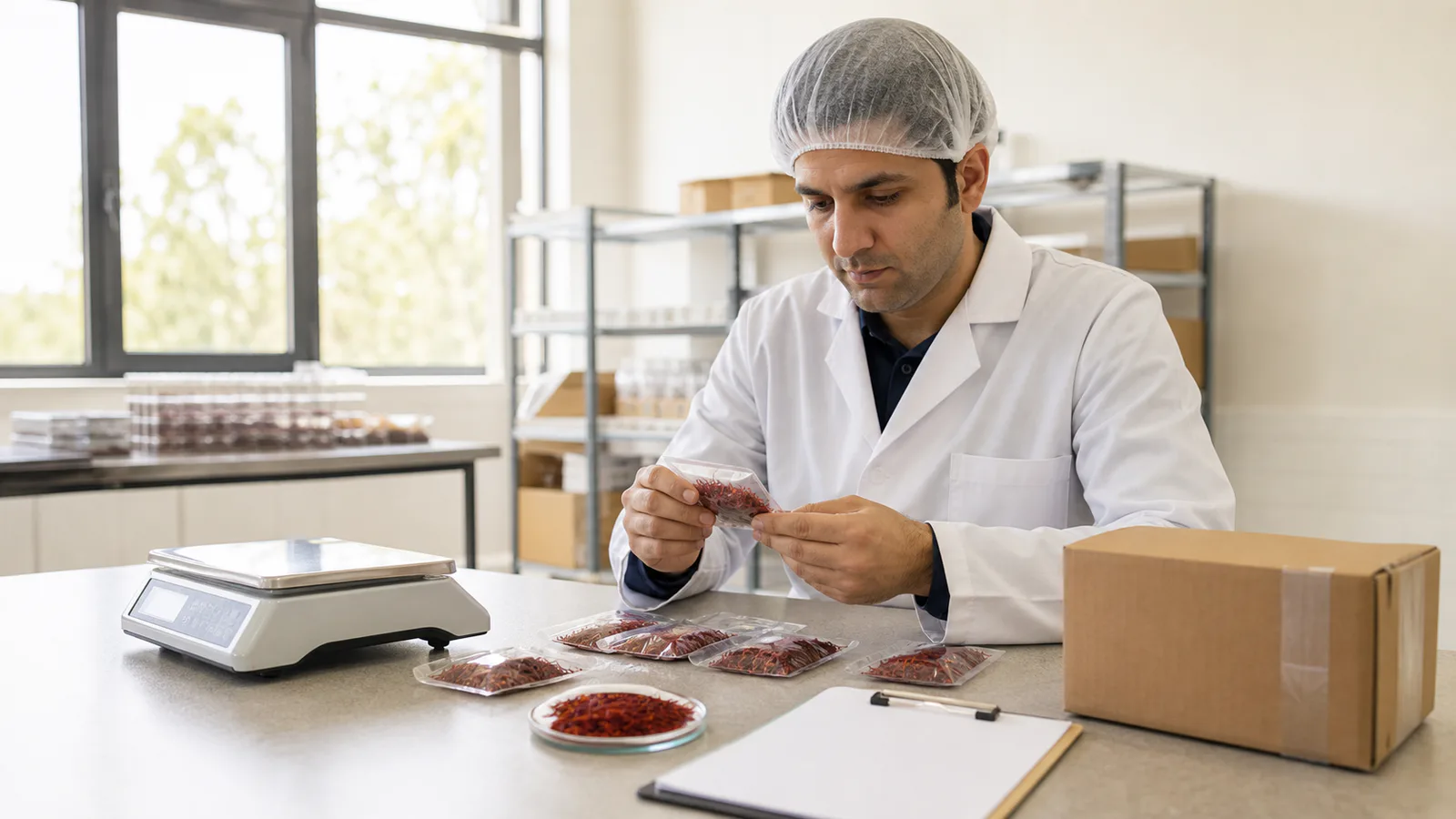
A professional pack can protect saffron from moisture, contamination, excessive light and avoidable handling. It can also carry the batch identity, net weight and supplier information a buyer needs. Those functions are more valuable than decoration alone.
For export, the pack must suit its destination. A retail jar, a food-service pack and a bulk ingredient shipment require different quantities, documents and labels. Exporters also need to distinguish the origin of the saffron from the country where it was packed or dispatched. Clear statements reduce confusion in markets where saffron passes through more than one trading centre.
How to verify an export-growth headline
A percentage without a base can hide more than it reveals. To assess a claim that saffron exports grew 21%, a reader should look for:
- the exact start and end dates for both comparison periods;
- whether growth refers to exported weight, customs value or both;
- the product code and whether the data cover saffron alone;
- the reporting country and partner coverage;
- revisions, missing quantities and any change in currency or valuation; and
- whether a few unusually large shipments explain the result.
The World Bank WITS and UN Comtrade records are useful for reported cross-border trade, but even official datasets require careful reading. A quantity can be absent while value is present, partner and world totals can be reported differently, and re-exporting countries may appear beside producing countries.
What the 2016 result did and did not prove
The first-quarter increase suggested that exports had moved in a positive direction after the named barriers were removed. It did not prove that lost markets had been fully recovered, that prices had stabilised or that transport and packaging problems were solved. Miri explicitly said improvement would be gradual.
For today’s reader, the value of the report lies in that fuller diagnosis. Administrative reform can open a door, but exporters still need dependable pricing, proportionate logistics, credible packaging and patient work with buyers. The 21% headline was one early measure. The long-term test is whether customers continue to choose, receive and reorder well-documented Iranian saffron.

![Exporting Saffron to Turkey + Price Guide [Complete 0 to 100]](https://img.rowhanisaffron.com/20260827003933/saffron-export-turkey-quality-inspection.webp)



