


Torbat Heydarieh saffron production was reported at an average of around 3 kilograms of dried saffron per hectare in an earlier local agriculture account. That number is a dated district benchmark, not a fixed biological limit: field age, location, corm condition, water timing and weather can move yields above or below it.
Where the 3-kilogram figure came from
The original report attributed the figure to Alireza Ghaderi, director of the Agriculture Jihad office in Torbat Heydarieh. He said the district averaged three kilograms per hectare and placed 9,200 of Khorasan’s reported 96,500 hectares of saffron in Torbat Heydarieh.
Ghaderi described the district as second in cultivated area after Zaveh County. The stored article did not include its reporting date or a link to the underlying statistics, so the acreage, provincial total and ranking should be read as a snapshot from that account rather than today’s official table.
Torbat-e Heydarieh is not one uniform growing zone
A district average combines fields with different elevations, soils, water access and ages. Cold, temperate and warmer parts of the wider production area do not flower at exactly the same time or produce identical yields.
That variation appears in field research. A study indexed by the FAO AGRIS research database examined the Rokh plain, Zaveh plain and central Torbat Heydarieh plain. It reported dry-stigma yields of 5.7, 3.35 and 4.1 kilograms per hectare respectively in the studied farms. Those values belong to that sample and its conditions, but they show why “Torbat-e Heydarieh yield” cannot be reduced to one permanent number.
The 9,200-hectare cultivation figure
The original article’s 9,200-hectare figure remains useful because a later report gave the same planted area. In October 2025, a local publication relaying an IRNA interview with Ghaderi again said the district had 9,200 hectares under saffron.
The dated 2025 account should still be interpreted carefully. Planted area is not necessarily the same as mature productive area, and a crop estimate should identify which fields contributed to the harvest total.
Modern irrigation covered 2,100 hectares
Ghaderi said 2,100 hectares of the district’s saffron fields had modern irrigation systems. The 2025 report repeated a figure close to 2,100 hectares, suggesting that the infrastructure detail was not merely a translation error.
Modern equipment does not guarantee efficient water use by itself. The benefit depends on system design, maintenance, pressure, water quality, application uniformity and timing. Saffron irrigation decisions also need to reflect soil moisture and the crop’s seasonal cycle rather than a fixed calendar applied to every field.
The reported 8,938 saffron growers
The earlier report counted 8,938 saffron growers in the district. It did not define whether this meant landowners, operators, household members or registered beneficiaries, and no later matching count was located during this review. The number is therefore retained as an attributed historical figure.
Grower count and planted hectares describe different things. One household may manage several plots, a plot may involve several family members, and seasonal workers may participate without being recorded as growers. Those categories should be separated in any updated economic assessment.
How saffron creates seasonal work
Ghaderi associated each hectare with about 200 person-days of labour. Harvesting flowers, transporting them promptly, separating stigmas and drying the crop all concentrate work into a short period, so the labour requirement is economically important even when it is not year-round employment.
The original article converted that estimate into one permanent job per hectare, or 9,200 permanent jobs, and said indirect employment was two to three times higher. A person-day total does not automatically equal a full-time annual job, and the report provided no method for the indirect multiplier. Those statements are best treated as the official’s economic framing, not independently verified job counts.
The harvest window runs from colder to warmer areas
The stored account said harvest begins around mid-October in colder areas and continues until the end of November. Ghaderi’s 2025 comments similarly described different timing across Rokh, the central district, Zaveh and Mahvelat.
Farmers still need to watch their own fields. Flower emergence responds to local temperature and moisture, and peak bloom can place heavy demand on pickers for several days. A district calendar is useful for preparation, but it cannot replace daily observation.
Why the average yield changes between seasons
Three kilograms per hectare can rise or fall because saffron yield reflects a chain of connected conditions:
- corm size, health, density and planting depth;
- field age and competition as daughter corms multiply;
- soil structure, drainage, fertility and salinity;
- water timing, application uniformity and rainfall;
- summer heat, autumn temperature and frost;
- pest, disease and rodent pressure;
- speed and care during flower collection; and
- stigma separation, drying and final moisture.
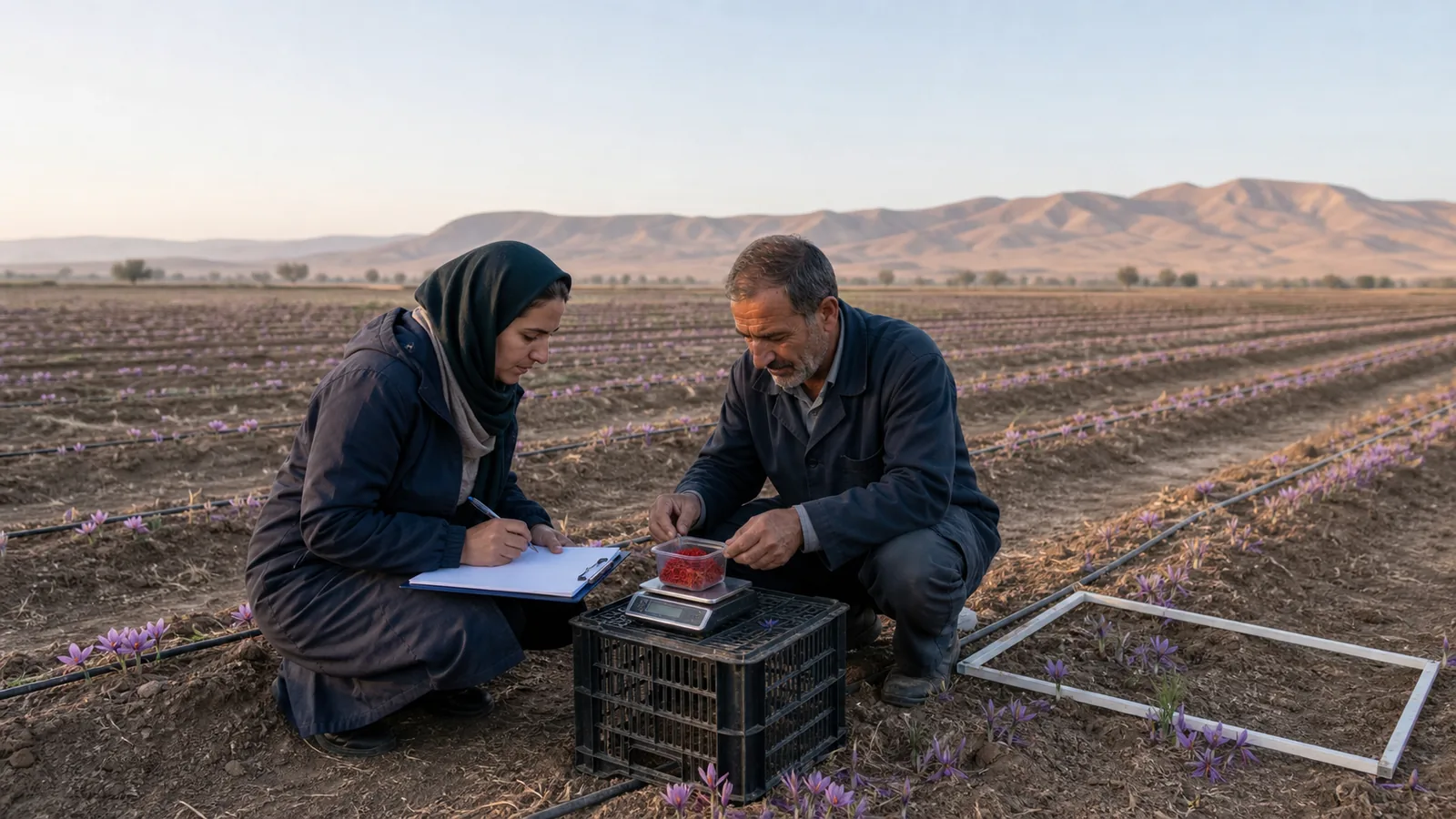
A grower can learn more by recording those variables alongside dry yield from the same measured area than by comparing one field with a district headline. Our guide to strengthening saffron corms explains why plant condition before flowering affects the next crop.
What the ten processing centres represented
The original report listed ten saffron processing centres and associated them with 60 tonnes of saffron and by-products annually. Its wording does not make clear whether 60 tonnes was incoming material, finished saffron, combined products or installed capacity.
That ambiguity matters. Fresh flowers, wet stigmas, dried saffron and floral by-products have very different weights. A current processing statistic should name the input or output, time period, operating capacity and actual throughput rather than present one unqualified tonnage.
Processing remains central to the district’s value chain. When flowers arrive, separation and drying must keep pace with the harvest. Clean handling, lot identity and controlled drying protect saleable quality; extra hectares without matching labour and facilities can create a bottleneck.
The unannounced government purchase price
Ghaderi said that the government’s saffron purchase price for “this year” had not yet been announced and that the provincial Agriculture Jihad organization was pursuing the issue. Because the original publication date is absent, that sentence must not be read as a statement about the current procurement season.
Any current purchase programme needs a dated official notice that identifies grade, delivery point, eligible sellers, testing, quantity limits and payment terms. A historical news article cannot provide a live price.
Liquidity and high harvest labour costs
The report identified limited cash and the cost of harvest and processing labour as major pressures on growers. These problems are connected: farms may need to pay pickers and processors before their dried saffron is sold, while holding inventory ties up money for longer.
Planning should use the expected peak-day labour requirement, not only total hectares. Written arrangements with workers, access to clean temporary storage, adequate separation and drying capacity, and clear buyer specifications can reduce last-minute decisions. Finance still needs terms that a farm can carry if yield or price is lower than expected.
How to compare yield fairly
A meaningful benchmark states dry saffron weight, productive hectares, field age, season and measurement method. It should also say whether the figure represents all registered farms, a sample, a forecast or the final marketed crop.
For Torbat Heydarieh saffron production, the headline’s “around 3 kilograms per hectare” preserves one reported average. Later accounts and field studies show other values. The careful conclusion is that the district is a major cultivation centre with real within-region variation—not that every hectare should produce the same amount.

![Exporting Saffron to Turkey + Price Guide [Complete 0 to 100]](https://img.rowhanisaffron.com/20260827003933/saffron-export-turkey-quality-inspection.webp)



