


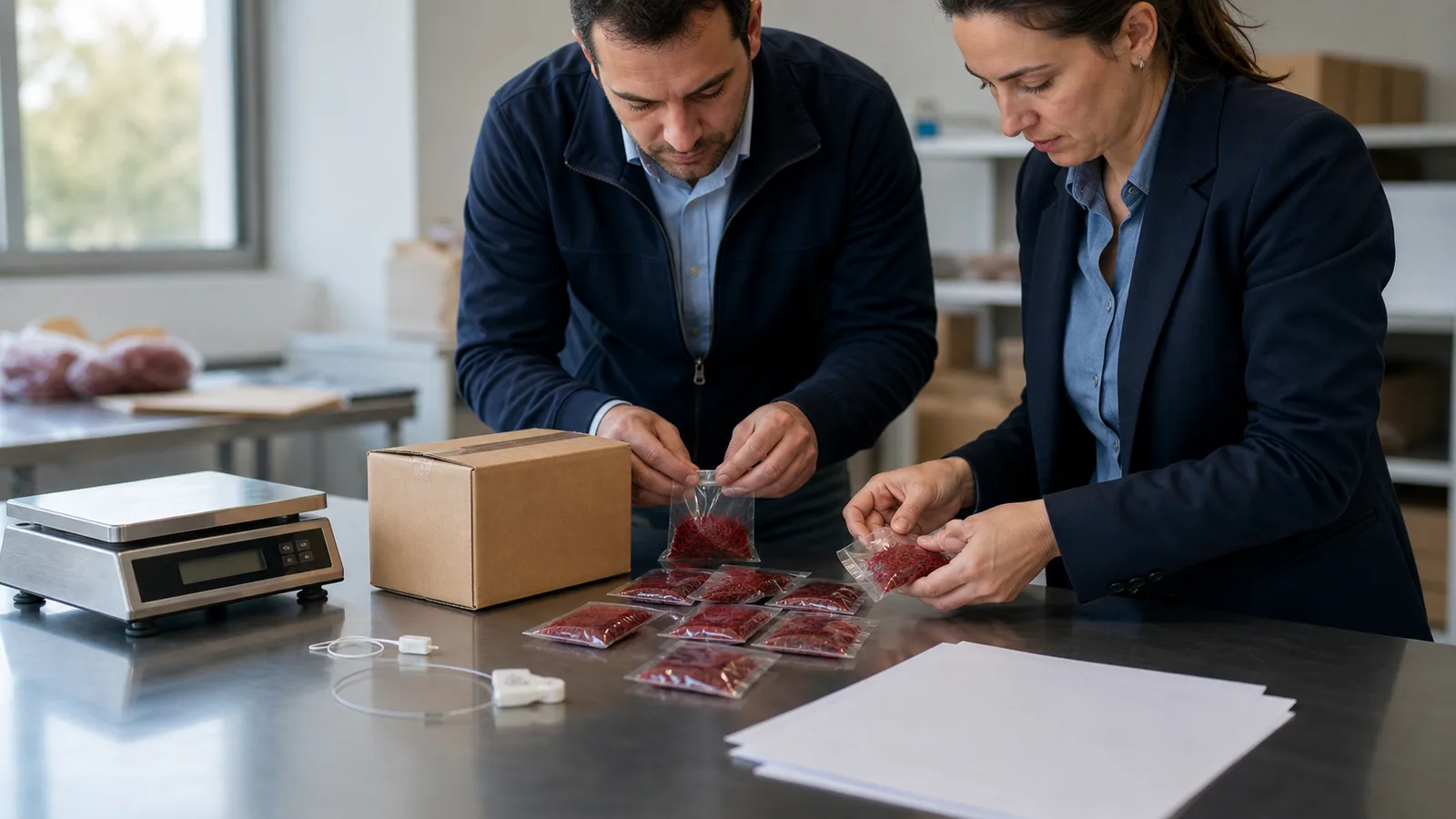
After roughly 15 years without a reported direct route, American buyers appeared again in an Iranian saffron export record. The shipment was tiny—about two kilograms—but its destination made it symbolically important. It suggested that a direct commercial channel had briefly opened during the sanctions-relief period associated with the 2015 nuclear agreement.
The archived ISNA-based report gave the cargo a value of about $4,600 in its opening line. A fuller companion version, however, recorded 7,895,000 tomans and an equivalent value near $2,682 for the same two-kilogram shipment. Because those values conflict, neither should be silently treated as exact. The weight and the fact that the packs were below 10 grams are the more consistent details.
This is a historical account, not a statement that Iranian saffron can be exported directly to the United States today. Current sanctions, customs, banking and counterparty requirements must be checked before any sale or shipment.
Why a two-kilogram shipment mattered
Two kilograms is negligible beside the 130–150 tonnes that the source said Iran exported in a year. Its importance lay in the route. During the preceding period, American demand was said to have been supplied through intermediaries in the United Arab Emirates and Spain.
An indirect route can be lawful, but it changes the commercial relationship. The original producer may not know the final buyer. Product can be repacked under a third-country commercial identity, and feedback about grade, packaging or documentation may not reach the Iranian supplier.
A direct order gives the two trading parties a chance to connect the specification, lot, documents and payment terms. It does not guarantee that the transaction is easier. The exporter still needs a lawful payment route, compliant packaging, reliable logistics and evidence that the buyer and other parties may participate.
The production and export context in the report
The article placed annual Iranian saffron production at approximately 250–300 tonnes and annual exports at 130–150 tonnes. Those were broad estimates from the period, not current figures and not a single customs-year total.
For the first nine months covered by the report, it listed 27 destinations: Germany, Jordan, Spain, Australia, Estonia, Afghanistan, the United Arab Emirates, Italy, France, the United States, Bahrain, Belgium, Taiwan, Turkey, Turkmenistan, the Czech Republic, Singapore, Kuwait, the Netherlands, Canada, Norway, Pakistan, China, the United Kingdom, Sweden, Saudi Arabia and Oman.
The list shows geographic reach, but it does not tell us how much each country bought or where consumers eventually used the saffron. Spain and the UAE, for example, can act as import, packing and re-export centres. A named destination is not automatically the final market or the origin later printed most prominently on a retail pack.
The announcement that came before the cargo
Mohammad Javad Rezaei, identified as head of the Saffron Export Development Fund, had announced that a first US shipment was expected after implementation of the Joint Comprehensive Plan of Action, commonly called the JCPOA. A related report said 20 kilograms were being prepared for dispatch the following week.
The later record of about two kilograms should not be converted into a claim that all 20 kilograms shipped. Preparation, order confirmation, licensing, payment and dispatch are separate milestones. The smaller recorded cargo may have been a first tranche or a different order; the archived material does not resolve that point.
This distinction is useful whenever an export story is assessed. An intention, a packed consignment, a customs declaration and a delivered shipment are not the same evidence. A credible timeline identifies which event the source actually documented.
What small packs imply
The report said the saffron was exported in packages below 10 grams. That suggests a retail, sample or specialist-food format rather than a single two-kilogram bulk container. It may also help explain why a simple dollar-per-kilogram comparison with bulk trade would be misleading.
Small packs add material, labelling and handling costs. They also need destination-compliant information and physical protection from moisture, heat, light and tampering. The commercial value comes from suitability for the buyer, not from decorative packaging alone.
Where Iranian origin is part of the offer, the pack should be supported by lot records. A country name on a label cannot replace documentation linking the threads to harvest, processing, testing and packing.
How to verify a historical export claim
A careful review would look for several independent records:
- a dated customs record with product code, weight, value and destination;
- the exporter’s invoice and packing list;
- transport and delivery evidence for the same consignment;
- the applicable authorisation or legal basis at that date; and
- a consistent explanation for any difference between announced and shipped quantities.
Official trade databases can help establish the broader pattern, but privacy thresholds and classification can hide a very small shipment. That is why an old news report may preserve details that are not visible in an annual public table. It is also why the conflicting $4,600 and $2,682 values should remain disclosed.
What changed after the 2016 opening
The policy setting did not remain fixed. In 2018, the US Treasury amended the Iranian Transactions and Sanctions Regulations and wound down an authorisation concerning certain Iranian-origin foodstuffs and carpets. The official Federal Register notice records that action and its dates.
The US Treasury continues to maintain an Iran sanctions programme. The rules may turn on the goods, owners, banks, carriers, currency, route and licences involved. This article cannot determine whether a proposed transaction is permitted.
Anyone evaluating a current shipment should screen every party, obtain current legal and customs advice, and document the decision before accepting money or moving goods. A route that opened during one policy period cannot be assumed to remain open.
What direct access could have changed for Iranian saffron
The original report argued that direct sales to Europe and America could improve packaging, product exchange and foreign-currency earnings. The durable part of that idea is the closer buyer relationship. Direct feedback can help an exporter understand preferred thread form, pack size, documentation and quality tolerance.
Yet directness is not a quality mark by itself. The shipment still has to be genuine, safe, traceable and consistent. Payment and delivery must work without exposing either side to unexamined risk. A strong commercial channel is built from repeated compliant deliveries, not the publicity around a first cargo.
The full sequence, including later reporting of 41 kilograms during the final 53 days of the year, is examined in our history of the first direct Iranian saffron export to the USA. The narrower record here is still worth preserving: after a long interruption, a small direct consignment put the United States back on a 27-market destination list. It was a sign of access at that moment, not a permanent route or a present-day permission.

![Exporting Saffron to Turkey + Price Guide [Complete 0 to 100]](https://img.rowhanisaffron.com/20260827003933/saffron-export-turkey-quality-inspection.webp)



