


“Saffron supply problems in Exchange solvent red gold” was the literal English headline attached to a 2015 report from Khorasan Razavi. Its underlying point was much clearer than the translation: a properly organised commodity exchange could make saffron trading more transparent, set measurable quality requirements and give farmers and buyers more confidence in each lot.
The report captured a moment when only a small share of the province’s crop was reaching the exchange. It also recorded the practical reasons for that slow start. Producers needed to understand the system, accepted saffron had to meet a defined standard, and promised incentives had not been funded. Those details still matter because an exchange is not a cure for every red gold market problem. It works only when grading, storage, documentation and participation work together.
What the original saffron exchange proposal was meant to solve
Mohammad Reza Ghodsi, then identified in the report as director of horticultural affairs at the Khorasan Razavi Agricultural Jihad Organization, described four expected benefits: clearer prices, quality assurance, stronger guarantees for both sides of a sale and less room for unlicensed intermediaries to dominate the market.
That is a different model from an informal sale in which a grower accepts the price offered by the nearest buyer. On an organised market, buyers can compare lots under shared rules. The seller can see bids rather than relying on one private quotation. Neither side is asked to trust a poetic label such as “red gold” or “red pearl saffron” on its own; the lot has to be identified and assessed.
Price visibility does not mean that prices stop moving. Harvest size, export demand, grade, moisture, storage conditions and the timing of a sale can all affect a saffron lot’s value. The advantage is that the basis of the transaction becomes easier to inspect.
Why farmers were slow to use the exchange
According to the archived ISNA report, the exchange had announced special admission arrangements for saffron, yet producer participation remained limited. During the previous year, only small quantities had been offered in 5, 10 and 15-kilogram consignments. Set against Khorasan Razavi’s production, the programme was still modest.
The report did not blame farmers for that hesitation. It described a system that was still being introduced. Meetings were planned in saffron-growing counties so brokers could explain how admission, quality checks and sales worked. An incentive programme for producers had also been discussed, but it was not implemented because funding was unavailable.
That distinction is important. A new sales channel can look attractive on paper while remaining difficult to use from a village. Farmers need to know where a lot will be delivered, how it will be sampled, what documentation is required, when payment is made and what happens if the product does not meet the stated grade. Without clear answers, low participation is a reasonable response.
Quality is the bridge between the farm and the market
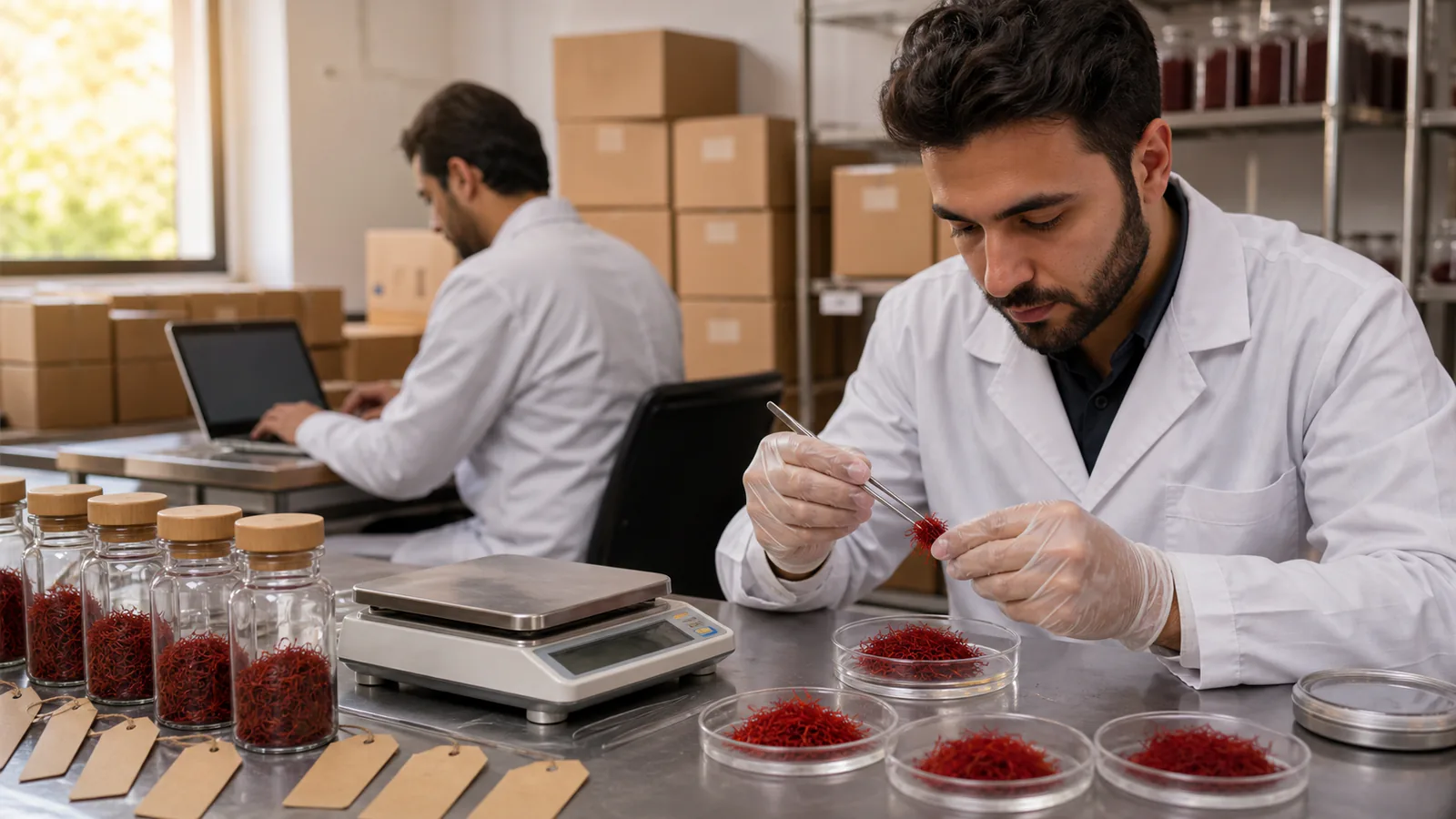
A saffron exchange cannot trade a vague promise of “good saffron.” Each accepted lot needs a consistent description. Threads that differ in stigma content, moisture, foreign matter, aroma and colouring strength should not be presented as interchangeable.
The original report said infrastructure and adequate product quality were prerequisites for exchange supply. In practice, that makes several steps part of the same chain:
- harvesting flowers promptly and separating the stigmas carefully;
- drying saffron without scorching it or leaving excess moisture;
- protecting the dried threads from humidity, light, odours and contamination;
- sampling and grading a lot consistently;
- using records that connect the submitted product to its owner and origin; and
- storing accepted lots under controlled conditions until sale and delivery.
For a closer look at the measurements behind commercial grades, see our guide to Iranian saffron standards. The exchange, wholesale and export routes are compared separately in Selling Saffron: Commodity Exchange, Wholesale and Export.
The related UNIDO training project
The second half of the 2015 report concerned a broader development programme involving the provincial agricultural organisation, Agricultural Bank and the United Nations Industrial Development Organization (UNIDO). It described a four-year, $2 million plan intended to support sustainable saffron farming and reduce pressure for rural-to-urban migration.
In its first reported stage, 17 experts worked across 13 counties. Farmers received instruction covering planting, field care and harvest, while the experts gathered information about local climate, geography and population. The surviving English translation garbled one institutional sentence, so it should not be read as saying that a provincial agricultural body was a “shareholder” in UNIDO. What can be verified is that UNIDO published a diagnostic study and a village-level analytical report for its saffron production efficiency work in Iran.
The UNIDO saffron value-chain study explains why training and market reform belonged together. It describes a sector dominated by small farms, concentrated in the Khorasan provinces, with weaknesses in productivity, post-harvest handling, marketing and coordination. Its figures are historical rather than current market statistics, but they provide primary-source context for the programme described in the news report.
What an effective saffron exchange still depends on
The exchange proposal addressed a real imbalance: growers often carried the production risk while other actors controlled information and access to buyers. A visible market can narrow that gap, but it cannot do so by trading alone.
Rules farmers can use
Admission requirements need to be written in practical language and explained before harvest. A farmer should be able to estimate whether a lot qualifies and what preparation will cost. Training is most useful when it follows the product all the way from the field to sampling, storage and settlement.
Independent grading and trustworthy storage
Buyers need confidence that the saffron delivered matches the lot they purchased. Producers need assurance that samples are taken fairly and that accepted stock will not be damaged or mixed. The warehouse and testing process therefore matters as much as the trading screen.
Enough participation to reveal a meaningful price
A handful of small consignments cannot represent an entire province. The more comparable lots and serious buyers take part, the more useful the price signal becomes. That does not guarantee a high price; it makes the market’s judgement more visible.
A choice, not a forced channel
Some growers will still prefer direct contracts, cooperative marketing or a trusted wholesaler. The useful question is whether the exchange gives them another credible option. Competition between channels can itself improve service, information and accountability.
Why this historical report remains useful
The awkward original headline hid a practical lesson. Saffron’s reputation as red gold does not protect a farmer from opaque pricing, inconsistent grading or a weak route to market. Those problems are solved through unglamorous work: common specifications, reliable handling, clear records, accessible training and buyers willing to compete for well-described lots.
The 2015 proposal was therefore less about moving saffron onto a new sales website than about building trust around the product. The exchange could help, but only after the crop had been prepared, assessed and documented well enough for an unknown buyer to purchase it with confidence.
Sources and historical context
- The archived 2015 ISNA report reproduced in the original version of this post, including its statements attributed to Mohammad Reza Ghodsi.
- UNIDO, Saffron Industry Value Chain Development in Iran: Diagnostic Study Report.
- UNIDO, Saffron Production Efficiency Improvement Project: Analytical Report on the Status of the Target Villages.

![Exporting Saffron to Turkey + Price Guide [Complete 0 to 100]](https://img.rowhanisaffron.com/20260827003933/saffron-export-turkey-quality-inspection.webp)



