


Iranian saffron exports were producing too little value at home when the crop left the country in bulk and was repackaged or re-exported through markets such as the UAE, argued former MP Abolqasem Khosravi. In the two historical interviews consolidated here, he called for better packaging, transparent exchange trading, direct legal exports under Iran’s name, farmer support, and a national saffron fund. His figures and revenue projections were political estimates rather than audited outcomes, but they capture a longstanding question: how can growers and Iranian exporters retain more of the value created after harvest?
The criticism of Iranian saffron exports through the UAE
Khosravi represented Torbat Heydarieh, Zaveh, and Mahvelat, three important saffron-producing areas in Khorasan Razavi. He criticized a trade pattern in which Iranian saffron reached global customers through the United Arab Emirates and other intermediaries rather than through direct Iranian branding and distribution.
The old translation is difficult to read, but the policy point is clear. Iran supplied the crop and absorbed the agricultural risk, while traders elsewhere could capture part of the margin through sorting, packaging, branding, and resale. Khosravi wanted government and private industry to take export organization more seriously so a small group of intermediaries could not exercise the same influence over prices.
This article preserves that historical argument; it does not claim that every UAE saffron shipment contained Iranian material or that the same trade pattern describes today’s market. Readers seeking broader commercial context can consult our overview of saffron exports.
Production had reportedly fallen 30–50%
In the destination report, Khosravi said saffron production in Khorasan Razavi had declined by roughly 30% to 50%. He associated the loss with successive drought, high heat, severe cold, and reduced rainfall. Farmers had reported lower harvests even in fields that received early irrigation.
He said agricultural agencies, universities, and the saffron research institute were examining the causes. That distinction is important: the weather factors were his working explanation, while the investigation was intended to identify the main cause more carefully.
Khosravi asked the government and Ministry of Agriculture to treat the situation as serious crop damage and support affected growers. He argued that a strategic export product could not remain viable if farmers carried the full cost of repeated weather losses while receiving little protection from unstable markets.
The $350 million and fivefold-earnings claim
The related interview added scale to Khosravi’s case. He placed Iran’s annual saffron production at about 250 tons, with roughly 200 tons coming from Khorasan Razavi. He also said bulk sales through dealers generated around $350 million.
Khosravi estimated that proper packaging and direct legal export under Iran’s name could lift earnings to approximately five times that amount. This was an advocacy projection, not a documented fivefold result. Packaging alone cannot guarantee such an increase: grade, quality testing, destination demand, contracts, tariffs, exchange rates, logistics, and the strength of the seller’s distribution network all affect the final value.
Even with that caveat, his underlying distinction is useful. Export weight measures how much saffron crosses a border; export value measures the revenue attached to it. A market can sell the same weight at a higher average value when it consistently grades the product, protects authenticity, uses suitable packaging, and reaches buyers through stronger commercial channels.
Why Khosravi wanted a saffron exchange
Both interviews called for an Iranian or international saffron exchange. Khosravi argued that a country responsible for most world production should play a larger role in price discovery and the organization of supply and demand.
One translated passage presents this as a rule of international law when a country produces more than half of a commodity. That should not be repeated as a legal fact. It is better understood as Khosravi’s policy argument for locating a leading saffron marketplace in Iran.
A well-run commodity exchange can standardize contract terms, make grades more comparable, record transactions, and improve price transparency. It does not automatically remove volatility or guarantee growers a particular return. Physical inspection, trusted laboratories, warehousing, enforceable contracts, and participation by credible buyers and sellers are still required.
Packaging and private investment were part of the plan
Khosravi said some export facilitation and private investment in packaging facilities had begun, but believed the sector remained far from offering enough Iranian saffron as a finished, clearly identified product.
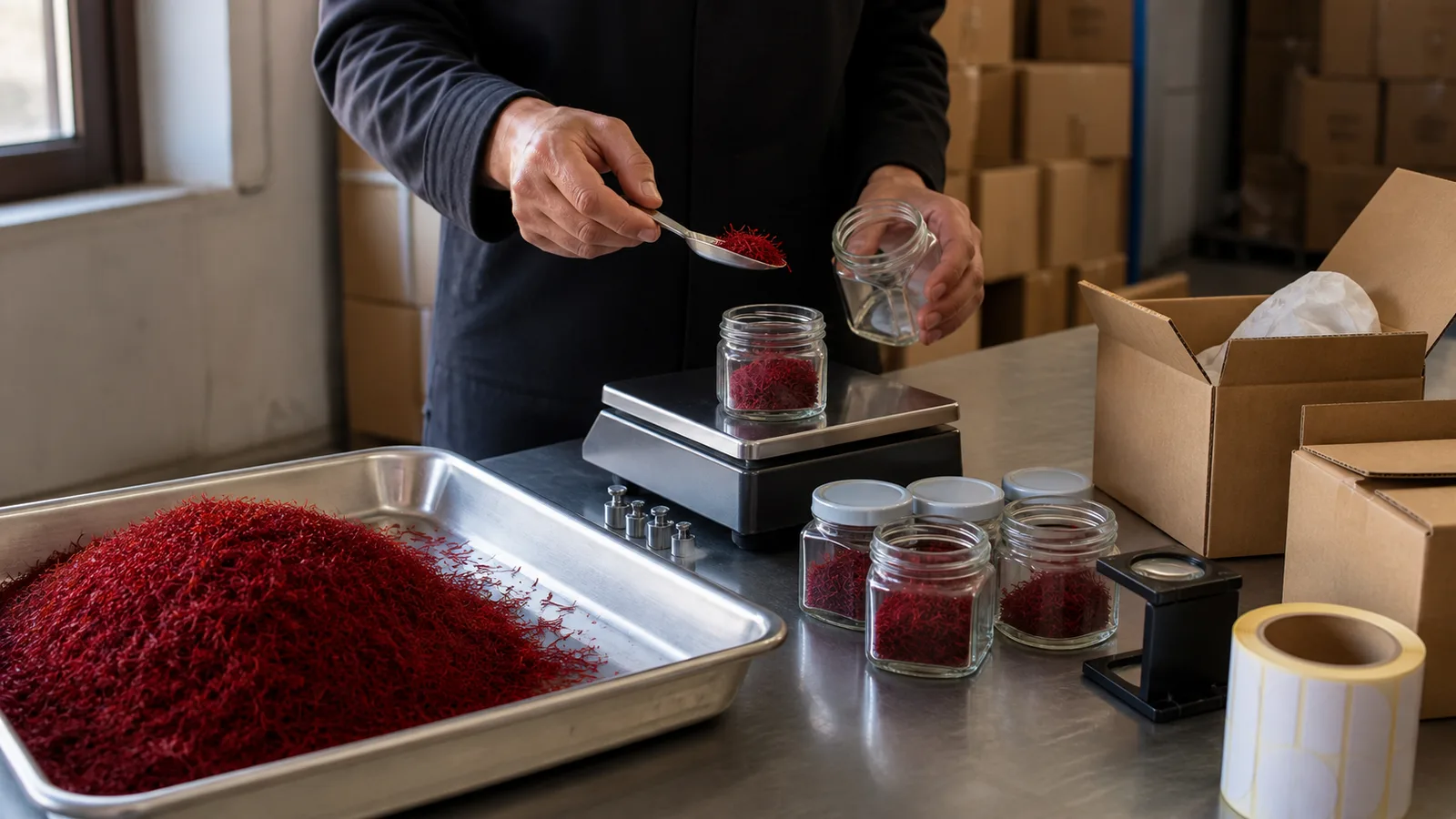
Packaging has several jobs in this context. It protects the spice from light, moisture, contamination, and physical damage; gives buyers a traceable grade and net weight; and creates space for the producer or exporter’s identity. It is not a substitute for quality. A polished box cannot rescue weak, adulterated, or poorly stored saffron.
Market prices also change over time, so the historical dollar and production figures above should not be used as current quotations. The site’s current saffron price page is the appropriate place for up-to-date pricing context.
More than 20,000 households depended on the crop
Khosravi said saffron supported more than 20,000 households across Torbat Heydarieh, Zaveh, and Mahvelat. The source translation incorrectly places these areas in South Khorasan; they are in Khorasan Razavi.
The household figure broadens the argument beyond export revenue. Saffron connects field preparation, corm management, picking, stigma separation, drying, grading, packaging, transport, and sales. When farm output falls or dealers capture an outsized share of the margin, the effects reach a regional network of seasonal labor and family businesses.
The source also contains cultivated-area figures rendered as 62 hectares for Iran and 21 hectares for Torbat, alongside a claimed 75-ton local output. Those area numbers have plainly lost scale in translation and are not reliable enough to repeat as facts. The 250-ton national and 200-ton Khorasan Razavi production estimates are retained because they are internally intelligible and central to Khosravi’s value-chain argument.
The proposed national saffron fund
To reduce the influence of short-term speculators, Khosravi proposed treating saffron as national capital and creating a dedicated fund for the sector. The reports do not provide enough operational detail to judge how the fund would have been financed or governed.
Any such mechanism would need clear rules: who can participate, how grades are verified, whether funds support crop finance or price stabilization, how conflicts of interest are controlled, and how growers receive payment. Without those safeguards, a new institution could simply add another intermediary.
What the two interviews establish
Taken together, the reports describe a historical policy program rather than a completed reform. Khosravi wanted weather-hit farmers supported, more saffron packaged and exported directly under Iranian names, a transparent exchange for trading, and a national fund capable of limiting speculative pressure.
His fivefold revenue estimate should remain an attributed ambition. The stronger conclusion is more practical: Iran retains more value when credible grading, protective packaging, traceability, market information, finance, and direct buyer relationships develop alongside production.

![Exporting Saffron to Turkey + Price Guide [Complete 0 to 100]](https://img.rowhanisaffron.com/20260827003933/saffron-export-turkey-quality-inspection.webp)



