


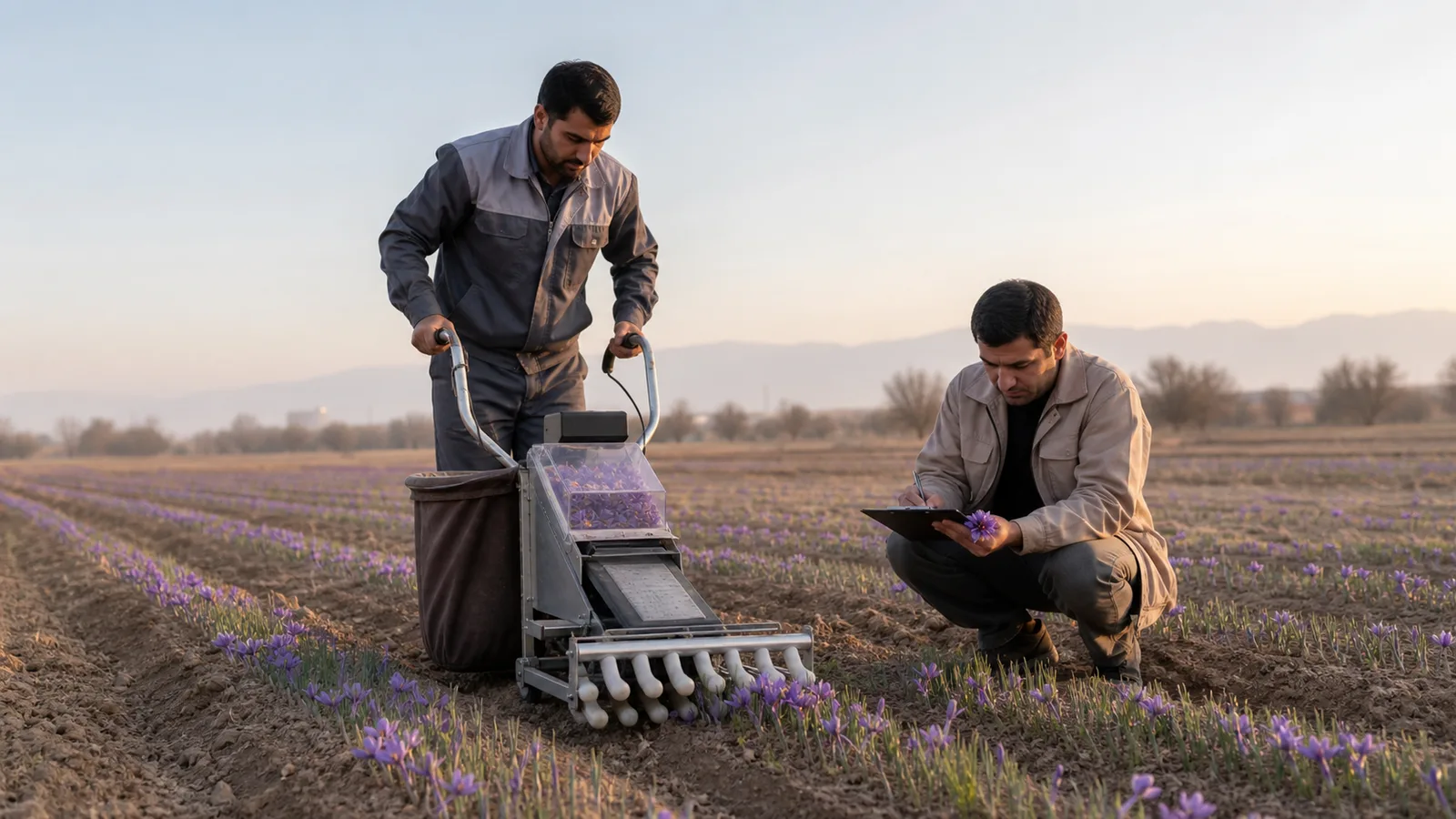
The unveiling of the new technology of mechanized production line safran was a short conference announcement about three separate parts of saffron work: collecting flowers in the field, separating the red stigmas from each flower, and drying those stigmas into the finished spice. The word safran is preserved in the historical title and URL; in English, the crop and spice are saffron.
According to the Khorasan service of the Iranian Students News Agency (ISNA), Dr. Ali Akbar Moayedi, then head of the Khorasan Razavi Agriculture and Natural Resources Research Center, said the equipment would be shown at a national conference on harvest and post-harvest technologies. The notice described a portable saffron flower harvester and a mechanized processing line containing a stigma separator and dryer. It did not report test results, a manufacturer, a model number or commercial availability.
This article keeps the 2015 announcement intact while asking the question an unveiling could not answer: what evidence would a grower or processor need before trusting the machinery with a short, valuable harvest?
What the mechanized safran announcement included
The National Conference on Modern Technologies for Harvesting and Post-Harvest Agricultural Products was scheduled for 29 and 30 Bahman 1393 at the Khorasan Razavi research center. Those Persian-calendar dates correspond to 18 and 19 February 2015. The former English version called them “29 and 30 February,” dates that do not exist in the Gregorian calendar.
The center organized the event with the Agricultural Engineering Research Institute, Khorasan Razavi Agriculture-Jahad Organization, the provincial agricultural training center, the Agricultural Mechanization Development Center, and the Agriculture and Natural Resources Engineering Organization.
Moayedi said the programme would cover the role of mechanization in reducing losses and raising efficiency, precision agriculture, sensors in harvest and post-harvest work, modern sorting machines, and commercialization of new technology for field and orchard crops.
The planned demonstrations were broader than saffron. The equipment list also included a three-row self-propelled combine, a cotton stripper and a self-propelled cotton picker. For saffron, however, the notice identified two distinct systems: the portable flower-harvesting machine and the post-harvest separation-and-drying line.
A production line is a sequence, not one miracle machine
The phrase “mechanized production line” can suggest that whole flowers enter at one end and retail-ready saffron leaves the other. The announcement supports a narrower description. It named a separator and a dryer, while the portable field harvester was listed separately.
A complete working sequence would therefore have at least three hand-off points:
- Flower collection: detach or gather open saffron flowers without excessive soil, leaf material or bruising.
- Stigma separation: isolate the three red stigmas from petals, stamens and unwanted portions of the style.
- Drying: remove moisture evenly while preserving the characteristics used to assess the finished spice.
Speed at one stage is useful only if the next stage can accept the flow. A fast harvester can overload separation. A fast separator can still deliver mixed or damaged material. A dryer can become the bottleneck if trays, airflow or temperature are not matched to the incoming crop.
What a portable flower harvester has to do in the field
Saffron flowers sit low among narrow leaves and emerge over a short season. Field conditions vary from row to row: flower height, opening stage, density, soil surface and moisture all change what a tool encounters. “Portable” says something about how the machine is carried or moved; it does not mean autonomous or universally suitable.
A useful trial should count more than flowers collected per hour. It should record flowers missed, flowers damaged, leaves or soil gathered, operator time, collection losses and any injury to the plant or corm system. The comparison should use the same field, time window and flower condition for mechanized and hand-picked samples.
Published engineering work shows why performance cannot be assumed. A field study of mechanical harvesting and airflow separation reported different flower-picking success rates across the device’s operating cycles, while two separation configurations damaged a substantial share of stigma filaments. Those results concern that experimental system, not the Iranian machine announced at the conference, but they show which kinds of losses a credible trial should reveal.
Stigma separation needs precision as well as throughput
Each flower contains a small amount of valuable red material surrounded by much larger petals and other floral parts. A separator has to recover the stigmas while limiting yellow style, stamens, petal fragments, dust and broken threads. A kilogram-per-hour figure cannot describe that result by itself.
Different designs solve the problem in different ways. Airflow systems use differences in the aerodynamic behaviour of flower parts. Cutting systems first orient or image each flower, choose a cutting point and then separate the wanted portion mechanically. One peer-reviewed automated saffron-flower cutting prototype used machine vision to locate the cut and reported a higher cutting rate than the traditional hand method under its test conditions.
That research establishes technical plausibility, not a universal performance claim. Flowers outside the tested size and condition, poor feeding, incorrect orientation or an imprecise cut can change the output. A processor should inspect both the recovered saffron and the rejected stream; valuable stigmas lost with the petals are as important as contamination carried into the product.
Drying determines whether the recovered stigmas become good saffron
Fresh stigmas are not yet shelf-stable spice. Drying changes their moisture and influences the colour, aroma and taste compounds that buyers expect. A mechanized line therefore needs control over loading depth, temperature, airflow, time and the drying end point.
An open-access review of saffron drying conditions describes how post-harvest method and temperature affect the product’s principal characteristics. It does not test the conference dryer, but it supports a simple procurement rule: a dryer should be judged by the finished batch, not by heat or speed alone.
Useful records include starting and final weight, final moisture, loading pattern, cycle time, energy use, temperature history and representative quality testing. Unevenly loaded trays can produce a batch with dry and damp zones even when the average reading looks acceptable.
The minimum evidence missing from the unveiling
The conference notice established that the machines were due to be presented. It did not establish that they entered production, remained available, lowered costs or improved saffron quality. No capacity, recovery rate, breakage rate, moisture result, energy figure, labour comparison or purchase price appeared in the source.
Before relying on a similar line, a grower, cooperative or processor should ask for a witnessed run using representative flowers. A useful test record would include:
- input flower weight and condition;
- clean stigma recovered and stigma lost in rejects;
- petal, stamen, style and foreign-material carryover;
- whole versus broken thread percentage;
- throughput, labour, cleaning time and stoppages;
- energy use and drying uniformity;
- and a quality comparison with a carefully prepared hand-processed control.
The result should be reported for more than one batch. Saffron flowers change during the harvest, and a demonstration with selected material may not represent a busy processing day.
When mechanization makes economic sense
The most obvious benefit is relief during the brief period when many flowers must be collected and processed quickly. Yet ownership is not the only model. A machine used for a few weeks a year may make more sense as a cooperative asset or mobile service, especially when small farms cannot keep it productive outside the saffron season.
The calculation should include operators, maintenance, cleaning, spare parts, storage, transport between farms and losses during setup. It should also value the product recovered, not only the hours saved. A cheaper process is not an improvement if it sends intact red stigmas into the waste stream or delivers unevenly dried saffron.
A later Rowhani Saffron report describes a different case of saffron flower processing technology. The reports do not identify a shared manufacturer or model, so the later device should not be treated as proof that the 2015 conference line was commercialized.
The conference dates and registration are historical
The old notice said the electronic conference secretariat at kanrrc-congress.ir was ready to receive papers and registrations. It gave a submission deadline of 15 Dey 1393, equivalent to 5 January 2015. Both the deadline and the February conference have long passed; the former secretariat must not be used as a current sales, registration or technical-support contact.
The preserved record is still useful. It shows that Khorasan Razavi researchers were presenting flower collection, stigma separation and drying as connected mechanization problems, alongside sensors, sorting and commercialization. It does not show that one machine solved every stage.
That is the sound way to read the unveiling of the new technology of mechanized production line safran today: as a dated announcement of a promising workflow, followed by the practical questions that determine whether such equipment protects labour, yield and saffron quality in real use.

![Exporting Saffron to Turkey + Price Guide [Complete 0 to 100]](https://img.rowhanisaffron.com/20260827003933/saffron-export-turkey-quality-inspection.webp)



