


“Afghans Risk for Iranian Saffron” is the original translated headline of a historical industry report. Its useful subject is competition between Iranian and Afghan saffron; its nationality-based wording is not a sound way to describe that competition. Afghan farmers are not the danger. The risk for any established producer is failing to improve yield, handling, traceability and market trust while another origin invests in them.
The figures in the report belong to the early-to-mid 2010s and are retained as a dated snapshot. They are not current production or export statistics. Used carefully, they show what Iranian industry leaders believed needed to change in Khorasan Razavi.
The historical productivity concern
The report described Khorasan Razavi as having more than 60,000 hectares of saffron and about 78% of Iran’s planted area at the time. It put average local dry-saffron yield at 3.5 kilograms per hectare, then contrasted that figure with claims of 10–12 kilograms per hectare in Afghanistan.
Gholamhossein Shafe’i, then quoted as chair of Iran’s National Saffron Council, also said Afghan cultivation covered about 650 hectares with an average near 10 kilograms per hectare. He referred to Afghan saffron receiving a leading quality recognition in 2013 and argued that Iran could not rely on market dominance alone.
These comparisons were advocacy figures, not a controlled farm study. Yield varies with field age, corm density and health, soil, irrigation, weather, management and what acreage is included in the denominator. Comparing one country’s average with selected high-performing farms in another would be misleading. The legitimate question is whether each farm can improve a measured baseline without sacrificing quality or exhausting its resources.
What the quality-improvement plan tried to change
The Khorasan programme joined field training with supervised processing. According to Ali Hosseini, a National Saffron Council board member associated with the work, farmers were taught cultivation, harvest and post-harvest practices step by step, then connected to processing stations intended to protect quality.
The report said pilot work began around 1390 in the Iranian calendar, with wider farmer participation in 1391. It credited the programme with lifting some fields from 3.5 kilograms per hectare toward 10–12 kilograms. It also said three to five tonnes of saffron would be handled through the project in the reported season.
Another translated claim says the dry saffron recovered from a kilogram of flowers rose from 9–13 grams to 15–17 grams. That metric is plausible as a stigma-to-flower recovery measure, but the old source does not describe sampling, moisture or grading. It should be treated as a programme claim, not a universal conversion rate.
Quality is measured, not declared by country
The old report said project saffron had stronger crocin readings, was free of contamination and could earn up to 30% more than traditionally handled product. Absolute wording such as “free of any contamination” requires batch-level laboratory evidence; no national or project label can guarantee it automatically.
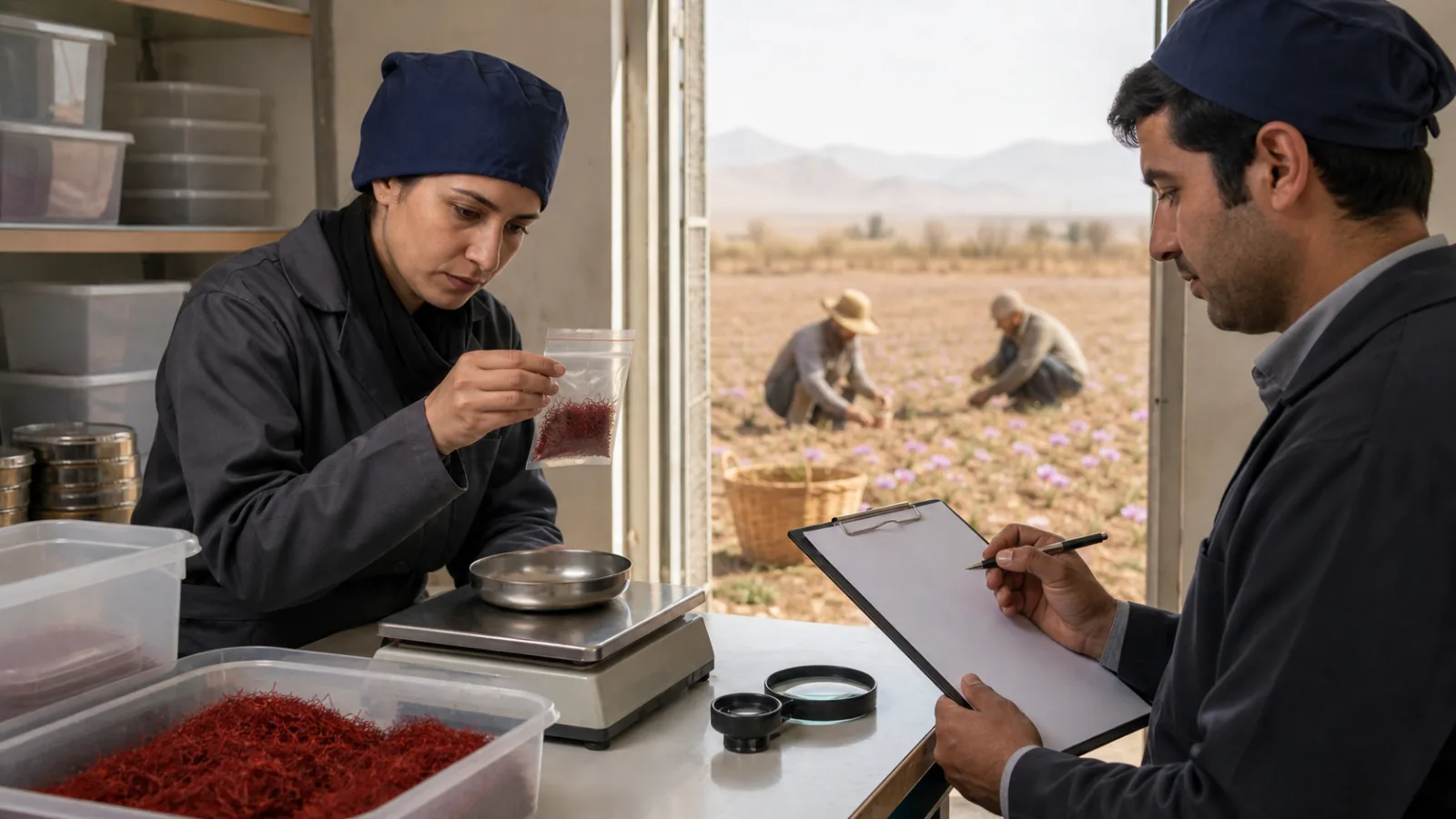
Modern quality control measures colour, aroma-related and bitterness-related characteristics, alongside moisture, foreign matter and safety checks. Research can also use chemical composition and stable-isotope patterns to investigate geographic origin. These tools make competition more constructive: a seller can support a grade and origin with evidence rather than a claim that one nation’s saffron is inherently superior.
The site’s article on the saffron quality and production plan in Ghaenat gives another local example of this field-to-processing approach.
Processing stations and a 15-digit identity code
Hosseini reported that 30 village processing stations had been established in saffron-growing parts of the province. Packages prepared under supervision were meant to carry an origin seal and a 15-digit producer identity code linking the saffron to a village, farm and grower.
That idea is stronger than decorative packaging. A useful traceability system records who produced a lot, where it came from, when it was harvested and processed, what transformations occurred, and which test results belong to it. A printed number adds little if the underlying records cannot be checked.
The original translation calls this a “genetic” registration issue in places. The surrounding context is provenance, national identity and brand protection, not genetic modification. Those concepts should not be confused.
Afghanistan built a real saffron value chain
Afghanistan’s development was not merely a lower-cost challenge. Its Ministry of Agriculture described a national programme built around suitable agro-ecological areas, farmer training, demonstration plots, corm distribution, processing centres, laboratory quality control, branding and export markets. FAO has also documented saffron enterprises in Herat and their role in rural livelihoods.
That is precisely why dismissing Afghan saffron would have been a mistake. Investment in skills and processing can improve any origin. Iranian producers can respond through better farm records, healthy corms, efficient harvest organisation, controlled drying, laboratory documentation and direct relationships with buyers—not by attacking neighbouring growers.
The scale of Iran’s historic position
The report estimated world saffron production at 280 tonnes and Iran’s share at 230 tonnes. It said Khorasan Razavi farmers had harvested about 200 tonnes from more than 60,000 hectares in the preceding season. Khorasan customs were reported to have exported 130 tonnes worth $400 million in the prior year, followed by 39 tonnes worth $56 million in the first six months of the reported year.
All of those numbers need their historical context. Production and customs data can use different periods and scopes, and customs location is not necessarily the same as farm origin. They still explain the urgency felt by local leaders: saffron represented a large share of agricultural value and non-oil exports.
The article also claimed saffron supported 23% of provincial employment, contributed 13% of agricultural production value, and created one permanent job per hectare in a province described as 75% desert. Those statements are not accompanied by a method, so they are preserved only as period estimates. What can be said more confidently is that saffron brings concentrated seasonal work and cash income to many Khorasan households.
A stronger response than fear of competition
Iranian saffron does not need protection from Afghan farmers; it needs protection from preventable weaknesses. The old report identified several of them despite its overheated language:
- low and uneven field productivity;
- traditional handling that can reduce quality after harvest;
- insufficient processing capacity and programme funding;
- weak links between a package and the producing farm;
- limited proof of origin and quality in export markets; and
- overconfidence created by a historically dominant market share.
The answer is a verifiable product. Farmers should be paid for measurable quality; processors should keep lot integrity; exporters should document grade and origin; and industry bodies should build a reputation buyers can audit. Competition then becomes pressure to improve rather than a reason to assign blame.
Sources and date boundaries
- The original Rowhani Saffron article, attributed to a Mehr/Tabnak report from the early-to-mid 2010s, supplied the Iranian programme, production, export, employment and speaker figures. Its damaged or absolute claims remain qualified.
- Afghanistan’s Ministry of Agriculture describes the structure and recorded results of its National Saffron Development Program.
- FAO’s Herat saffron value-chain account documents processing, enterprise and livelihood development.
- Peer-reviewed research on chemical quality evaluation and geographic-origin traceability shows why laboratory evidence is more useful than country-level quality slogans.

![Exporting Saffron to Turkey + Price Guide [Complete 0 to 100]](https://img.rowhanisaffron.com/20260827003933/saffron-export-turkey-quality-inspection.webp)



