


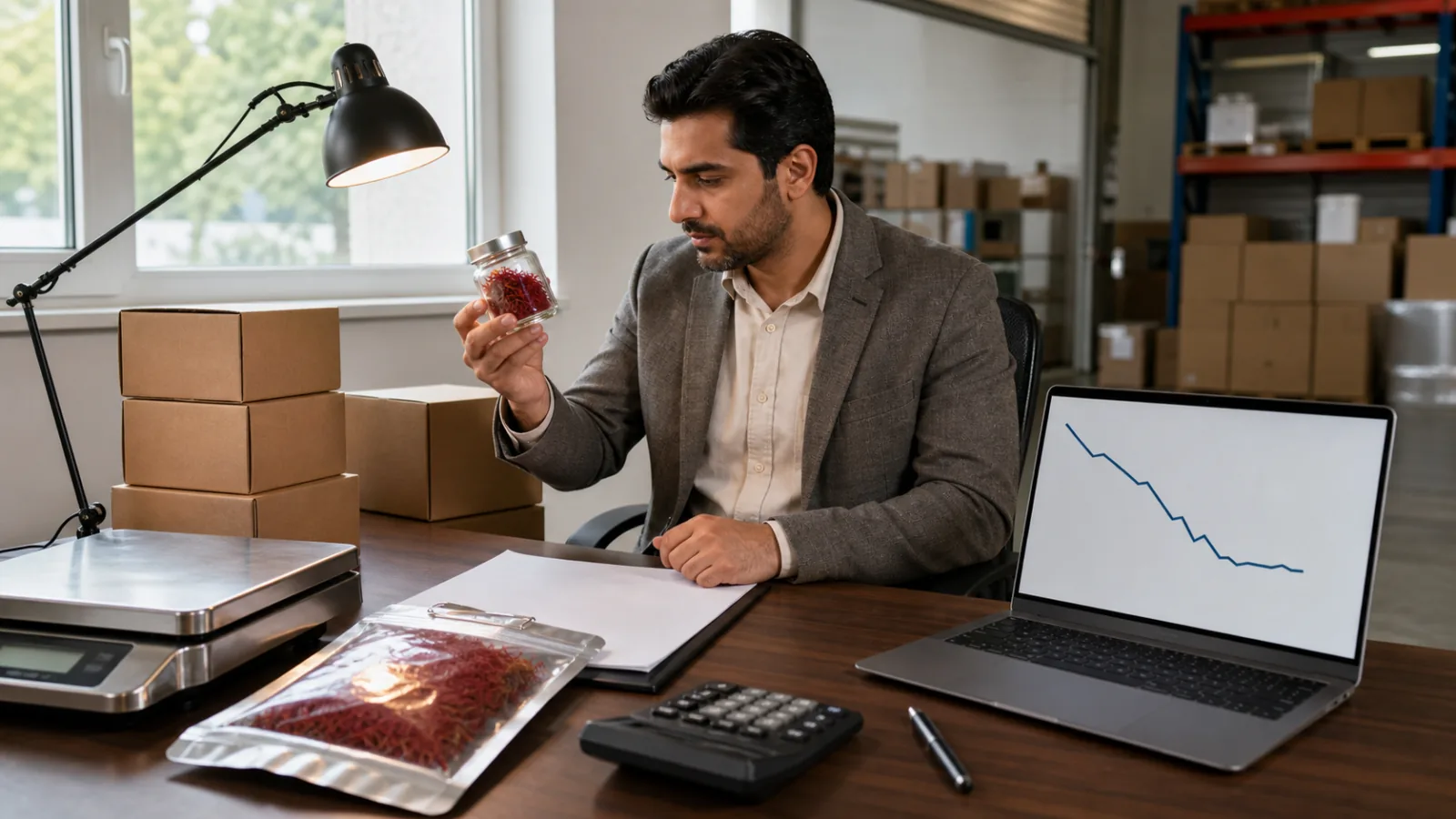
“Extreme price drop for export saffron” records a historical market dispute, not today’s saffron price. The report said an indicative export figure had fallen from €2,700 to €1,200, a decline of roughly 56% when calculated from those two numbers. Its stated 53% fall does not quite match the arithmetic, and the underlying period, grade, shipment terms and data series were not supplied.
That uncertainty does not make the report useless. It shows the tension among three different prices: what an overseas buyer pays, what an exporter receives after costs, and what a farmer receives in Iran. Those amounts can move differently, so “the saffron price” is never a complete description by itself.
What the historical export-price report claimed
The article attributed the €2,700-to-€1,200 comparison to Saeed Ghaffarzadeh, identified as a vice-president of a saffron exporters’ association. He argued that Iranian growers could continue producing at lower prices even as export margins narrowed.
It also quoted Ali Hosseini of the South Khorasan Saffron Producers and Exporters Association. His position was that lower prices reduced Iranian farmer profit but also made production less attractive to competing origins. Afghanistan was the main competitor discussed. According to the report, Afghan cultivation had expanded when saffron was worth about €4,300 per kilogram, while a much lower market price weakened the incentive to plant.
These are attributed industry opinions from the period. They should not be read as a current cost study for either country. Farm yields, labour, corms, exchange rates, support programmes and routes to market can all change the price at which cultivation remains viable.
The source contains an unresolved contradiction
One sentence in the old English translation says the Iranian saffron export price moved “from €2,700 last year to €2,700 this year.” That cannot describe a fall. Elsewhere, the same page gives €1,200 as the later figure.
The original-language interview could not be recovered during this review, so the damaged sentence has not been silently repaired. The article preserves the clearly stated €2,700 and €1,200 comparison, labels it historical and notes the discrepancy. Guessing a missing figure would create false precision around a search topic where readers may make commercial decisions.
Farmgate price is not export price
The report also said farmers were being paid between 2.05 million and 2.1 million tomans, apparently per kilogram. That figure belongs to the report’s own market period and must not be used as a current quote. It was presented as evidence that some income still reached growers while exporters’ profit declined.
Comparing those toman figures directly with euros would require the exchange rate used at the time. Even then, a farmgate kilogram and an export shipment may not be equivalent. The exported product can carry additional costs for testing, grading, processing, packing, finance, insurance, documentation, transport and the buyer’s agreed delivery terms.
Anyone checking the current saffron price should therefore confirm all of the following before comparing offers:
- the date and currency of the quote;
- whether the amount is per gram, kilogram or another trading unit;
- the saffron grade, cut, moisture and laboratory specification;
- whether packaging, testing and export documentation are included;
- the shipment quantity and payment terms;
- where ownership and transport risk pass from seller to buyer; and
- whether the number is farmgate, wholesale, customs-declared or delivered price.
Why lower prices affect competitors differently
A mature producing region can have trained seasonal labour, established corm stocks, processing capacity and regular buyers. A newer region may still be paying to develop those systems. That can make a price fall harder for new entrants, which is the competitive argument Ghaffarzadeh and Hosseini were making.
It is not a guarantee that established Iranian growers remain profitable at any price. Existing farms still face picking, separation, drying and financing costs. The old text also referred to farmer subsidies, but it did not identify the programme, amount or eligibility rules. It would be unsafe to treat that remark as evidence that every grower’s household costs were covered.
High prices can also damage an export market
Mohsen Ehtesham of Iran’s National Saffron Council offered the other side of the debate. He had warned that an artificial price increase could cost Iran target markets and argued for an export development fund to reduce damaging volatility.
Neither an extreme fall nor an unsupported spike creates a healthy market. A very low price can push quality growers out, weaken careful processing and leave too little margin for traceability. A sudden high price can encourage substitution, delay purchases or send buyers to competing suppliers. Stability is valuable because farmers and exporters make decisions months before a shipment is completed.
How to use this historical price record
This page is best read as evidence of an earlier industry debate: whether a steep fall in export price would hurt Iranian farmers, deter Afghan production and reduce exporter margins. It does not answer what saffron costs now, and it does not provide enough detail to reproduce the old quote as a benchmark.
For any present transaction, request a dated written specification and compare like with like. The exact grade, quantity, currency, delivery term and quality documentation matter more than a bare number copied from an old news story.
Sources and date limits
- The original Rowhani Saffron article, attributed to an ISNA/Tabnak report and republished in 2018, supplied the named speakers and historical euro/toman figures. The underlying page was not recovered, so its contradictory export-price sentence remains explicitly unresolved.
- Afghanistan’s Ministry of Agriculture has published background on its National Saffron Development Program. It confirms that cultivation economics depend on production development and export access, but it is not used to validate the old Iranian price quotes.

![Exporting Saffron to Turkey + Price Guide [Complete 0 to 100]](https://img.rowhanisaffron.com/20260827003933/saffron-export-turkey-quality-inspection.webp)



