


Saffron production in Semnan rose by a reported 50% by weight in the historical provincial account covered here. The same account described a 243-hectare cultivation program. A separate report from Sarein, in Ardabil province, recorded another 50% increase on a much smaller base: more than 5.5 hectares and an 18-kilogram dried harvest.
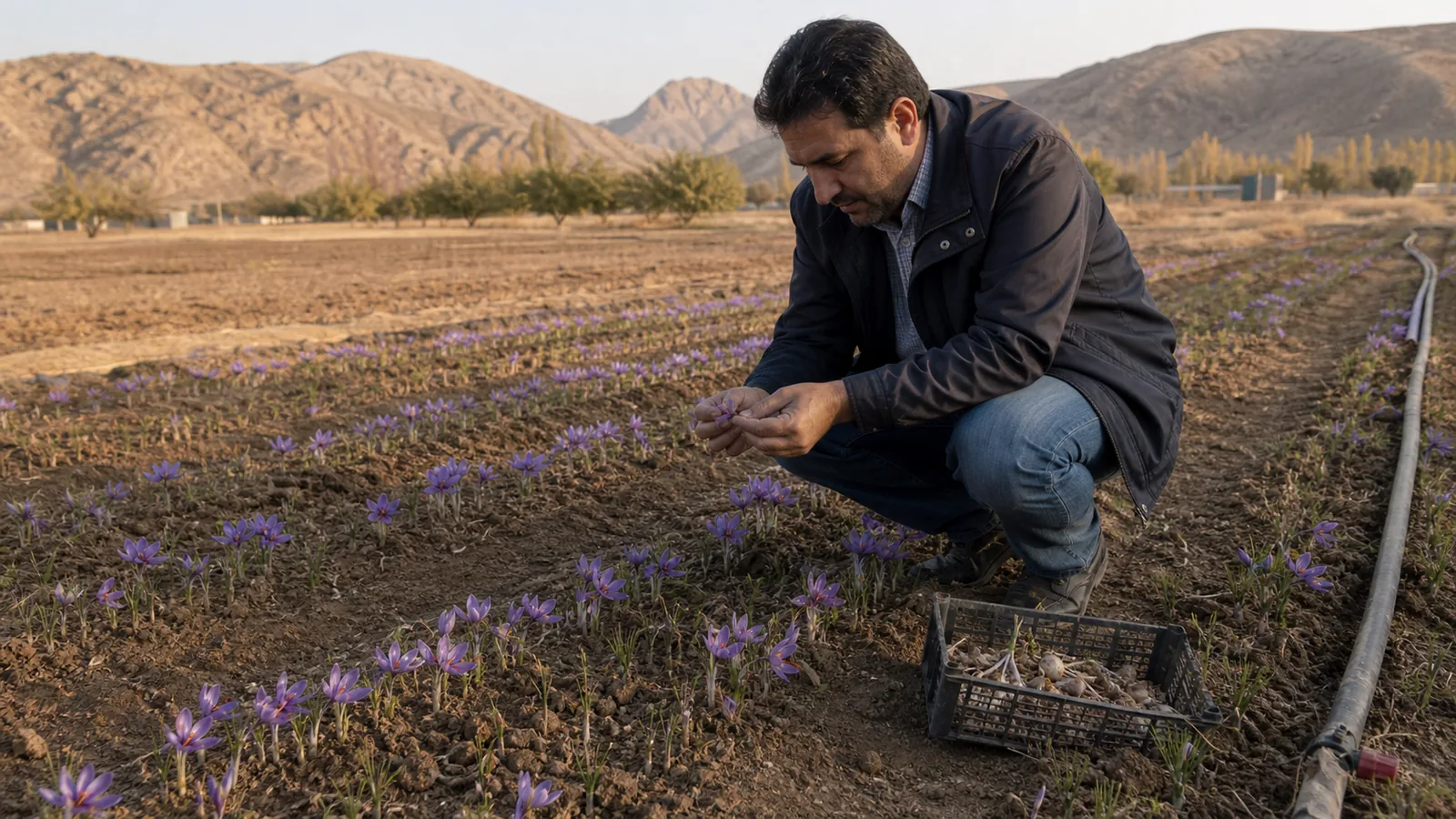
Both reports use the same growth percentage, but they do not describe one combined market or the same scale of production. Semnan is the main subject of this article. Sarein provides a useful comparison of how a small local program can post a large percentage change without approaching the cultivated area of a larger province.
Semnan’s reported 50% increase
Mehdi Qaraian, identified in the original report as director of horticultural affairs at the Semnan Agricultural Jihad Organization, said production had increased 50% by weight from the previous year. He also reported that the value of the crop in rials had risen by more than 100%.
Those measures should not be treated as interchangeable. The first describes a change in harvested weight. The second combines the quantity sold with the price received in the currency of the period. A doubling in rial value therefore does not, by itself, mean that farmers harvested twice as much or earned twice as much after costs.
The account places saffron cultivation across Semnan province at 243 hectares. It then says 160 hectares were productive and 103 hectares were not yet productive. Those two components add to 263 hectares, not 243. The available article does not include a primary table or correction that resolves the 20-hectare discrepancy.
For that reason, 243 hectares is retained as the reported headline total, while the 160/103 split is presented as an unreconciled detail rather than silently “fixed.” It would be unsafe to calculate province-wide yield from these figures without a confirmed productive-area total and the actual dried-harvest weight.
Why Semnan promoted saffron cultivation
Qaraian linked the crop’s expansion to two local considerations: suitable growing areas and farmers’ interest in changing their crop pattern to make better use of available water. The provincial horticulture program was described as supporting that shift through its water-productivity and crop-pattern policies.
The practical support named in the report included:
- help with farm mechanization;
- assistance with water supply and pressurized irrigation systems;
- oversight of healthy, good-quality planting corms; and
- support toward the cost of purchasing corms.
The original translation calls saffron corms “onions.” Corm is the more accurate horticultural term. Quality planting material matters, but it is only one part of establishment: field drainage, planting density, corm health, weather, irrigation timing, labor, and drying practice all affect the useful harvest.
The report does not provide the province’s dried-saffron tonnage, yield per productive hectare, farm-gate price, water use, or program cost. Its 50% figure is therefore evidence of year-on-year growth in that reporting period, not enough information to judge the long-term economics of every Semnan field.
Sarein, Ardabil: 50% growth on a small base
Mohammad Ebrahim Mohammadi, then director of Sarein’s Agricultural Jihad office, described a smaller program in a different province. More than 5.5 hectares were planted with saffron, producing 18 kilograms of dried spice. He said production was 50% higher than in the previous year.
If 5.5 hectares is used as the rounded area, 18 kilograms works out to about 3.3 kilograms per hectare. Because the source says the planted area was more than 5.5 hectares, the true average would be slightly lower unless its area was rounded in the other direction. This derived figure is a way to understand scale, not a new official yield claim.
Mohammadi attributed farmer interest to the crop’s value and the region’s suitable conditions. He also praised the aroma, taste, and color of Sarein saffron. No laboratory grade, chemical analysis, or comparative sensory data accompanies that statement, so it remains an attributed local assessment rather than proof that the product outranked saffron from another region.
The Sarein office encouraged crop-pattern change and distributed saffron corms free of charge in affiliated villages. That intervention can lower the initial cost of planting material. It does not remove the need to verify corm health, select suitable land, plan labor for the short flowering season, and find a buyer for the dried crop.
How the two regional reports compare
The clearest difference is scale. Semnan’s reported area was about forty-four times Sarein’s 5.5-hectare base. Sarein supplies a harvest quantity, while the Semnan account supplies only a growth rate and a disputed area breakdown. The two 50% claims therefore cannot be used to rank productivity.
They do show a common development model. Local agricultural offices promoted saffron as an alternative crop, helped farmers obtain corms or irrigation support, and expected cultivation to expand where conditions appeared suitable. Similar programs form part of the wider story of saffron production in Iran beyond the traditional Khorasan heartland.
What would confirm lasting growth
A future comparison needs more than a percentage. Useful follow-up data would include the reporting year, mature productive area, dried kilograms harvested, yield distribution rather than a single average, laboratory grade, irrigation volume, establishment and labor costs, sale price, and how much of the crop actually reached buyers.
The historical record supports a narrower conclusion: saffron production in Semnan grew sharply in the season described and received provincial support, while Sarein recorded the same percentage increase on a small, expanding base. The reports are complementary once their different geography, scale, and missing data are kept visible.

![Exporting Saffron to Turkey + Price Guide [Complete 0 to 100]](https://img.rowhanisaffron.com/20260827003933/saffron-export-turkey-quality-inspection.webp)



