


Qom province can become a center of saffron production, but the strongest case is built field by field. The province’s dry conditions make saffron worth testing, while soil, water, healthy corms, skilled labour and a workable market decide whether an individual farm succeeds.
How saffron production began in this Qom account
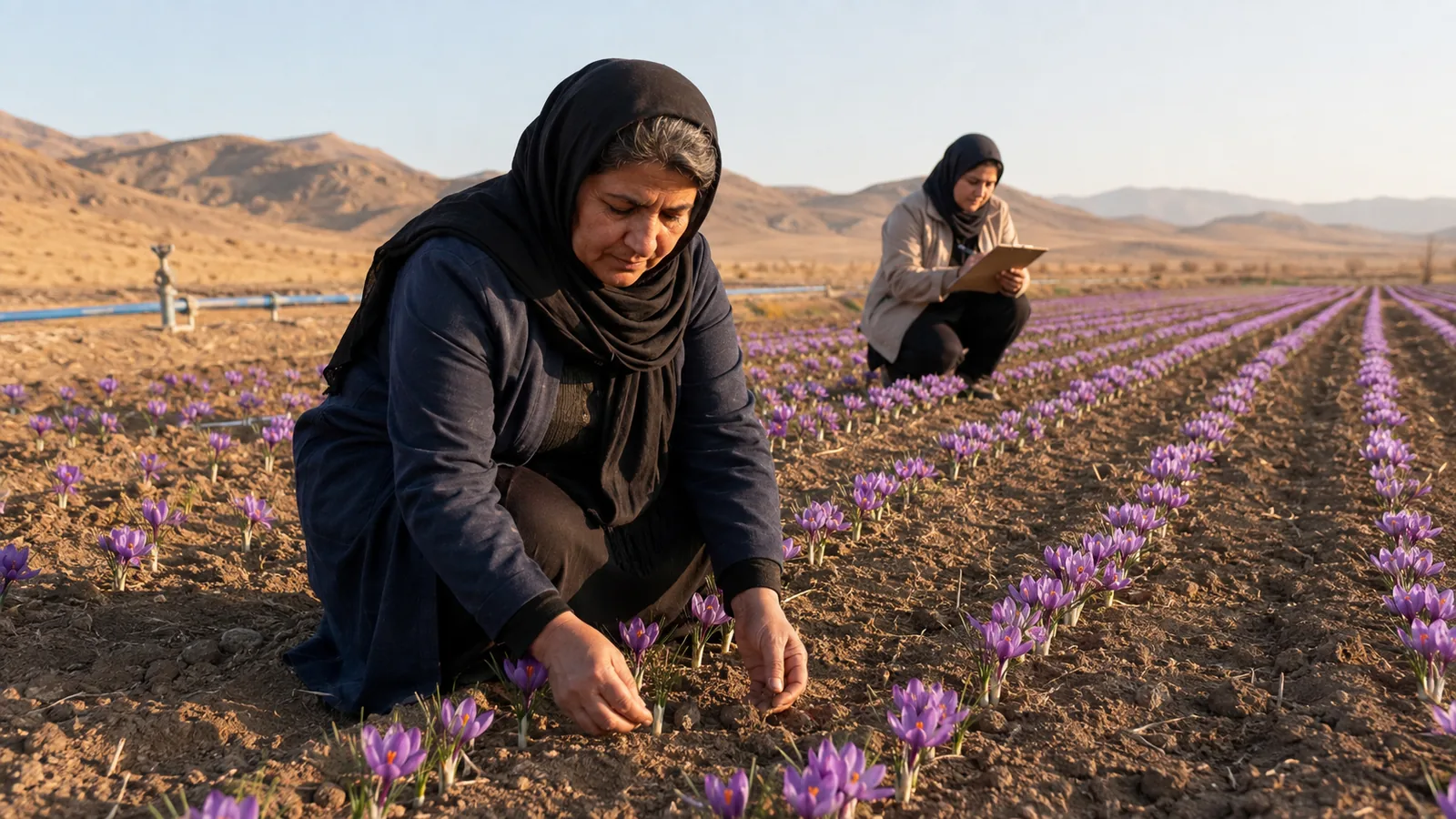
Kobra Vafaee, described in the original report as Qom province’s first saffron producer, said she and her wife began planting saffron on their own land in 2005. Their experience matters because it shows both the promise of a new crop and the obstacles that appear after the first successful seasons.
Vafaee said her activity later became very limited because she could not secure suitable land. That is a more precise problem than a simple shortage of acreage. A replacement field has to offer workable soil, drainage, water access, reasonable travel time and enough security for a crop that remains in the ground for several years.
Why Qom considered saffron in its crop plan
An official December 2016 report from Qom’s agricultural authority recorded ten hectares of saffron cultivation in the province. It placed the crop within a shift away from more water-intensive crops, described local cultivation as experimental and said better yield per unit of land would be necessary for it to be economical.
The same historical report said 30 percent of Qom’s land had the potential for saffron. That figure should not be read as permission to plant every parcel within a broad area. Province-level potential is only a starting point; a farmer still needs a plot-level assessment and a small trial before committing more land or capital.
Low-water does not mean no-water
Saffron is often called a low-water crop because it is dormant through the hot summer and its active season falls in cooler months. It still needs water at the right times. The amount and timing depend on soil, rainfall, planting age and local conditions, so a schedule borrowed from another province may be wrong for a Qom field.
Research catalogued by the FAO AGRIS database on irrigation and soil texture found that both influenced flower and replacement-corm yield. It is evidence against two easy assumptions: that saffron needs no irrigation, or that planting in any dry soil is enough.
The land problem described by Vafaee
Vafaee’s account said saffron corms multiply and that she expected to move them in about the seventh year. She also said land used for saffron was no longer suitable after roughly ten years. Those were practical limits from one grower’s experience, not universal expiry dates.
As daughter corms multiply, a bed can become crowded and performance may decline. Weeds, disease pressure, nutrient balance and soil structure also change over time. A grower should use field records and corm health—not the calendar alone—to decide when to lift, divide, rotate or replant.
Why one replacement field underperformed
After renting other land, Vafaee said its production was neither as strong nor as abundant as on her previous plot because the new land lacked the same quality. Her observation is useful, even though the report did not provide soil tests, yield records or irrigation details.
Before moving a planting, the old and proposed fields should be compared for texture, drainage, salinity, organic matter, previous crops, pests and water quality. Healthy corms can then be selected and transferred under clean conditions. Moving crowded or diseased material without diagnosis can carry the old field’s problem into the new one.
Distance and water access can rule out otherwise available land
Vafaee said the agricultural authority offered land close to Saveh, but it was too far from her home, so she declined it. She proposed another nearby parcel, yet that land did not have the water supply she needed. Both concerns are commercially relevant.
Saffron flowers arrive over a short harvest period and need timely picking and processing. A distant plot increases travel and supervision costs just when labour is most time-sensitive. A nearby field without dependable water, on the other hand, may expose the crop to avoidable establishment and yield risk. Available land is not necessarily suitable land.
Saffron needs regular attention, especially at harvest
The producer described saffron as a crop that needs round-the-clock care and warned that delays could destroy the product. The wording is dramatic, but the underlying point is sound: flowers can open and deteriorate quickly, and separated stigmas need careful drying and storage.
The workload is seasonal rather than literally constant throughout the year. Farmers must plan for weed control and field health, then have enough people ready to pick flowers, separate stigmas and dry them hygienically during the harvest window. A high-value crop can lose quality through slow or careless handling.
What a responsible Qom expansion plan should measure
A serious trial should record the field’s location, soil and water tests, corm source and size, planting density, irrigation dates, labour hours, flower weight, dry-saffron yield and quality results. Costs and the actual sale price belong in the same record.
Those numbers make it possible to compare fields and seasons rather than relying on a good first harvest or a broad claim about climate. They also reveal whether a lower-water crop is improving farm income or merely shifting costs into labour, land rental and processing.
Can Qom become a saffron production center?
Qom has a credible reason to develop saffron on carefully selected land, and its early growers supplied valuable local experience. Becoming a center of production, however, requires more than increasing planted hectares. It calls for healthy planting material, suitable fields, practical water access, trained harvest teams, clean processing, quality testing and reliable buyers.
Vafaee’s story is therefore both encouraging and cautionary. It shows that saffron can grow in Qom, while the difficulty of finding a suitable replacement plot explains why expansion must follow evidence from real farms.

![Exporting Saffron to Turkey + Price Guide [Complete 0 to 100]](https://img.rowhanisaffron.com/20260827003933/saffron-export-turkey-quality-inspection.webp)



