


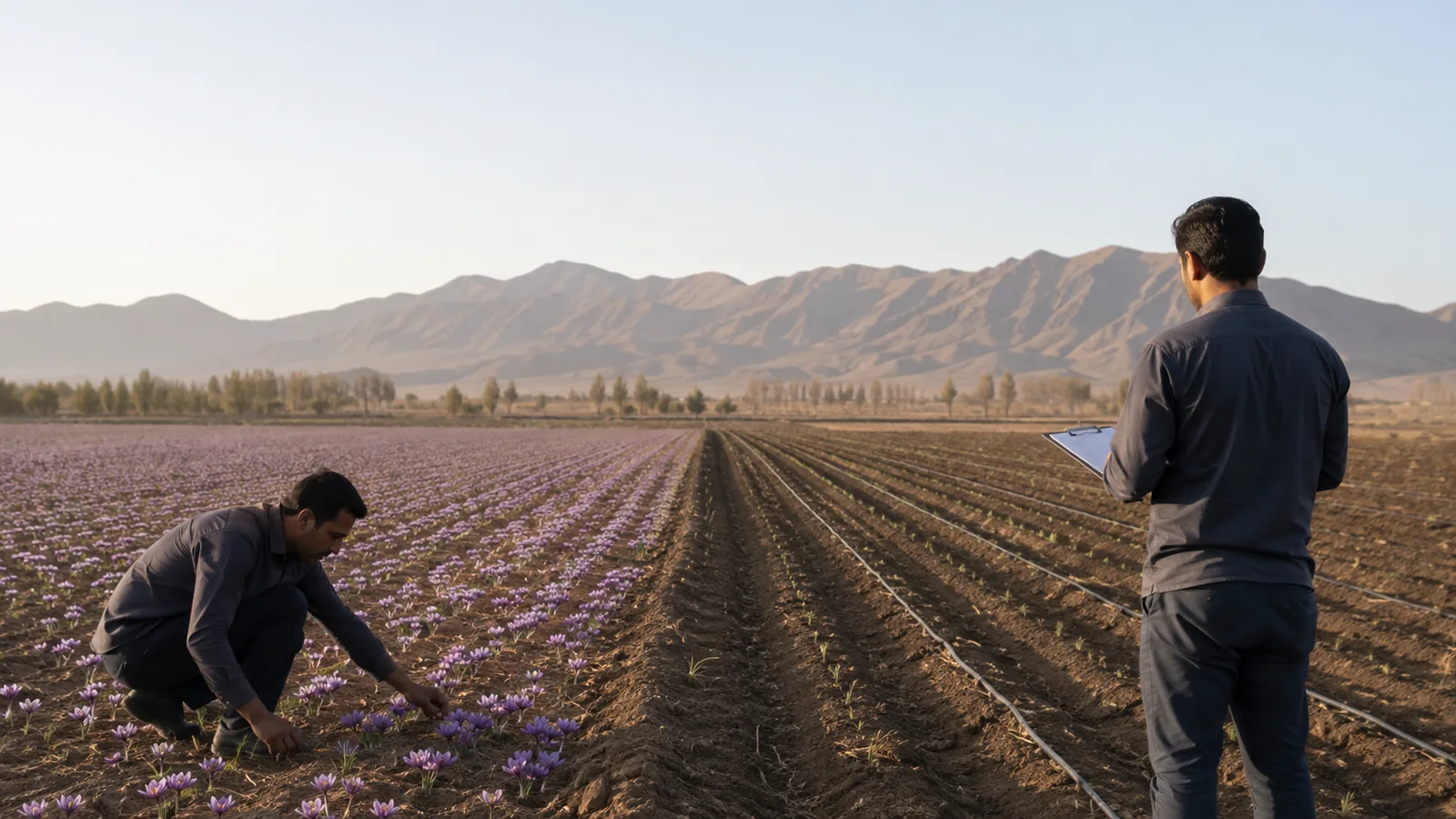
The area under saffron cultivation in Damghan increased to a reported 14.6 hectares, with 11 hectares already at an economically productive stage. The figures describe a small local sector in development and, just as importantly, show why new planting must be separated from bearing fields when yield is discussed.
What the Damghan saffron report said
Seyed Mohsen Tabatabayan, then identified as the director of Damghan’s Agricultural Jihad office, said 14.6 hectares in the county were under saffron. Of that total, 11 hectares had reached what the report called economic yield; the remaining 3.6 hectares were still in early growth.
The item did not state its reporting year in the English text retained here. These area figures are therefore a historical snapshot, not a current estimate of saffron cultivation in Damghan.
Why bearing and newly planted hectares differ
A new saffron field is not directly comparable with an established one. Corms multiply below the soil, flowering changes as a bed matures, and field condition can vary between seasons. Combining all planted hectares in one yield calculation can make a young sector appear weaker or stronger than it really is.
An official agricultural report from Qazvin illustrates the useful practice: it recorded bearing and newly planted saffron area separately and described output as dried saffron. Damghan’s 11-hectare figure provides the same kind of essential context.
The reported yield was three kilograms per hectare
Tabatabayan gave an average yield of three kilograms per hectare for the reported season. The source did not say whether that average used only the 11 economically bearing hectares or all 14.6 planted hectares, and it did not provide a final county harvest weight.
Accordingly, three kilograms per hectare remains an attributed historical figure. A reliable production record would specify dry stigma weight, measured bearing area, field age and the number of farms represented.
How officials planned to improve yield
The Damghan Agricultural Jihad office expected better farm nutrition, field operations and harvesting to raise output per hectare. That direction is reasonable, but each part needs a measured plan rather than a general promise.
Nutrition should follow soil and plant evidence. Field operations include weed control, corm health, drainage and correct timing. At harvest, flowers need prompt picking, stigma separation and controlled drying so that more of the field’s potential becomes clean, stable saffron rather than processing loss.
Soil, corms and irrigation work together
Research indexed by the FAO AGRIS database on saffron irrigation and soil texture found that both affected flower and replacement-corm yield. Results from one soil or irrigation schedule should not be copied across Damghan without checking local field conditions.
Growers need healthy corms, well-drained soil and water of suitable quality. Records of planting density, irrigation timing, rainfall, field age and dry yield make it possible to identify which change actually helped.
What financial support was intended to do
Tabatabayan said bank support and long-term, low-interest facilities had been made available to develop the crop. The translation on the original page called them “low-yield” facilities; in this context, concessional credit is the clearer meaning.
Credit can help with corms, field preparation, irrigation or processing equipment, but repayment still depends on realistic yields and sales. A farmer should budget for concentrated harvest labour and the years required for a new planting to mature, not only the first planting cost.
Low water demand is not an absence of water demand
The report described saffron as valuable and economically viable because it needs very little water. It also contained the contradictory phrase “its lack of water,” which appears to be a translation error. Saffron requires water; its advantage is the timing and pattern of that demand compared with many warm-season crops.
The economic comparison also depends on more than irrigation volume. Land, corms, labour, drying, grade, price and access to buyers all affect net income. A crop can be lower-water without being lower-risk.
Damghan’s local context
Damghan is a city and county center in Semnan province. The original article cited a population of 59,300 from the 2006 census and described the city as an important settlement of historic Qumis. Those details locate the report, but they do not establish present population or agricultural scale.
For saffron, the more relevant local questions are which villages and elevations supplied the 14.6 hectares, how their soils and water differed, and whether growers had nearby facilities for rapid, hygienic processing.
What would demonstrate successful expansion
Future comparisons should publish total planted area, bearing area, new area, dry harvest weight and average yield on a clearly stated basis. Field records should add soil and water results, corm source, labour, quality testing, sale price and destination.
That evidence would show whether the increase in saffron cultivation in Damghan led to better productivity and durable farm income. The original figures are a useful baseline, provided they remain dated, attributed and separate from any current claim.

![Exporting Saffron to Turkey + Price Guide [Complete 0 to 100]](https://img.rowhanisaffron.com/20260827003933/saffron-export-turkey-quality-inspection.webp)



