


Spain and the United Arab Emirates have appeared in historical accounts as markets for Iranian bulk saffron, sometimes followed by repacking and re-export. That trade is not proof that every Spanish or UAE product is Iranian, nor that repacking is deceptive: the decisive issues are truthful origin, traceable lots and whether the product remains pure.
What Farzad Saharkhiz said about Iranian bulk saffron
Farzad Saharkhiz, then described as a board member of Iran’s Youth House of Industry, Mining and Commerce, said Spain bought Iranian saffron in bulk and exported it after repacking. He linked that activity with Spain’s reputation as a large saffron exporter.
His remarks captured a long-standing concern among Iranian producers: when an unpacked commodity leaves the country, more of the branding and retail value can be created elsewhere. The statement is historical and should not be treated as a current trade table without customs data for the same year.
Bulk export, repacking and false origin are different things
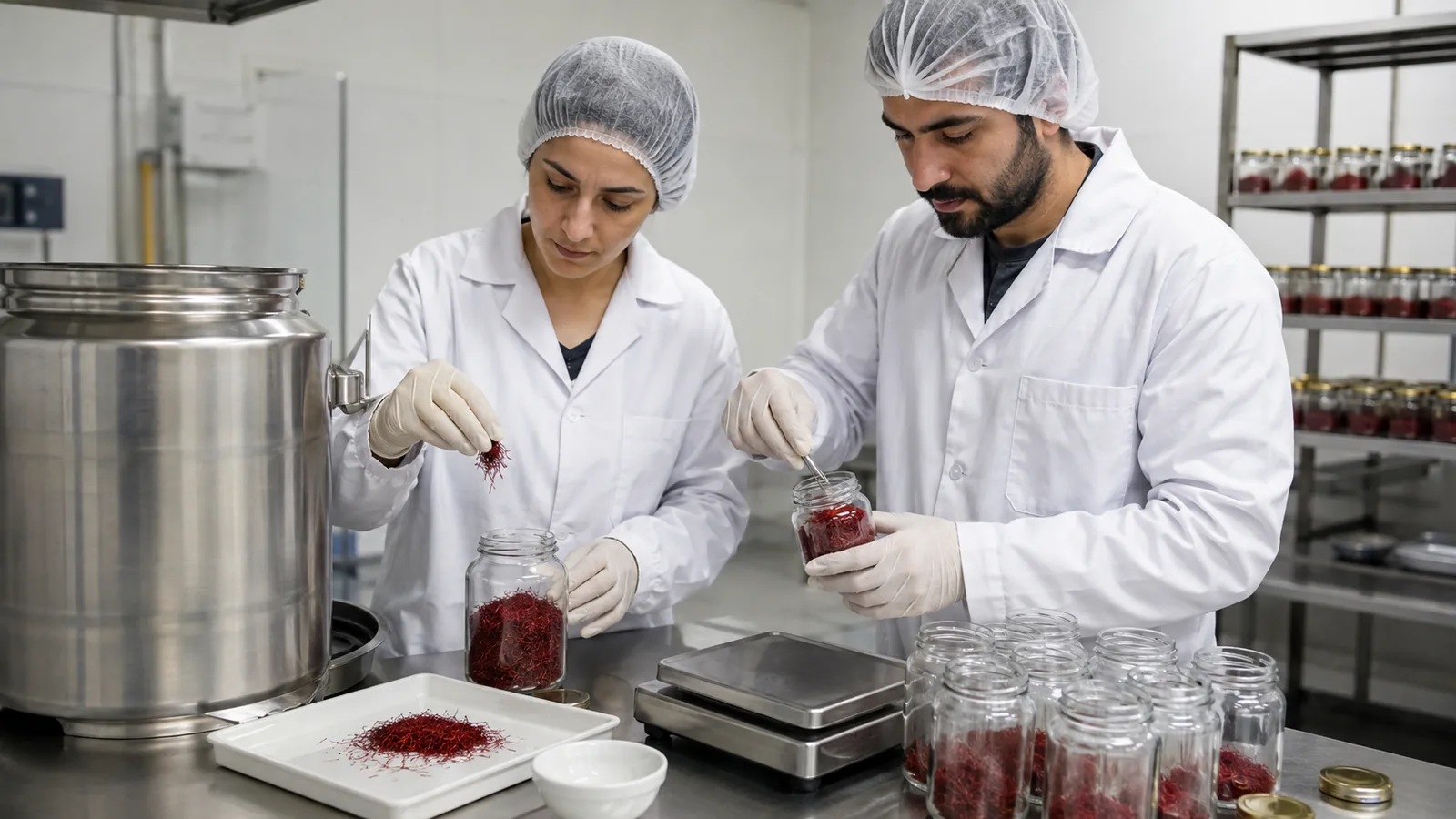
Bulk saffron is simply product shipped in larger trade packs rather than final consumer units. A buyer may lawfully grade, blend, pack or distribute imported saffron if food rules and labelling are followed. The problem begins when the stated country of origin, composition, grade or certification is false.
Packaging location also does not automatically determine agricultural origin. “Packed in Spain” and “grown in Spain” are different claims. A trustworthy label and invoice should make the difference clear and keep the lot traceable back through the supply chain.
Spain also grows genuine Spanish saffron
Spain is not only a repacking market. The European Union protects Azafrán de La Mancha as a Spanish Protected Designation of Origin. Its current specification limits that name to certified saffron from the defined production area and sets requirements for purity, physical and chemical characteristics, packing and numbered labels.
This is important when comparing Iranian saffron with Spanish saffron. A certified La Mancha lot has a documented Spanish origin; an imported product packed by a Spanish company may have another origin. Country-level slogans cannot replace the information on the particular pack.
The UAE adulteration statement was an allegation
Saharkhiz alleged that some unprofessional traders bought Iranian saffron in the UAE on a daily or weekly basis, mixed it with impurities, and resold substandard material to Persian Gulf countries, Africa and China. He further alleged that some product used Iranian packaging and even an Iranian standard mark.
Those are serious claims, but the source did not identify traders, tested lots, enforcement cases or laboratory results. They must remain attributed allegations rather than a description of all saffron sold in the UAE. Legitimate UAE importers and packers should not be grouped with unnamed bad actors.
Why adulteration and false marks matter
Added plant material, excess floral waste, moisture, colourants or non-saffron matter can change weight, appearance and safety. A copied certification mark can also mislead buyers even when the spice itself looks convincing.
Visual inspection helps but cannot settle every case. Commercial buyers should use documented sampling and appropriate laboratory methods, then tie the result to a sealed lot. Consumers can reduce risk by choosing intact threads, traceable packaging and a seller who identifies the producer or importer.
China was named as another bulk buyer
The historical account called China the largest buyer of Iranian bulk saffron after Spain and the UAE. That ranking belongs to the period and source in which it was made. Trade volumes and routes can change with tariffs, sanctions, banking access, demand and customs classification.
For current market analysis, country rankings should come from dated customs data using the same commodity code and flow. A shipment’s destination may also be an intermediary rather than the place where the saffron is finally consumed.
Afghanistan was described as both customer and competitor
Saharkhiz also described Afghanistan as a buyer of Iranian bulk saffron and a future competitor, alleging that Iranian material was sold onward as Afghan saffron. Afghanistan has its own saffron production, so Afghan-labelled product cannot be assumed to have Iranian origin.
An official Iranian agricultural news report later quoted a deputy agriculture minister saying that re-export through Afghanistan was based on informal reports. That qualification matters: it supports concern about the route, not proof about every Afghan consignment.
Saudi Arabia and Qatar were linked with packaged saffron
The original article named Saudi Arabia and Qatar as major buyers of Iranian packaged saffron. Saharkhiz said travellers from Arab countries were familiar with Iranian quality and that their preference for Iranian over Spanish saffron was increasing.
No survey, sales series or date-by-date comparison was supplied, so this remains his market observation. Packaged trade can help preserve producer identity, but only when the label, lot and quality claim are trustworthy.
Iranian saffron versus Spanish saffron
Searches for Iranian saffron versus Spanish saffron often assume that one country must win every comparison. In practice, a careful comparison uses two identified lots. Stigma-to-style ratio, foreign matter, moisture, colour strength, aroma-related measurements, harvest age, drying and storage all matter.
Iran has a much larger production base, while Spain has a smaller documented production tradition and a protected La Mancha designation. Neither fact makes every pack from one country better than every pack associated with the other.
What buyers in Spain or the UAE should verify
A commercial buyer should obtain the agricultural country of origin, packer and importer identity, lot number, harvest or packing date, net weight and storage conditions. The invoice and test certificate should refer to the same lot, and seals should remain intact through delivery.
If saffron is blended, the label and specification should say so accurately. If it claims an official origin or standard, the certification should be verifiable with the responsible body. These controls protect Iranian producers, genuine Spanish growers, reputable UAE traders and the final customer alike.
The enduring lesson is traceability
The historical statements about Spain, the UAE, China, Afghanistan, Saudi Arabia and Qatar show how many hands and markets can sit between a saffron field and a consumer pack. They should not be mistaken for a current ranking or a finding against entire countries.
Bulk trade itself is not the enemy. Loss of origin, unverified quality and adulteration are the risks. A traceable supply chain allows saffron to be packed wherever commerce requires while preserving an honest account of where it was grown and what the buyer received.

![Exporting Saffron to Turkey + Price Guide [Complete 0 to 100]](https://img.rowhanisaffron.com/20260827003933/saffron-export-turkey-quality-inspection.webp)



