


Saffron opened a new window for agriculture in Dudangeh District, Sari, Mazandaran by giving some upland farmers another crop to test on suitable land. Dudangeh—also written Dodangeh in English—is green and rainy in places, so success depends on matching saffron to a well-drained field rather than assuming the whole district has one climate.
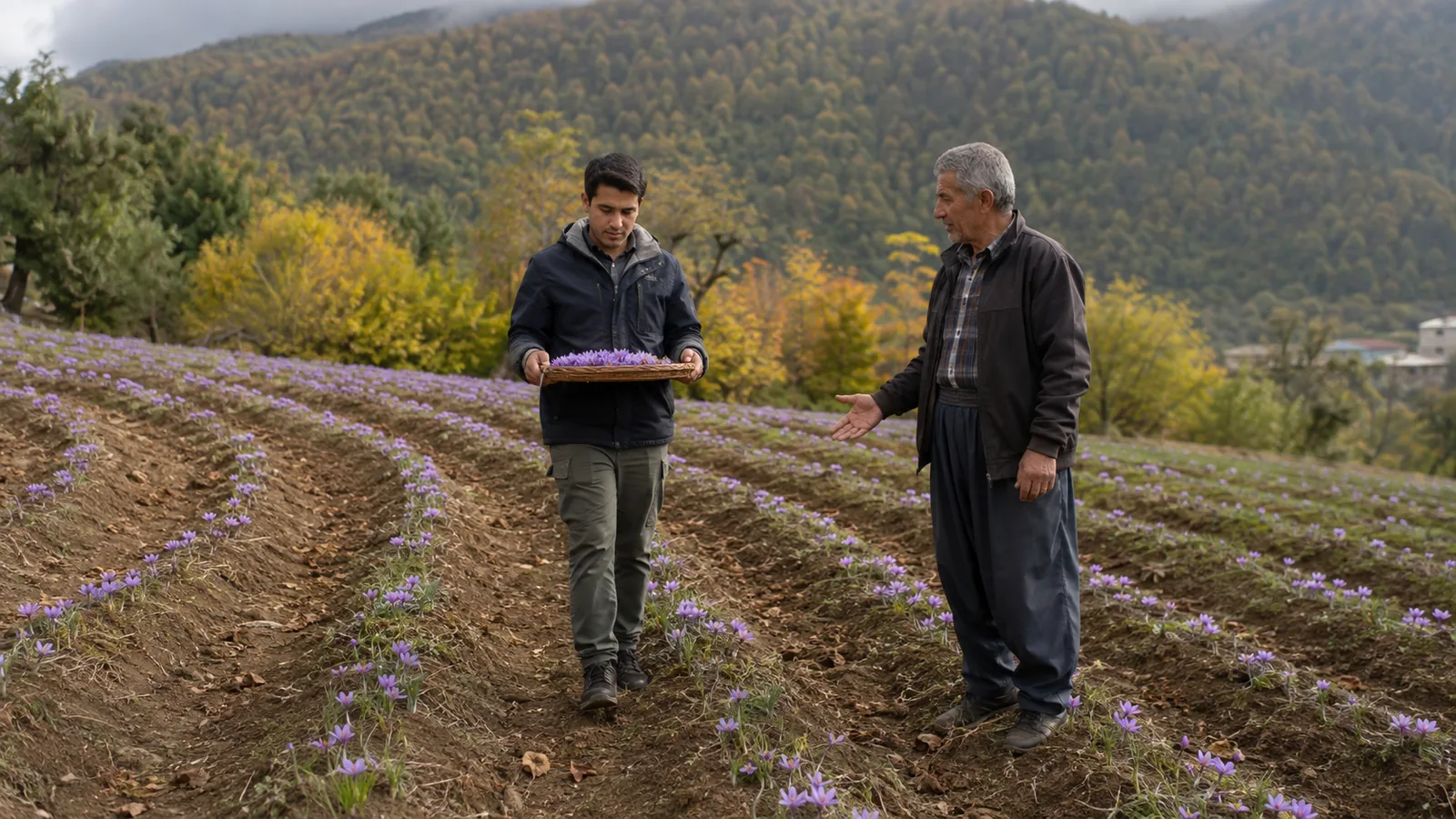
A new crop for agriculture in Dudangeh District, Sari
The original account presented Mazandaran as a lush province where farming can be economically sound when each crop is matched to the capacity of its area. That principle is more useful than the idea that one high-value crop belongs everywhere.
Dudangeh lies in the uplands south of Sari. Farms there differ in elevation, slope, soil depth, rainfall and access to water. Saffron can suit selected plots, especially where summer drainage is good, but a local field assessment remains essential.
Why the project focused on rural livelihoods
The report described Dudangeh as a deprived area and said saffron cultivation was helping some of the remaining young residents stay and farm. It framed the project around production, rural employment, better use of existing land and reducing migration from villages.
Those are aims, not outcomes that planting alone can guarantee. A small saffron sector supports livelihoods only when dry yield, labour, handling, price and sales cover the cost and effort over several seasons. Counting participants and actual income would show whether the project delivered what it promised.
Marketing was part of the original concern
The writer hoped local people could use expert advice to market their saffron and sell at a reasonable price. This remains central to the project. Flowers have to be picked quickly, their red stigmas separated and dried carefully, and the finished saffron protected from moisture, light and contamination.
Growers also need a credible way to describe origin and quality. Traceable lots, consistent drying, clean packaging and realistic claims are more valuable than simply calling the product premium. Marketing cannot compensate for uneven handling.
What “resistance economy” meant in this project
The historical article linked saffron cultivation with Iran’s resistance-economy policies, local production and employment. In practical farm terms, that meant trying to use low-yield sloping land more productively, retain more value locally and create an activity that could complement other rural income.
Policy language does not remove agronomic or commercial risk. A project still needs suitable soil, healthy corms, labour at harvest, processing discipline and buyers. Those details determine whether the “new window” stays open.
First-year fields and mature fields behave differently
The source said saffron spends its first and second years in corm growth and that multiplication begins from the third year. Daughter corms actually develop as part of the annual cycle, while flowering and field performance commonly strengthen as the planting establishes. “Third year” is better treated as a maturity guide than a fixed biological switch.
A newly planted plot should therefore not be judged against a mature field. Records should separate field age, planted area, bearing area, flowers picked and dry stigma yield so that apparent growth is not caused by mixing stages.
Why an old saffron field may need renewal
The report also said flowering declines after about ten years because the food supply below the soil is reduced. That wording oversimplifies what happens. Corm crowding, shallower daughter corms, depleted nutrients, weeds, pests, disease and soil structure can all contribute to lower performance in an ageing field.
Ten years is not an automatic expiry date. A grower should use plant density, health and measured yield to decide whether to thin, lift, rotate or replant. Healthy material should not be transferred into a new plot without checking for pests and disease.
Saffron and Damask rose were compared
Sadeghi, described as an adviser to the governor of Sari on Dudangeh’s pilot resistance-economy project, gave saffron priority over Golmohammadi, or Damask rose. The two crops have different labour, processing and market requirements, so priority should be tied to the particular site and business plan.
An official May 2018 report from Frim in Dudangeh shows why Damask rose remained part of the district’s wider strategy. It described extensive planting on sloping land, including about 500 hectares of Damask-rose gardens, as part of efforts to improve value, manage water pressure and reduce erosion.
Saffron does not have zero water needs
The source claimed saffron needed no water, fertiliser or pesticide. All three absolutes are unsafe. Saffron’s summer dormancy can make its water schedule attractive, but the crop still needs moisture at appropriate stages. Dudangeh’s rainfall also makes drainage and disease management especially important.
Fertiliser should be based on soil condition and crop need, not applied automatically or rejected categorically. Pesticides may not be routinely necessary in a healthy field, yet pests, rodents, weeds and corm diseases still require monitoring. Prevention and targeted management are different from saying risks do not exist.
Sloping land needs soil protection
The project aimed to make better use of low-yield sloping land. Cultivation on a slope can expose soil if rows, access and drainage are poorly designed. The 2018 Dudangeh report warned that working directly down a slope could multiply erosion and described contour-aware orchard development as a way to improve land use.
Saffron’s small canopy does not protect bare soil throughout the year. Before planting, a farmer should consider runoff, row direction, safe access, organic matter and how the field will be managed outside the flowering season.
What should be measured before expansion
A useful Dudangeh trial records elevation, slope, soil drainage, planting date, corm source and size, irrigation and rainfall, field age, labour hours, fresh flowers and dry saffron. It also records what the finished crop sold for and whether the buyer returned.
That evidence connects the article’s social goals with farm reality. Saffron can be a valuable part of agriculture in Dudangeh District, Sari, but it succeeds through careful site selection, realistic production records and a market—not through zero-input promises.

![Exporting Saffron to Turkey + Price Guide [Complete 0 to 100]](https://img.rowhanisaffron.com/20260827003933/saffron-export-turkey-quality-inspection.webp)



