


The claim that 95% of Iran’s saffron products are exported in bulk is not supported by the surviving article. Historical Iranian reporting used a figure above 95 percent for Iran’s share of world saffron production while also criticizing bulk exports; those are two different measures and should not be merged.
Where the 95% bulk-export claim breaks down
The original body does not give an export tonnage, packaging breakdown, customs code or calculation that produces 95 percent. It discusses weak value-added production and the loss of recognition when Iranian saffron is packed or branded elsewhere, but that does not prove the percentage in the title.
An official Iranian agricultural commentary on saffron exports said Iran produced more than 95 percent of the world’s saffron and separately described criticism of bulk exporting. That is the most plausible source of the confusion, but it cannot retroactively prove what the headline intended.
Who took part in the saffron roundtable
The article names Amir Massoud Pejmanpour, president of the Khorasan Razavi Rural Cooperative Union; Akbar Mirzapour, director of physical market development at the Iran Commodity Exchange; saffron producer Gholamreza Karimi; and Hossein Zeinali.
The surviving English text reads like notes from a specialist ceremony or roundtable rather than a complete report. It moves between speakers without a date, venue or full attribution for every number, which is why its historical claims require careful labels.
Quality was placed ahead of acreage growth
Zeinali, described as the Ministry of Agricultural Jihad’s medicinal-plants project lead, said the goal was not slight or indiscriminate development of saffron acreage. Quality mattered more than quantity, even as medicinal-plant cultivation expanded.
That priority remains useful. More land does not guarantee more saleable saffron. Field health, prompt picking, clean separation, controlled drying, storage and representative testing all affect what a buyer receives.
The $400 million turnover statement
Zeinali was quoted as putting Iran’s saffron turnover at $400 million: $350 million abroad and $50 million at home. These two parts add correctly to the stated total, but the article does not identify the year, exchange basis or data source.
It then says global turnover was $8 million, which is impossible if Iran alone accounted for $400 million. The intended unit may have been different, but changing it to “billion” without a primary record would be guesswork. The safest conclusion is that the global figure was mistranscribed and cannot be used.
Iranian production and Spanish recognition
Zeinali complained that European markets did not recognize Iran as the main producer and instead associated much saffron with Spain. This is better understood as a branding and origin-recognition concern than a claim that Spain produces no genuine saffron.
Bulk saffron can be legally imported, tested, packed and re-exported, while origin claims must still be truthful. Processing or packaging in another country does not change where the crop was grown. Traceable lot records and accurate origin labelling protect both producers and buyers.
What official historical export data did show
Another official historical report on Iranian saffron exports and re-export concerns cited 351 tonnes of production and 113.5 tonnes of recorded customs exports in its reference year. It also warned that some saffron left through informal channels.
Those figures cannot be used to calculate a packaging share: production and exports have different timing, inventories can carry between years, and the source did not divide exports into bulk and branded retail packs. They do demonstrate why “95 percent exported in bulk” needs a defined year and customs-based denominator.
Private-sector growth and shared knowledge
Zeinali criticized weak development of saffron products and argued that government should support private-sector growth. He also called for an organization able to bring new knowledge into saffron production.
The useful objective is coordination across growers, processors, laboratories, packers and exporters. It should not mean a label alone. Training, shared specifications, traceability, accessible testing and transparent market information are practical ways to turn knowledge into quality and value.
The Khorasan Razavi production figures
Seyyed Hashemi Naqibi, identified as the horticulture director of the Khorasan Razavi Agricultural Jihad Organization, said the province expected roughly 300 to 310 tonnes of saffron from 86,000 hectares. He linked further farmer interest to water shortage.
The retained article gives no reporting year or final harvest, so these remain a forecast and acreage snapshot. It also says farms yielded “three to three kilograms and 500 kilograms per thousand meters,” an internally broken phrase. The likely intended measure is around three to 3.5 kilograms per hectare, but the exact wording cannot be verified from this page and should not be asserted as fact.
Not every soil is suitable for saffron
Naqibi cautioned that saffron flowers cannot be grown successfully in every soil and said officials were trying to improve both quality and quantity. This is an important restraint on expansion driven by water scarcity.
Site selection should consider drainage, salinity, soil texture, previous crops, corm health and a field-specific irrigation plan. A lower-water calendar does not make a poorly drained, diseased or unsuitable field economically sound.
What “value added” requires in practice
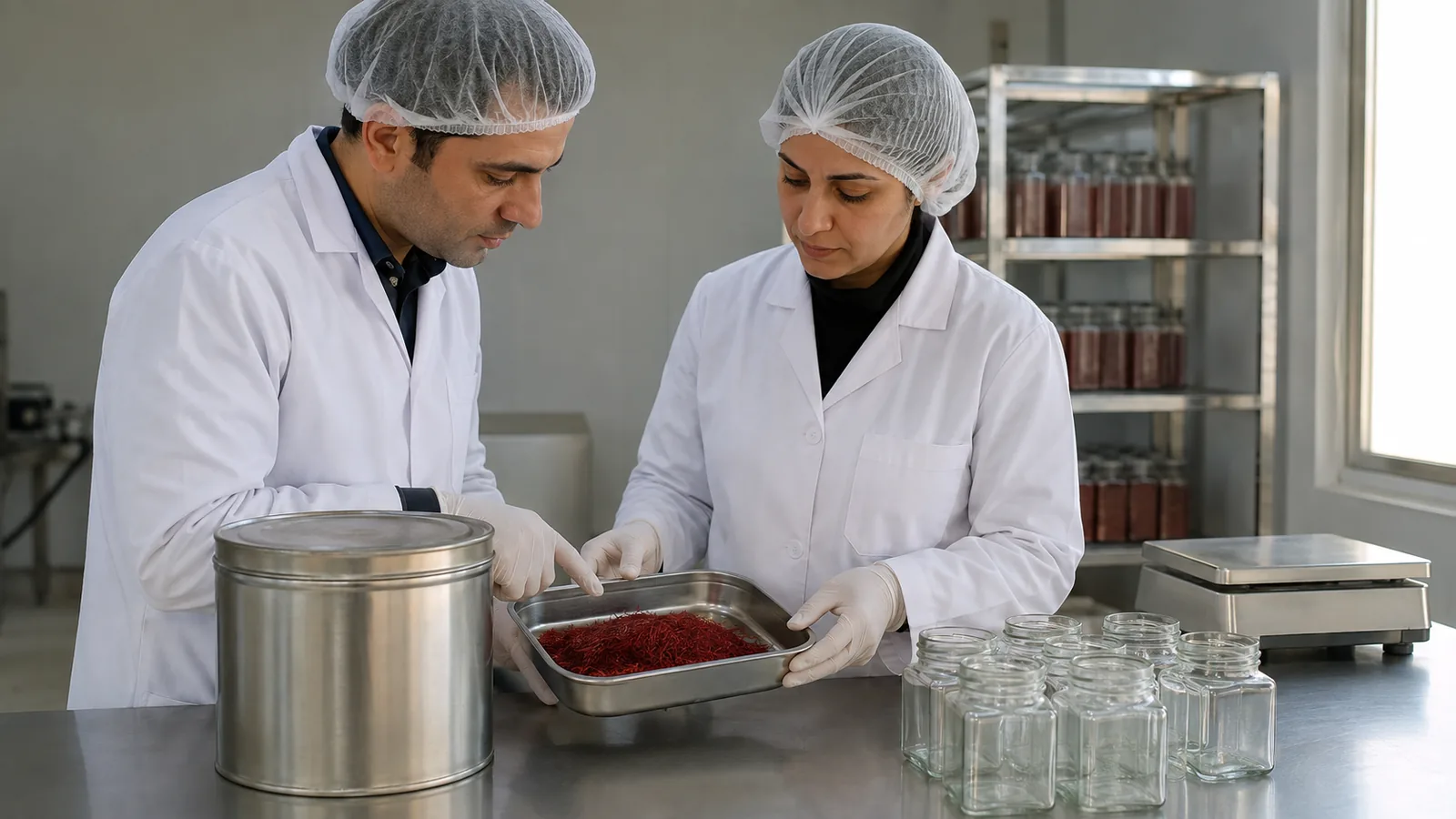
Value does not come from smaller packaging alone. A product needs verified identity and purity, consistent drying, accurate net weight, food-safe handling, truthful origin and lot traceability. Branding works only when those fundamentals are dependable.
Research indexed by FAO AGRIS on saffron production systems and quality used ISO 3632 references when evaluating colour and taste measures. This kind of stated method gives quality work a technical base rather than relying on broad “premium” language.
How the 95% claim should be used
The title is retained because it is the page’s historical search identity, but readers should not quote it as a verified export statistic. The evidence on this page supports a narrower conclusion: Iran held a dominant production role, bulk trade and foreign rebranding were industry concerns, and the roundtable wanted more quality, knowledge and domestic value creation.
A defensible bulk-export percentage would require a stated year, official export weight, a consistent definition of “bulk,” and shipment-level packaging data. Until those fields exist, 95 percent remains an unverified headline claim—not a fact about Iran’s saffron products.

![Exporting Saffron to Turkey + Price Guide [Complete 0 to 100]](https://img.rowhanisaffron.com/20260827003933/saffron-export-turkey-quality-inspection.webp)



