


A 20% increase in the area under saffron cultivation in Razan took the reported planting from 15 to more than 18 hectares. The modest scale matters: it shows a local crop-pattern trial expanding, while leaving room to ask whether yield, quality and farm income supported the next stage.
What the Razan saffron report recorded
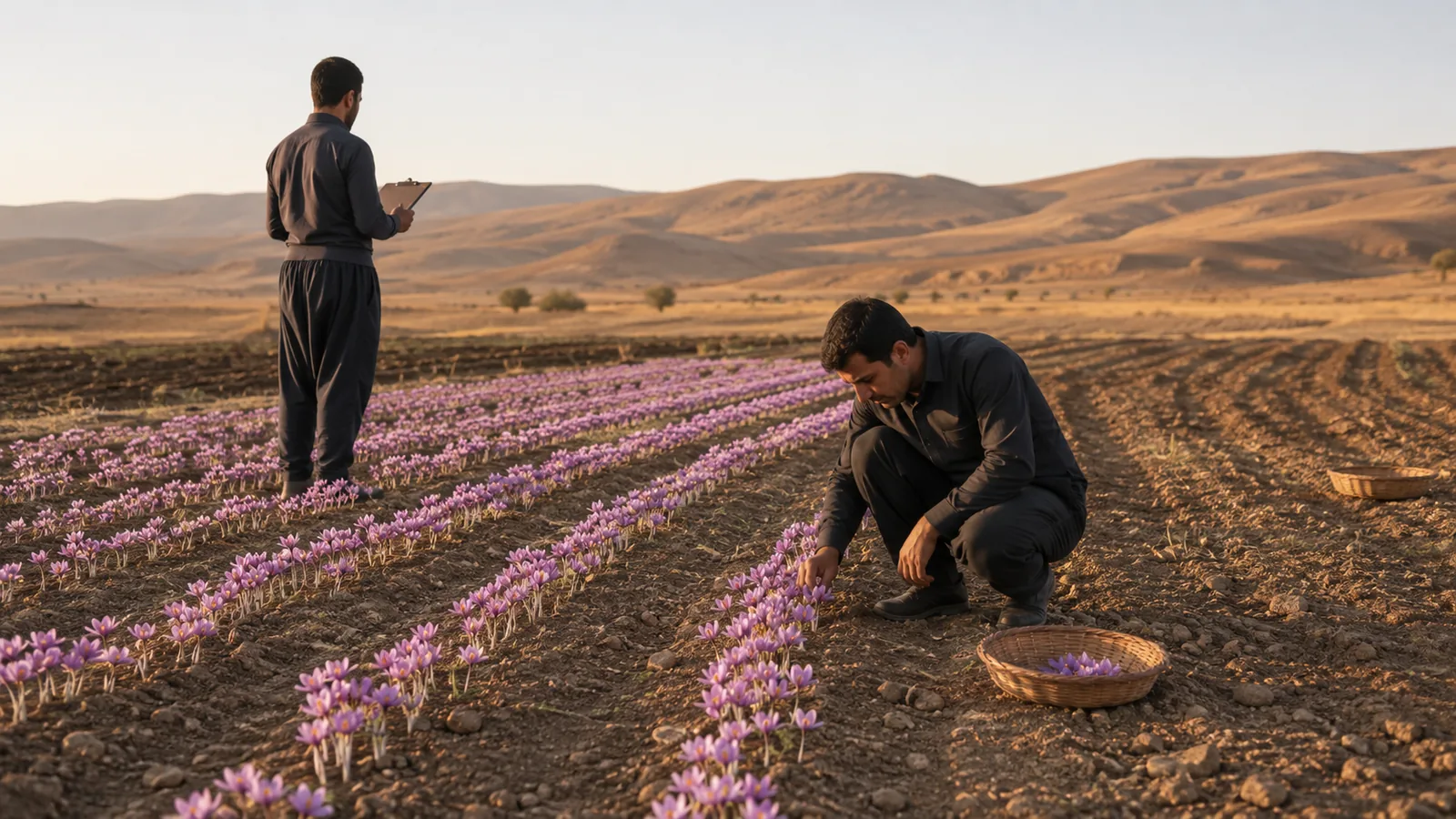
Mahmoud Fathi, identified as the director of Razan’s Agricultural Jihad office, announced that the county had more than 18 hectares under saffron. He said this was an increase of more than 20 percent from the previous year’s 15 hectares, a gain of about three hectares.
The original item did not state its reporting year in the text retained on this site. Its figures should therefore be read as a historical snapshot, not as Razan’s current acreage or production forecast.
Why Razan was changing its cultivation pattern
Fathi linked the expansion to drought, water shortages and a local effort to change the crop pattern. Saffron was presented as an alternative to crops with heavier water requirements and as a possible source of farm income.
That comparison needs care. Saffron’s summer dormancy and cool-season growth can make its irrigation schedule attractive in a water-stressed area, but “lower water use” does not mean that a field can succeed without suitable water. Establishment, autumn growth and spring corm development all depend on moisture being available when the crop needs it.
The 15-to-18-hectare increase in context
Moving from 15 hectares to 18 hectares is mathematically a 20 percent rise. Because the report said the new total was more than 18 hectares, its description of growth as more than 20 percent is internally consistent.
Planted area alone does not show whether production rose at the same rate. New fields may yield differently from established ones, and a county total can combine beds of different ages. A useful comparison records bearing area separately from newly planted area, then measures dry stigma yield rather than counting hectares as output.
The forecast was 100 kilograms of saffron
Fathi forecast a harvest of 100 kilograms for the county. Against a little more than 18 hectares, that would imply an average close to 5.5 kilograms per hectare if every hectare were bearing and the forecast referred to dried saffron. The source did not supply those qualifications or a final harvested total.
For that reason, 100 kilograms remains the official’s forecast in this historical report. It should not be treated as a verified result. Field age, flower count, drying losses and the distinction between fresh flowers and dry stigmas all affect how production figures should be interpreted.
Soil and irrigation still control field performance
Fathi described Razan saffron as very good quality, but the item included no laboratory grade, sample results or quality standard. Appearance and local reputation can be useful observations; objective quality claims require representative sampling and analysis.
Research indexed by the FAO AGRIS database on saffron irrigation and soil texture found that both factors affected flower and replacement-corm yield. For a Razan grower, that makes a soil test, drainage assessment and field-specific irrigation plan more useful than assuming all nearby land will behave alike.
Where the crop was expected to go
The report said local saffron met needs within Razan and was also sent to other provinces. The English source used the unclear phrase “involved provinces” and did not name the destinations, volumes, buyers or form of the product.
A credible market record would distinguish fresh flowers, dried stigmas and packaged saffron. It would also record lot weight, grade, buyer and destination. Those details show whether growers are building a repeat market or simply selling the harvest wherever a buyer is available.
Annual expansion was set at ten hectares
Fathi said adding ten hectares of saffron each year was an important local agricultural programme. That target was substantially larger than the three-hectare increase described for the reported year.
Expansion should follow results from existing fields. Healthy corm supply, suitable land, irrigation access, harvest labour, drying capacity and buyers all have to grow together. Adding hectares without those supporting parts can produce uneven quality or leave farmers with costs that the market does not cover.
Does saffron automatically provide stable income?
The official described saffron development as a way to generate stable income and said its cultivation, maintenance and harvest demands compared favourably with some water-intensive crops. Stability, however, is an outcome to measure rather than a guaranteed feature of the plant.
Growers face corm and land costs, concentrated hand labour at flowering, processing losses, quality differences and changing sale prices. A farm budget should count all of these over several seasons. Gross revenue from a high-value spice is not the same as dependable net income.
What should be checked before Razan expands further
Each field should have a record of soil and water tests, corm origin and size, planting date and density, irrigation, field age, labour, fresh flower weight, dry saffron yield and quality results. The sale record should include the form sold, lot size, price and destination.
These measurements preserve the useful idea behind the original announcement. Saffron cultivation in Razan may fit a lower-water crop strategy, but the strongest reason to add land is evidence that existing fields are healthy, productive and profitable—not acreage growth by itself.

![Exporting Saffron to Turkey + Price Guide [Complete 0 to 100]](https://img.rowhanisaffron.com/20260827003933/saffron-export-turkey-quality-inspection.webp)



