


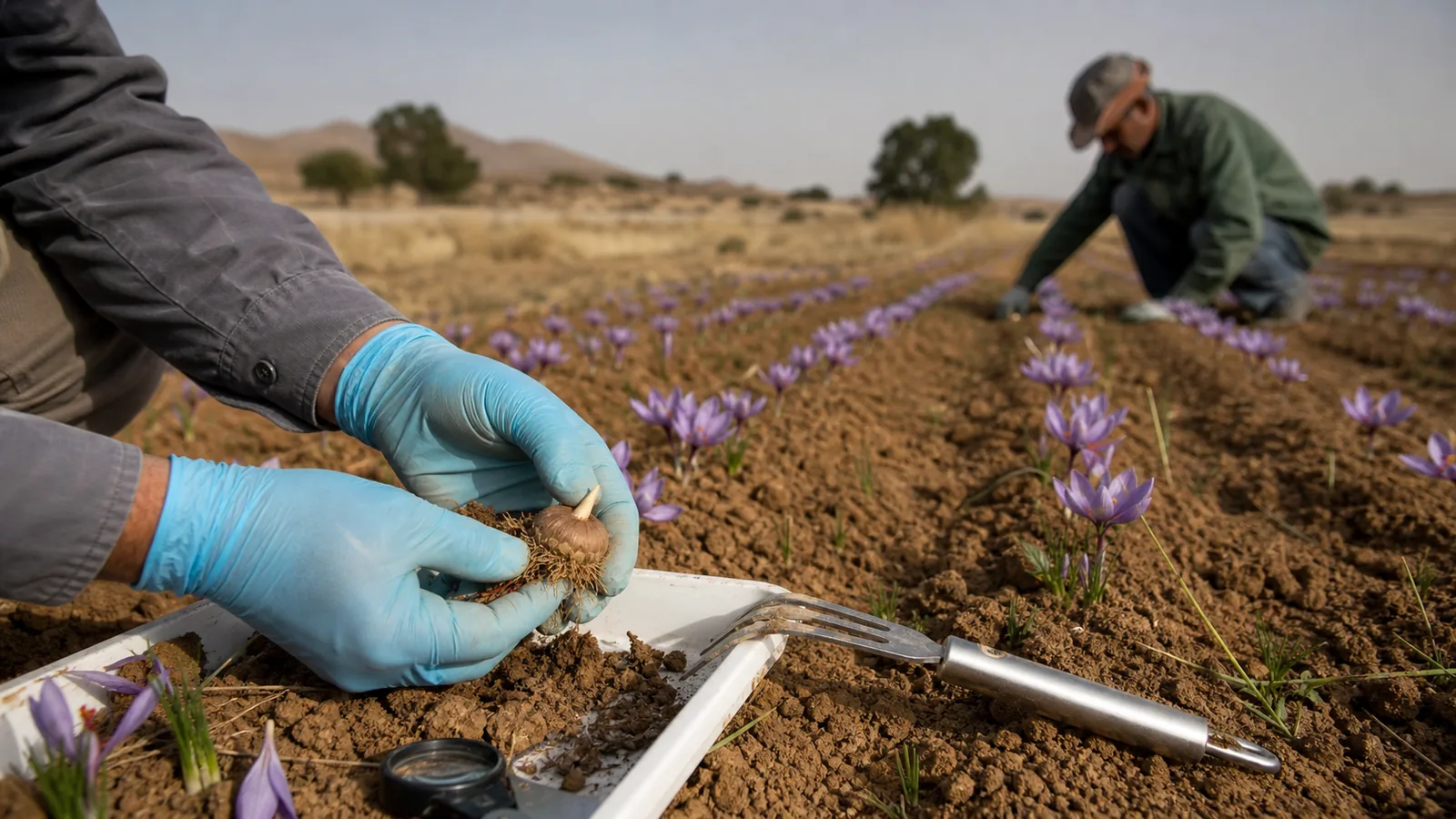
Iranian saffron and pests without pesticides can coexist, but only when “without pesticides” describes a documented production system rather than a broad marketing claim. Saffron growers can prevent or manage many weed, rodent and disease problems through field selection, clean planting material, monitoring, sanitation and well-timed physical controls. That does not mean every Iranian crop is pest-free, nor does the absence of spraying automatically prove that harvested saffron contains no pesticide residue.
The distinction matters to farmers, buyers and anyone searching for information about saffron pesticide use. A pest is the organism or plant causing damage. A pesticide is a control product; the term includes herbicides for weeds, insecticides for insects, fungicides for fungal disease and rodenticides for rodents. Organic production is a separate, certified system with its own permitted inputs and records.
What the Birjand saffron research statement said
In a 2015 interview reported by the Iranian Students News Agency’s South Khorasan service, Dr Mohammad Ali Behdani of the Saffron Research Group at the University of Birjand discussed pest management in Iranian saffron. Research projects cited in the interview indicated that more than 50% of the surveyed farmers did not use herbicides to control weeds in their saffron fields.
That is a valuable observation, but its limits are important. It describes farmers covered by those projects at that time; it is not a national residue survey and cannot support the claim that all Iranian saffron was produced without pesticides. Behdani’s central point was practical: farmers already possessed useful local knowledge, and training and incentives could help them rely more consistently on non-chemical crop management.
His role is not merely an attribution carried over from an old news item. A published research record identifies M. A. Behdani with the Saffron Research Group at the University of Birjand. The interview’s emphasis on education, field practice and research is therefore more useful than its over-broad translated wording about “no pests” or “no residues.”
Why weeds are a serious problem in saffron fields
Saffron is not a forceful competitor. Its narrow leaves and seasonal growth leave light, moisture and nutrients available to weeds, especially in an established field that remains in place for several years. When weeds are allowed to build up, they interfere with corm growth and flower production. This is why the original interview linked weed control directly with field performance.
Herbicide-free weed management is possible in many situations, although it is not labour-free. The right combination depends on the field, the weed species and the saffron growth stage. Options may include removing weeds before they set seed, shallow mechanical work that does not injure corms, suitable mulch, clean field edges and rotation before a new saffron stand is planted. A 2021 field study in Morocco found that several mulches reduced weed biomass and improved saffron growth, illustrating one option rather than prescribing a universal method.
Timing is critical. Digging too deeply can wound corms. Leaving weeds until seed is mature makes the next season harder. Applying an unsuitable herbicide can injure the crop or leave an avoidable residue problem. Before taking action, a grower needs to identify the dominant weed and check what is legal and appropriate locally.
The pests are not limited to insects
In saffron farming, the word “pest” covers more than insects. Mice and other rodents can feed on corms below ground; rabbits and larger animals may disturb or browse a field. Mites, thrips and nematodes can also damage planting material or plants. Fungal and bacterial diseases are crop-protection problems even though the organisms responsible are not insects.
The original report referred particularly to mice and rabbits and to the attraction of saffron corms. The useful point is the corm damage, not the awkward suggestion that saffron’s flavour itself attracts every animal. A recent review of saffron production and crop protection likewise identifies rodents, corm mites, thrips and a range of pathogens as potential problems, with local climate and field conditions determining which ones actually matter.
Corm rot needs diagnosis, not guesswork
Discoloured, soft or decaying corms are often described collectively as corm rot, but several organisms and poor growing conditions can produce similar symptoms. Waterlogging, wounds and contaminated planting stock can increase risk. Removing suspect corms from healthy lots, correcting drainage and avoiding movement of contaminated soil are sensible preventive steps.
Crop rotation and field sanitation were among the measures highlighted by Behdani. Infected plants should be removed and disposed of according to local plant-health and waste rules; routine open burning should not be assumed safe or legal. Any pre-plant corm treatment must follow an accurate diagnosis and use a product or biological preparation registered for that crop and location. An old article is not a pesticide label.
A practical integrated approach to saffron pesticide use
The Food and Agriculture Organization describes integrated pest management, or IPM, as the careful combination of biological, physical, cultural and, when justified, chemical measures. It is not a promise never to intervene. It is a way to avoid automatic spraying and choose the least disruptive effective response to a correctly identified problem.
For a saffron field, that approach can be organised through the season. Our broader saffron cultivation methods guide covers the crop cycle beyond pest management.
Before planting
- Review the field’s crop and disease history rather than immediately replanting a troubled site.
- Choose firm, healthy corms from a traceable source and separate damaged or suspicious material.
- Prepare drainage for the soil and irrigation system; persistently wet soil raises disease risk.
- Reduce the existing weed seedbank and identify perennial weeds before the corms go in.
During growth
- Walk the field regularly and record where weeds, burrows, feeding damage or weak patches occur.
- Identify the cause before treating it. One damaged plant does not establish a field-wide outbreak.
- Use barriers, traps, cultivation, hand removal or other suitable physical controls where they can solve the problem safely.
- Manage irrigation and field hygiene so that the crop is not placed under avoidable stress.
If a control product is genuinely needed
A grower should confirm that the product is registered for saffron and the target problem in that jurisdiction, then follow the label, application interval, protective-equipment instructions and pre-harvest interval. The buyer’s residue requirements also matter. Export food must meet the rules of the destination market, which may differ from domestic rules.
The European Commission’s official EU Pesticides Database, for example, provides current and historical maximum residue levels for food products and active substances. A maximum residue level is a legal tolerance, not a recommended dose. Compliance is checked against the finished food, and a laboratory result is more persuasive than an unsupported “chemical-free” statement.
“No spray,” “residue-free” and “organic” do not mean the same thing
A farmer may truthfully say that no herbicide was applied to a particular field during a defined period. That statement says nothing about fungicides, insecticides, drift from nearby land, persistent soil residues or contamination after harvest. “Residue-free” requires a clear analytical scope: which substances were tested, by which method, at what limit of quantification and on which batch?
Organic is different again. Organic certification covers production and handling rules, records, inspections and permitted inputs. A long tradition of manual weed control can help a grower move toward certification, but tradition alone is not a certificate. Behdani’s call for farmer training, institutional support and better use of older growers’ knowledge makes sense precisely because the market claim must be backed by a repeatable system.
Protecting the harvested saffron
Pest management does not end when the flowers are picked. Drying surfaces, storage rooms and packages need protection from moisture, insects, rodents and cross-contamination. Each lot should remain identifiable from the field through drying, grading and packing. If certified organic and conventional saffron are handled at the same facility, physical separation and cleaning records become especially important.
Buyers evaluating Iranian saffron can ask for a batch-specific certificate of analysis, the testing laboratory and method, the substances included in a residue screen, origin and crop information, and handling records. Visual quality is still relevant, but colour and aroma cannot prove the absence of a pesticide residue.
The strongest version of the original idea is therefore not that Iranian saffron somehow has no pests. Fields do face weeds, rodents, corm disease and other pressures. The opportunity is to manage those pressures with observation, prevention and local knowledge first, using a saffron pesticide only when the problem, law and evidence justify it. That approach protects the crop and makes any low-residue or organic claim far more credible.

![Exporting Saffron to Turkey + Price Guide [Complete 0 to 100]](https://img.rowhanisaffron.com/20260827003933/saffron-export-turkey-quality-inspection.webp)



