


“Cheaters caught, red gold market calm in the future” was the hopeful message of a 2015 Iranian saffron-market report. Ali Hosseini, then identified as a member of Iran’s National Saffron Council, said suppliers accused of selling dyed safflower as saffron had been detained. He argued that continued enforcement, together with the approaching new harvest, could help the market regain balance.
The headline needs two cautions. The report presented Hosseini’s comments and expectations; it did not publish court records or prove that fraud had disappeared. It also described market conditions from a specific harvest cycle. It is not evidence of today’s saffron price, supply or enforcement activity.
What Ali Hosseini said about the arrests
In the interview attributed to the Iranian Students News Agency, Hosseini referred to vendors who had allegedly coloured safflower and offered it in the market as saffron. He welcomed news of arrests but made his conclusion conditional: if the reports were correct and action against offenders continued, he believed habitual fraudsters would find it harder to operate.
Safflower is a real plant and a legitimate product in its own right. The fraud occurs when its petals, or any other material, are dyed or presented as the dried stigmas of Crocus sativus. The same principle applies to harmless plant stems: adding them to increase the weight of a package sold as pure saffron is economically motivated adulteration.
The US Food and Drug Administration uses saffron as a specific example in its guidance on economically motivated adulteration, noting that an expensive spice may be bulked out with other plant material. Depending on what is added, the harm may extend beyond lost value to a food-safety problem.
Why the report expected the red gold market to settle
Hosseini linked the expected calm to both enforcement and harvest timing. He said international demand and export prices had already weakened. As the next crop approached, buyers were less willing to pay for old inventory, while people holding saffron in the hope of a higher price faced pressure to sell.
The inherited English version rendered the new-crop timing as September. That month is not dependable enough to repeat as a precise forecast: saffron harvest dates vary by region and weather, and the main Iranian season is generally later in autumn. The sound reading of the old statement is that fresh supply was close enough to influence expectations and purchasing.
He also argued that Iran supplied much of the world market but exported only about half of its production in that period. In his view, the remaining domestic supply made it difficult for stockholders or speculators to dictate the entire market indefinitely. This was an industry representative’s interpretation, not a measured finding that one group controlled—or could not control—the price.
Enforcement can help, but it cannot authenticate every pack
Removing a fraudulent seller can protect customers and reputable traders. It does not certify every product still on the shelf. A durable response needs controls from the field and drying room through grading, storage, packing and sale.
Useful controls include named suppliers, recorded lot numbers, tamper-evident seals, documented weights, retained samples and a clear chain of custody. When bulk saffron is divided into smaller packs, the packer should be able to connect each retail unit to the original lot and its test result. That record makes a complaint traceable instead of turning it into a dispute over an anonymous jar.
Price is a warning signal only when it is considered with the rest of the evidence. An implausibly cheap offer deserves scrutiny, but a high price does not prove authenticity. Attractive packaging, a familiar marketplace and a seller’s confidence are not laboratory methods either.
What fake saffron may contain
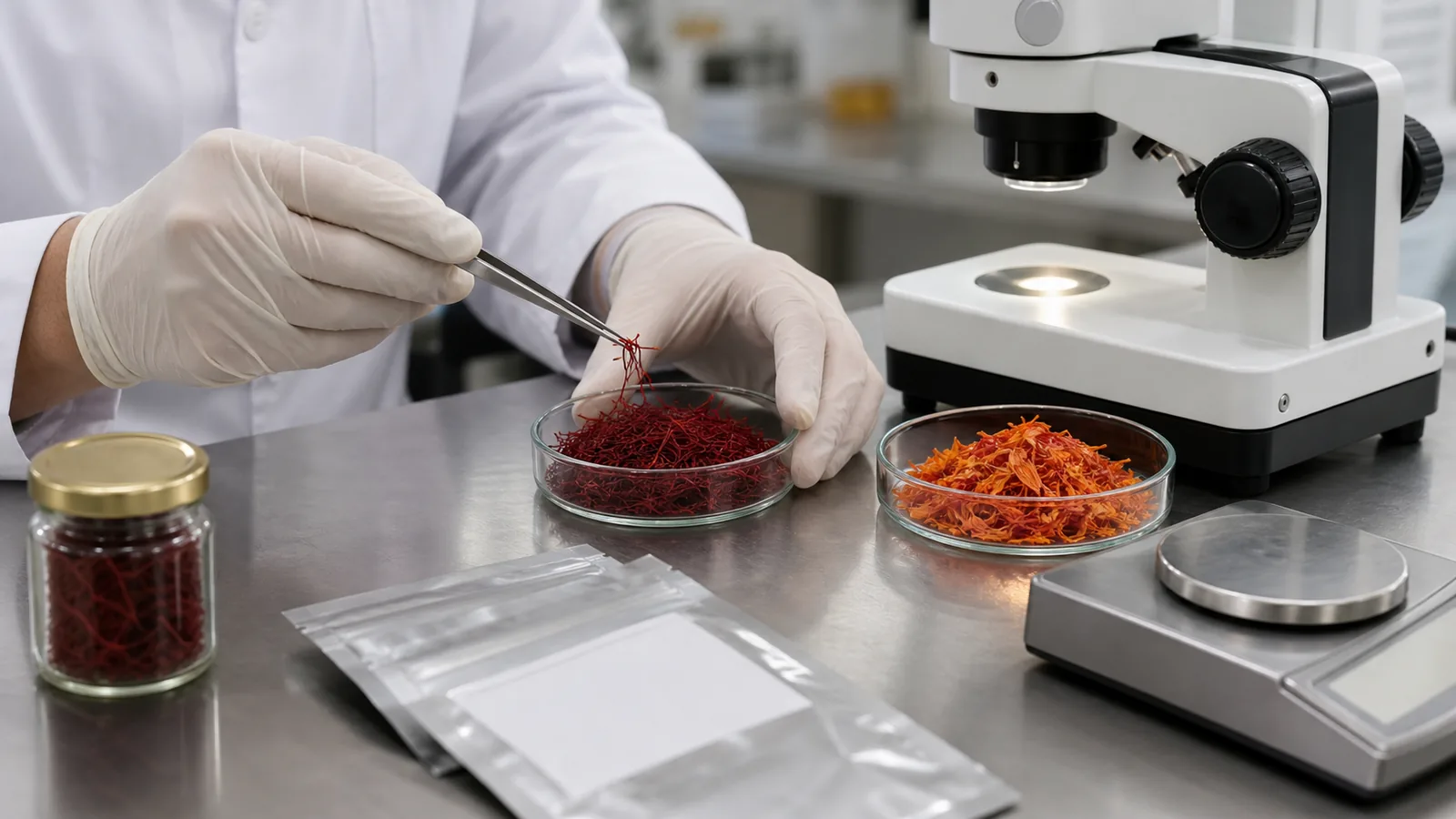
Scientific reviews describe several broad forms of saffron adulteration:
- other plant material, including safflower, marigold, maize silk or parts of the saffron flower other than the red stigmas;
- spent or low-value saffron recoloured to look fresh;
- sugar, syrup, glycerine, oil, salts or moisture added to increase weight;
- natural or synthetic colourants used to imitate the expected red or yellow release;
- powder blended with cheaper spices or fillers that are difficult to recognise by sight.
A 2023 open-access review of saffron quality control and adulteration methods documents these practices and the laboratory techniques used to investigate them. The list describes known methods of fraud; it does not imply that every sample or market has the same problem.
How genuine saffron is assessed
Start with traceability and a sensible visual check
Whole threads reveal more structure than powder. Genuine saffron stigmas usually have a deep-red colour and a widened, trumpet-like end, but natural size and colour vary. A buyer can look for excessive yellow style, suspiciously uniform fibres, loose dye, dampness or unrelated petals. These signs can justify further testing; their absence cannot prove purity.
Simple water demonstrations are often promoted online as instant tests. Release speed and colour can be affected by grinding, temperature, thread condition and the adulterant used. Treat a home test as a screen, not a certificate. Do not taste an unidentified sample merely to test it.
Use a specification and the right laboratory method
ISO explains that saffron is considered pure under ISO 3632 when it meets the standard’s requirements and no foreign matter has been added. The standard covers dried saffron as filaments, cut filaments and powder, with test methods for characteristics related to colour, aroma, flavour, moisture and extraneous matter. The current specification is ISO 3632-1:2025.
No single number answers every authenticity question. A competent laboratory may combine microscopy, spectrophotometry, chromatography, spectroscopy or DNA-based methods according to the suspected adulterant. The FDA also publishes a supplemental macroanalytical method for saffron. Buyers should ask what the certificate actually measured, not simply whether a document carries the word “tested.”
What a trustworthy saffron purchase should include
For a consumer pack, look for a sealed container, declared net weight, responsible business name, lot or batch identification, origin information and a realistic best-before period. The seller should be reachable after the sale. Our guide to buying high-quality saffron explains how to combine label information with a careful look at the threads.
For a commercial lot, the paperwork should go further:
- a purchase specification that names the saffron form and agreed quality criteria;
- a batch-specific certificate of analysis from an identifiable laboratory;
- sampling records that show the tested sample represents the delivered lot;
- seal, storage and transport records that protect the lot after testing;
- a documented process for rejection, investigation and recall.
Market calm depends on trust as well as supply
The old report connected several real forces: enforcement against alleged counterfeit sellers, soft export demand, old inventory and the approaching harvest. Each can affect trading behaviour. None, on its own, guarantees a stable price. Exchange conditions, crop size, buyer demand, finance and expectations also influence the market.
Hosseini expressed hope that continued action against violators and the arrival of the new crop would make the coming months calmer. That expectation should remain in the article because it explains the original headline. It should not be rewritten as a claim that the forecast came true.
The more durable lesson is about confidence. Arrests may stop a particular alleged fraud. Reliable sourcing, batch records, representative sampling and appropriate testing make deception harder to repeat. For growers and honest sellers, those controls protect the value of Iranian saffron. For buyers, they replace guesswork with evidence—exactly what a red gold market needs if calm is to last.

![Exporting Saffron to Turkey + Price Guide [Complete 0 to 100]](https://img.rowhanisaffron.com/20260827003933/saffron-export-turkey-quality-inspection.webp)



