


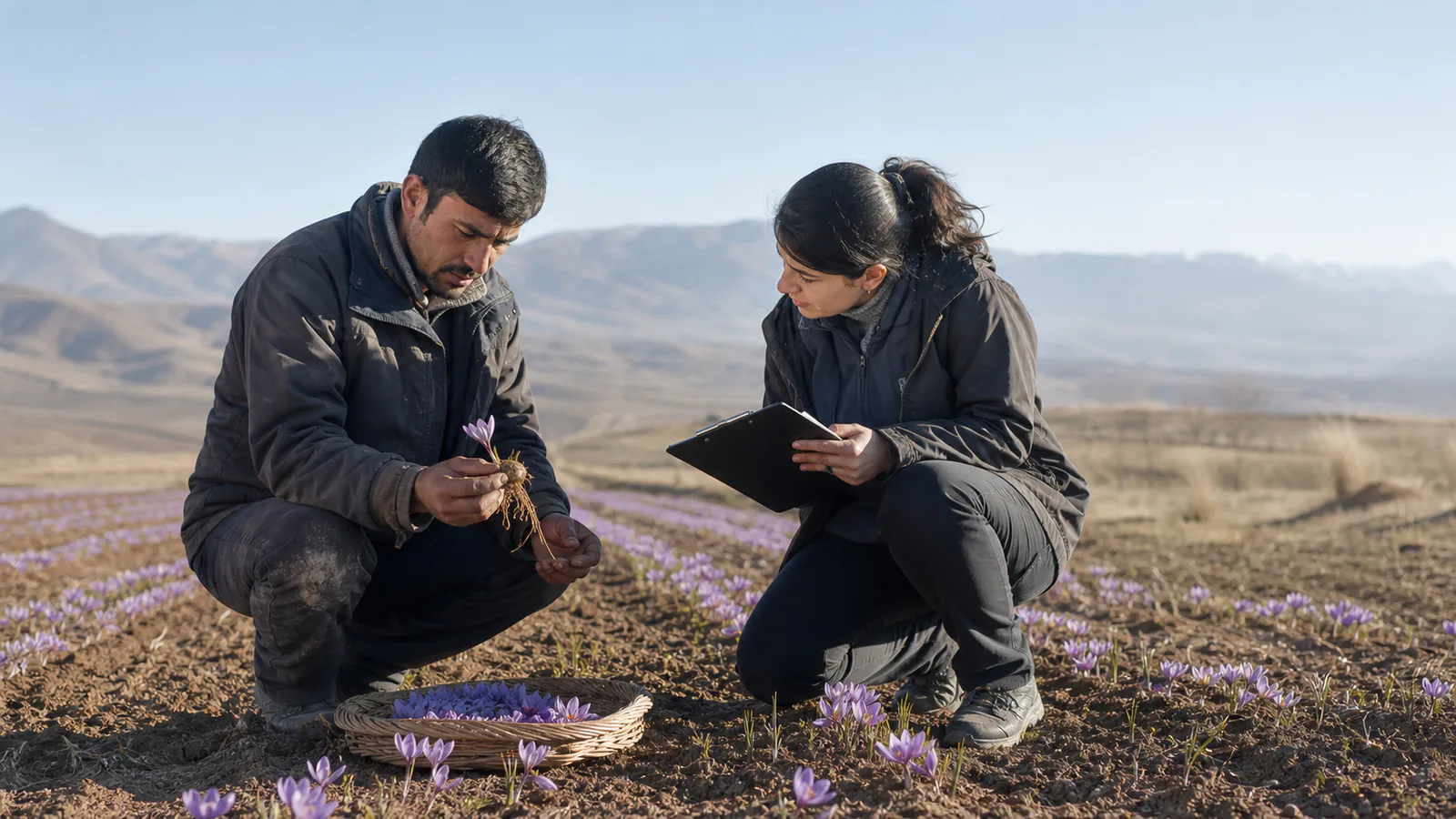
26 hectares of agricultural land planted saffron Zanjan was the central finding of a provincial agriculture report published in January 2016. Behnam Ojaqlou, Zanjan’s director of horticultural affairs at the time, said the crop was spread across 214 small plots and that the Agricultural Jihad Organization was supporting applicants interested in cultivation.
The report belongs to a specific moment in Zanjan’s crop-development programme. Its acreage, production forecast and corm price are historical figures, not today’s planting advice or market quotation. What remains useful is the picture it gives of small, local trials and the practical questions farmers had to answer before expanding them.
The 26-hectare saffron picture in Zanjan
Ojaqlou told the Iranian Students News Agency’s Zanjan bureau that 26 hectares had been divided among 214 plots. That works out to an average of about 0.12 hectare per plot, although the individual holdings would not all have been identical. The pattern suggests that saffron was still being tested mainly on modest areas rather than established as a large-field crop.
Officials expected roughly 50 kilograms of dried saffron from the province that season, similar to the previous year. The implied average was just under two kilograms per hectare. A simple division cannot show the performance of a mature field because the total area may have included new plots that produced few flowers. Field age, corm size, planting density, weather and management all affect the result.
At that production level, growers were selling principally in local markets. Ojaqlou said the agriculture organisation nevertheless saw potential across the province and would support new applicants. Later in 2016, a provincial Agricultural Jihad report said the area had reached 65 hectares after nine hectares of new planting. Both numbers should be read with their dates attached.
Why the crop attracted growers
Saffron’s annual growth cycle can fit places with a dry summer and a cool growing season. The plant is dormant through much of the hottest period, then resumes activity after autumn conditions and irrigation trigger growth. That timing can reduce summer water demand compared with crops that remain actively growing in hot weather.
“Low water use” does not mean “no water” or “suitable for every dry field.” Establishment and flowering depend on timely moisture, while waterlogging can damage corms. Zanjan’s varied elevation, winter cold, soil depth and drainage make a site-level assessment more useful than a province-wide promise.
The report described concern about drought and falling groundwater levels as part of the appeal. Saffron can be one option in a more water-conscious crop pattern, but the comparison should use a farm’s actual irrigation volume and calendar. The Food and Agriculture Organization’s account of Iran’s qanat-based saffron system in Gonabad also notes the crop’s relatively modest water requirement while emphasising the local knowledge and irrigation system around it.
Corms, not ordinary seed, establish the field
Crocus sativus is sterile and is propagated with corms. The old translation called them “scallions” or onions, but the correct agricultural term is corm. A mother corm forms replacement corms underground, allowing the stand to continue for several seasons.
Ojaqlou described planting three or four corms together and using roughly two to six tonnes of corms per hectare. Those figures record the provincial advice reported in 2016; they are not a universal prescription. The number of corms in a tonne changes with corm size, and both size and planting density influence flowering and the multiplication of replacement corms.
A two-year field study catalogued by FAO AGRIS found that mother-corm size and irrigation regime affected flower number, dried stigma yield and daughter-corm development. Its treatments and results are useful evidence that these choices matter, not a recipe to copy into a Zanjan field without local soil and climate advice.
Preparing a Zanjan plot
The 2016 guidance began with spring ploughing, followed by soil preparation before autumn planting to break down large clods. The aim is a workable, well-drained root zone rather than a loose surface sitting above compacted or waterlogged soil.
Before buying corms, a grower should check:
- field drainage, soil texture, salinity and previous crop history;
- the health, size and traceable source of the corms;
- planting date and depth for the district’s conditions;
- the quantity and quality of available irrigation water;
- weed, rodent and corm-disease risks; and
- labour available for the short flower harvest.
The report mentioned 15 to 20 tonnes of well-rotted manure and two rounds of weed control. Manure should be mature and its amount should follow soil analysis, nutrient needs and local extension advice. Fresh or excessive material is not automatically better, and a fixed tonnage cannot account for every soil.
Irrigation numbers need local interpretation
The original article said a saffron field was watered seven times, beginning immediately after planting or in early autumn. That should not be treated as a rule for Zanjan. Irrigation frequency changes with rainfall, soil water-holding capacity, field age, temperature and the timing of flowering and leaf growth.
Research helps explain why a single number is unsafe. Trials have found interactions among irrigation rounds, corm size, flower yield and quality. The useful decision is not whether seven is the correct count everywhere, but whether the root zone has the moisture the crop needs at each stage without standing wet.
Farmers planning saffron cultivation in Zanjan should build their schedule with a local agronomist and measurements from the field. Our guide to saffron cultivation and growing conditions provides a broader framework for those discussions.
Harvest the flower promptly, not three days later
The damaged English text said harvest should take place three days after flowers appeared. That would risk wilted, open flowers and loss of quality. Saffron flowers are normally picked promptly, with work beginning early in the morning before sun and warmth accelerate deterioration.
Flowers then need gentle transport in clean, shallow containers, timely stigma separation and controlled drying. The value is concentrated in a very small dried product, so careless handling during a few harvest hours can undo much of the work invested in the field.
Early picking was one of Ojaqlou’s sound practical points. It also explains why production cannot be planned from land area alone: a farm needs enough trained people to collect and process flowers during the peak, even when several plots flower together.
What the old corm price can and cannot tell us
The report ended with a corm purchase figure of 45,000 to 50,000, but the surviving English text does not identify the currency, unit or grade. Without those details, the number cannot be converted into a meaningful price and should not guide a purchase today.
A current corm quotation must state price per kilogram or per piece, average weight or size class, health status, origin, delivery terms and the date of the offer. The cheapest lot can become expensive if it contains undersized, damaged or diseased material.
A sensible way to build on the 26 hectares
Zanjan’s 214 small plots offered something valuable: a distributed set of local observations. Their best use was not simply to add hectares, but to compare which locations, corms and methods produced clean flowers and a saleable crop with manageable water and labour.
For a new grower, a measured pilot remains the safer starting point. Record establishment cost, irrigation, labour, flower weight, dried stigma yield, quality and selling price over more than one season. Expand when those records—not the reputation of “red gold”—show that saffron fits the farm.

![Exporting Saffron to Turkey + Price Guide [Complete 0 to 100]](https://img.rowhanisaffron.com/20260827003933/saffron-export-turkey-quality-inspection.webp)



