


A historical Damghan agriculture report recorded 17 hectares under saffron cultivation, of which 14 hectares were productive. After an average harvest of about 3 kilograms per hectare in the previous season, local officials forecast 4 to 5 kilograms per hectare under favorable conditions. A national briefing from the same broader period provides scale: roughly 60,000 hectares and 150 tonnes of saffron, with 98% of production attributed to Khorasan Razavi and South Khorasan.
The national figures are not current acreage totals, and the Damghan forecast is not a confirmed harvest result. Their value is historical: together they show how a small emerging district fitted into an industry still concentrated heavily in the two Khorasan provinces.
Saffron cultivation in Damghan: the 17-hectare report
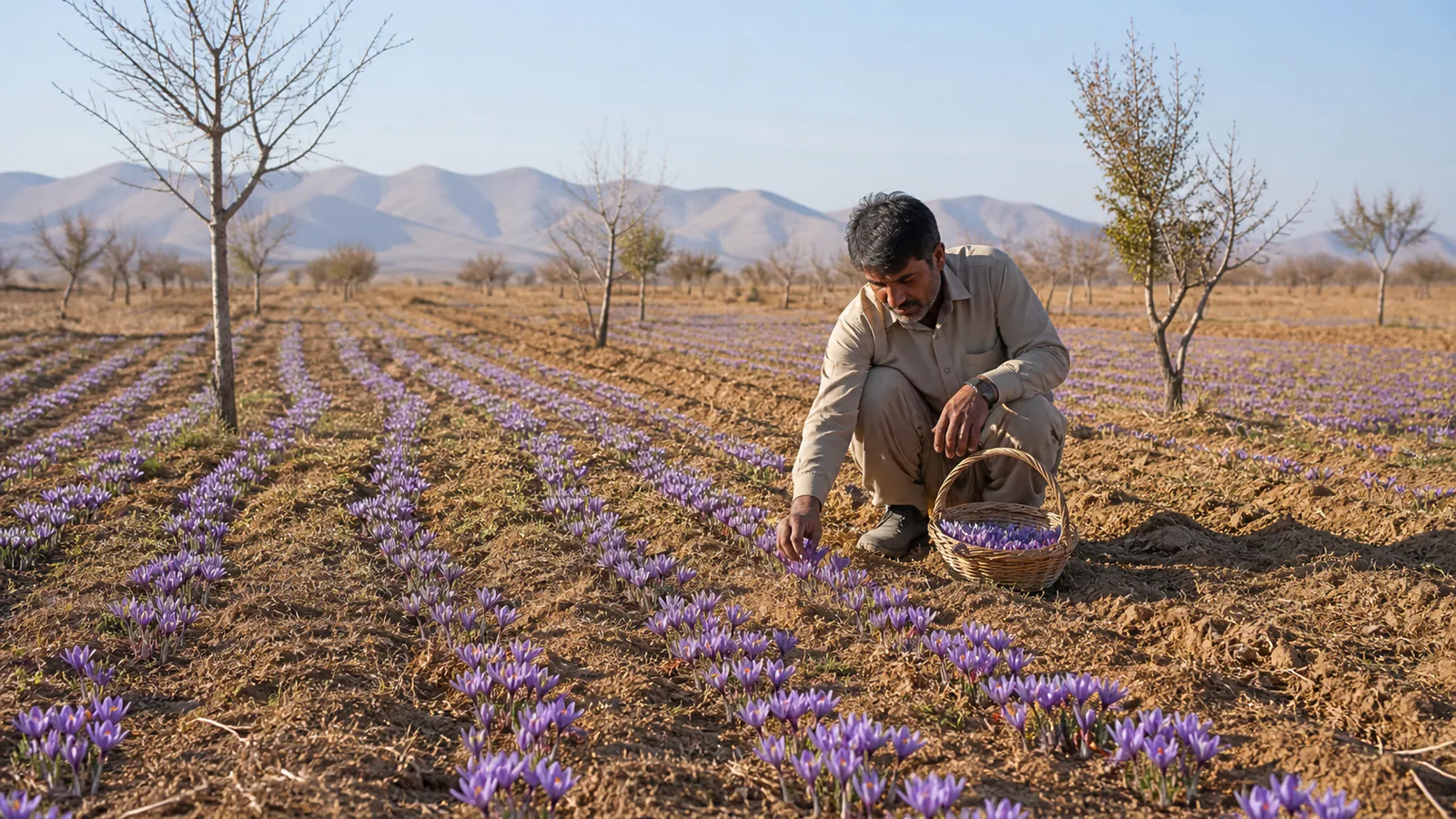
Seyyed Mohsen Tabatabayan, identified as director of Damghan Agricultural Jihad, said 17 hectares of the county’s agricultural land had been planted with saffron. Fourteen hectares were described as fertile or productive, indicating that part of the planted area had not yet reached a normal harvest stage.
The prior season’s average was reported at 3 kilograms per hectare. For the current season in that report, officials expected 4 to 5 kilograms per hectare. That higher number was a forecast based on field conditions, not a result that this article can independently confirm.
Tabatabayan also said there had been no frost damage to the local crop that season. Two favorable years had encouraged more Damghan farmers to consider saffron, and the district’s climate was described as suitable. Those observations belong to the period covered; they do not guarantee that a future season will avoid frost, heat, drought, pests, or uneven flowering.
Why farmers were interested in saffron
The local report emphasized two attractions: saffron can be cultivated on a relatively small parcel, and its water schedule can fit dry-region farming better than some alternatives. Farmers could allocate an area beside an orchard or another field rather than reorganizing an entire holding.
That does not make saffron a low-effort crop. Corm preparation, weed control, flower picking, stigma separation, drying, and storage all require care, and the harvest window creates an intense labor requirement. Profit also depends on corm health, yield, grade, market price, and the producer’s route to the buyer. Our practical saffron planting and harvest guide covers those field decisions in more detail.
How Damghan compared with the national industry
In a separate National Saffron Council meeting in Birjand, vice president Mohsen Ehtesham put Iran’s saffron area at about 60,000 hectares and the previous year’s harvest at roughly 150 tonnes. He attributed 98% of production to Khorasan Razavi and South Khorasan, leaving about 2% for the rest of the country.
Against that national estimate, Damghan’s 17 hectares represented a very small emerging cluster. The contrast is important. A local expansion headline can sound large without context, while the national figures show that knowledge, processing capacity, trading networks, and market identity were still centered in Khorasan.
| Measure | Reported figure | Scope |
|---|---|---|
| Damghan planted area | 17 hectares | 14 hectares described as productive |
| Damghan yield | 3 kg/ha previous season; 4–5 kg/ha forecast | Local report, not a guaranteed result |
| Iranian saffron area | About 60,000 hectares | Historical National Saffron Council estimate |
| Iranian production | About 150 tonnes | Previous year in the national report |
| Khorasan share | 98% | Khorasan Razavi and South Khorasan combined |
The national problems behind the acreage figures
Ehtesham’s briefing was not simply a celebration of scale. He listed limited working capital, high marketing costs, unstable domestic prices, and saffron fraud in world markets among the industry’s main problems. He also argued that sharp price rises had reduced consumption in some markets and that poorly coordinated trading weakened the sector.
These problems affect a new district as much as an established one. A farmer may produce sound saffron and still struggle if drying is inconsistent, buyers lack transparent grading, cash arrives late, or the product enters a market where adulteration has damaged trust.
Export capacity and the call for branding
The national report counted about ten specialized export units and roughly forty prominent individual or corporate exporters. These were attributed historical estimates, not a current directory. Ehtesham’s larger point was that Iran needed stronger specialist businesses and a clearer place for Iranian saffron in international markets.
Branding in this context should mean more than a decorated box. It depends on repeatable quality, traceable origin, accurate weight, compliant labeling, laboratory verification where required, and reliable delivery. Those systems help a small producing area connect to the value chain without losing its identity or competing only on raw price.
What the combined report means for Damghan
Damghan’s 17 hectares were evidence of diversification, not a challenge to Khorasan’s production base. The district had favorable conditions in the years described and a forecast for better yields, while the national picture showed how much infrastructure sits behind a mature saffron industry.
For local expansion to last, acreage should follow measured field performance. Growers need healthy planting material, realistic labor plans, consistent drying and storage, and buyers who reward quality. A small area can produce valuable saffron, but the economics are strongest when cultivation and market access grow together.

![Exporting Saffron to Turkey + Price Guide [Complete 0 to 100]](https://img.rowhanisaffron.com/20260827003933/saffron-export-turkey-quality-inspection.webp)



