


The area under saffron cultivation increased in Chaharmahal and Bakhtiari to a reported 200 hectares after doubling in the period covered by these local reports. The expansion included 50 hectares planted mechanically and a 40-hectare cluster in Ben County, where officials forecast a 180-kilogram harvest.
The numbers describe an emerging province, not a current land census or a guarantee of profit. They also reveal the work still missing between field and customer: reliable local data, careful corm planting, harvest capacity, quality control, packaging and a traceable regional identity.
How far saffron cultivation had expanded
Zabihullah Gharib, then head of the provincial Agricultural Jihad organization, said the area planted with saffron had doubled and reached 200 hectares. He also reported growing farmer interest and described saffron as a potentially good source of income.
The article does not state the earlier baseline year, survey method or later harvested area. Doubling to 200 hectares implies a comparison near 100 hectares, but that inference should not be turned into an exact crop-year series without the provincial records.
FAO describes saffron as a high-value, climate-resilient crop relevant to arid regions, while also placing it within a complete system of production practice, post-harvest handling, safety, traceability and marketing. That distinction matters here: adding hectares creates potential supply; it does not by itself create a dependable market or farmer return.
The first reported mechanized corm planting
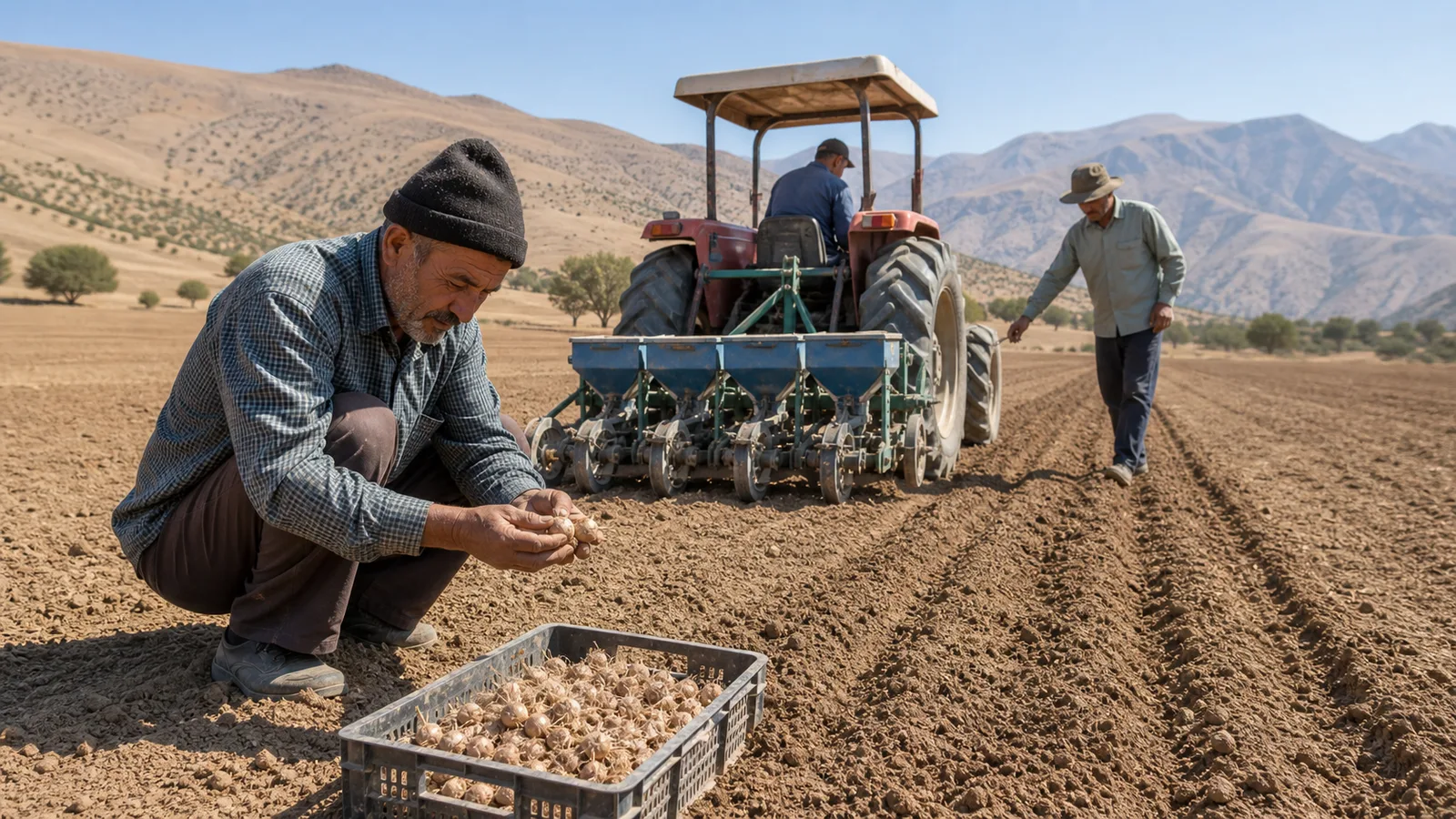
Hamidreza Danesh, then deputy for plant-production improvement, said saffron corms had been planted mechanically on 50 hectares for the first time in the province. With the province reported at 200 hectares, the mechanized area represented one quarter of the stated total.
This was mechanized planting, not mechanized flower picking or stigma separation. The distinction prevents a common overstatement: a machine that places corms does not remove the concentrated labour needed when flowers open.
The archived translation calls the planting material “onions.” Botanically, they are corms. Cultivated saffron is sterile and reproduces vegetatively; peer-reviewed plant research confirms that propagation is through corms rather than viable seed. Danesh’s statement therefore describes a mechanized way to place the crop’s normal planting material, not a new seed variety.
Danesh also gave a provincial yield of 5 kilograms of dried saffron per hectare. The source provides no sample, farm-age distribution or range, so 5kg/ha should remain an attributed benchmark rather than a promised yield for every grower.
Why water policy encouraged the shift
The mechanization report linked saffron to Chaharmahal and Bakhtiari’s effort to change its cultivation pattern as water resources declined. Officials wanted more crops with relatively low water demand.
That does not make saffron a crop without water or site limits. FAO’s recognized Qanat-based system in Gonabad shows how saffron and carefully managed irrigation can support livelihoods under severe water scarcity. A farm plan in Chaharmahal still needs local soil, weather, water availability, field age and irrigation evidence.
Ben County’s 40-hectare example
A second source focused on Ben County, rendered as “Bonn” in the old English title. Bagheri, then the county’s agricultural director, said 40 hectares were planted with saffron and forecast a 180-kilogram harvest.
The forecast is internally consistent with his stated average of 4–5 kilograms per hectare: 180 kilograms across 40 hectares equals 4.5kg/ha. He added that fields with better water, soil, management and irrigation could yield more, but supplied no trial data that would support a universal higher target.
Ben’s saffron area was part of a much larger agricultural base. The report divided the county’s 28,000 hectares into:
- 10,000 hectares of rainfed land;
- 14,000 hectares of irrigated arable land; and
- 4,000 hectares of gardens or orchards.
The categories reconcile to the stated 28,000 hectares. Saffron’s 40 hectares were therefore a small, targeted part of the county’s land use rather than its dominant crop.
The missing local brand and processing chain
Gharib said provincial saffron was sold in other provinces without a Chaharmahal and Bakhtiari brand. The phrase translated as “Babrand province” is best read as “unbranded.” Bagheri gave the local version of the same problem: Ben saffron was sold raw through brokers and packed or marketed elsewhere because the county lacked packaging, processing and complementary industries.
Selling through another province is not automatically harmful. A specialist packer may provide testing, compliant materials and buyer access. The loss occurs when the grower cannot verify the grade and realised price, or when the producing place disappears from the lot record.
A credible local chain would identify the farm and harvest, test a representative sample, record grade and weight, preserve the lot during drying and storage, and state accurately where it was grown and packed. The Codex saffron standard CXS 351-2022 supplies a shared starting point for quality classes, contaminants, hygiene, packaging, labelling and analysis.
What progress should be measured next?
For Chaharmahal and Bakhtiari, success is more specific than another increase in area:
- confirm planted and harvested hectares for the same crop year;
- compare mechanized and conventional corm planting for accuracy, corm damage, labour, cost and later yield;
- record dried yield by field age rather than quote one provincial average;
- measure water use under local conditions;
- track the tested grade, sale route and net return of Ben and other provincial lots; and
- verify whether new packaging or processing keeps the producing province visible.
The 200-hectare total, 50 mechanized hectares and Ben’s 180-kilogram forecast fit together as one regional story. Saffron cultivation increased in Chaharmahal and Bakhtiari because farmers and officials saw a crop suited to a water-constrained future. The lasting result will depend on whether the province can turn that expansion into measured yields, reliable quality and sales that growers can trace beyond the broker.

![Exporting Saffron to Turkey + Price Guide [Complete 0 to 100]](https://img.rowhanisaffron.com/20260827003933/saffron-export-turkey-quality-inspection.webp)



