


Ghaenat was reported to have produced 22 tons of dry saffron from 5,300 hectares in 2019, alongside a large barberry harvest and an established processing sector. The figures describe that period; they are not a current production forecast.
Where the 22-ton figure came from
Mohammad Karimi, then governor of Ghaen, presented the figures at the Ghaen Barberry and Saffron Thanksgiving Festival on 2 November 2019. The original Mehr News Agency report records 22 tons of dry saffron across 5,300 hectares and says the county ranked first in the province for the crop.
It does not identify the survey method, field ages or whether the 22 tons was a final weighed total or a rounded administrative figure. The safest reading is a dated county-level report attributed to the governor.
What the figures imply about average yield
Twenty-two tons is 22,000 kilograms. Spread across 5,300 hectares, that works out to roughly 4.15 kilograms of dry saffron per cultivated hectare. This is a derived provincial-style average, not a promise for an individual farm.
A planted-area total may include young, mature and declining fields. Corm density and health, soil salinity, irrigation timing, autumn weather, flower collection and drying losses can all move a particular plot far above or below the broad average.
Saffron and barberry formed one local economy
Karimi discussed saffron together with seedless barberry. Ghaenat was reported to have produced 7,000 tons of dried barberry from 6,200 hectares in the same account. South Khorasan was also said to supply 95 percent of Iran’s barberry.
The two crops have different harvest and handling needs, but both rely on concentrated seasonal labour, clean processing, storage and a route to market. Reading the figures together helps explain why the festival focused on the wider rural value chain rather than saffron alone.
The employment number covered both crops
The report associated barberry and saffron activity in the county with 25,000 job opportunities. It did not say that these were 25,000 permanent full-time posts, nor did it allocate them between farming, seasonal harvesting, processing and export.
That distinction matters. Saffron creates intense work during a short flowering period, while grading, drying, packing, quality control and sales can extend activity beyond the field season. The 25,000 figure should remain attributed to the combined sector and its original date.
Processing capacity was already part of the story
Fifteen processing units and three export units for saffron and barberry were reported active in Ghaen. This infrastructure can help keep more value in the producing region, but the number of units does not reveal their capacity, certification status or how much crop they handled.
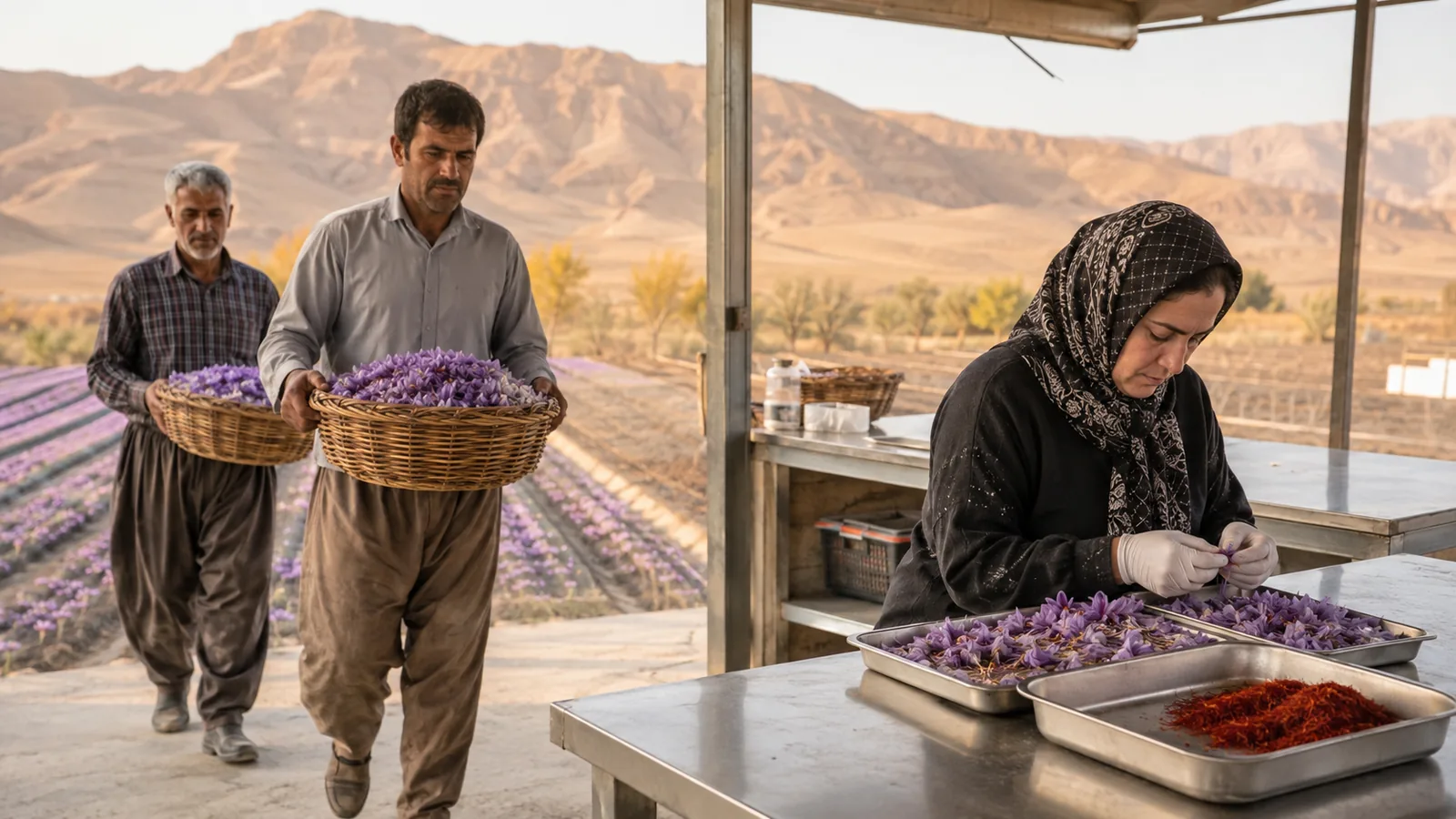
For saffron, effective processing means flowers reach a clean separation area quickly, stigmas are dried under controlled conditions, lots remain traceable and packaging protects the finished threads. A unit adds value only when its handling preserves quality and meets the requirements of its buyers.
Training and traceability matter at field level
Karimi called for stronger knowledge among growers and producers. That is a practical issue in a county with thousands of hectares: uneven corm selection, irrigation, picking or drying can create large differences between lots sold under the same regional name.
Earlier quality work in the region offers a useful example. An Iranian Agricultural News Agency report described a quality and production-identification programme covering 22 villages, including five in Ghaen. The principle remains relevant: recorded origin and handling are more useful than an unsupported quality adjective.
“Organic” requires evidence, not a label
The governor also encouraged progress toward organic production. In ordinary speech, that phrase is sometimes used for reduced chemical inputs, but a commercial organic claim requires compliance with the rules of the intended market and valid certification.
Farmers and sellers should therefore distinguish a production goal from a verified status. A lot should not be presented as organic merely because saffron is hand-picked or grown in a traditional area.
Food, health and pharmaceutical uses need separate controls
Karimi called for food, health-related and pharmaceutical industries to support the two crops. That is an industrial-development proposal, not evidence that any particular saffron product treats disease.
Each use has its own specifications. A food spice needs hygienic handling and accurate identity; an extract or regulated ingredient may require additional testing, documentation and manufacturing controls. The presence of saffron in a product does not by itself establish a health effect.
Purchase finance and export were proposals
The report requested low-interest facilities for agreed purchasing and called for export arrangements. These were policy requests, not confirmation of a permanent buying programme, a guaranteed price or an export entitlement for every producer.
For growers, the safer commercial foundation is a clear specification, documented lot, known buyer and agreed terms. For the region, finance can help only when storage, quality control and market access prevent the crop from losing condition while it waits for sale.
Be cautious with broad world-share claims
The 2019 remarks included very large claims about Iran’s share of world saffron production, but the source wording is internally unclear and does not identify a dataset or crop year. Those percentages should not be repeated as precise global statistics.
The local figures are better supported within the report: 22 tons of dry saffron from 5,300 hectares, 7,000 tons of dried barberry from 6,200 hectares, and the stated processing and export units. They are substantial without adding an uncertain global comparison.
How to read the Ghaen record today
The article preserves an important 2019 benchmark for a major saffron-growing county. It shows that cultivation, seasonal work, processing, traceability, purchase finance and export planning were already connected concerns in Ghaen.
Current claims need current agricultural data. The 22-ton figure remains a historical result, while the enduring lesson is that regional reputation has to be protected lot by lot through sound field practice, rapid handling and verifiable quality.

![Exporting Saffron to Turkey + Price Guide [Complete 0 to 100]](https://img.rowhanisaffron.com/20260827003933/saffron-export-turkey-quality-inspection.webp)



