


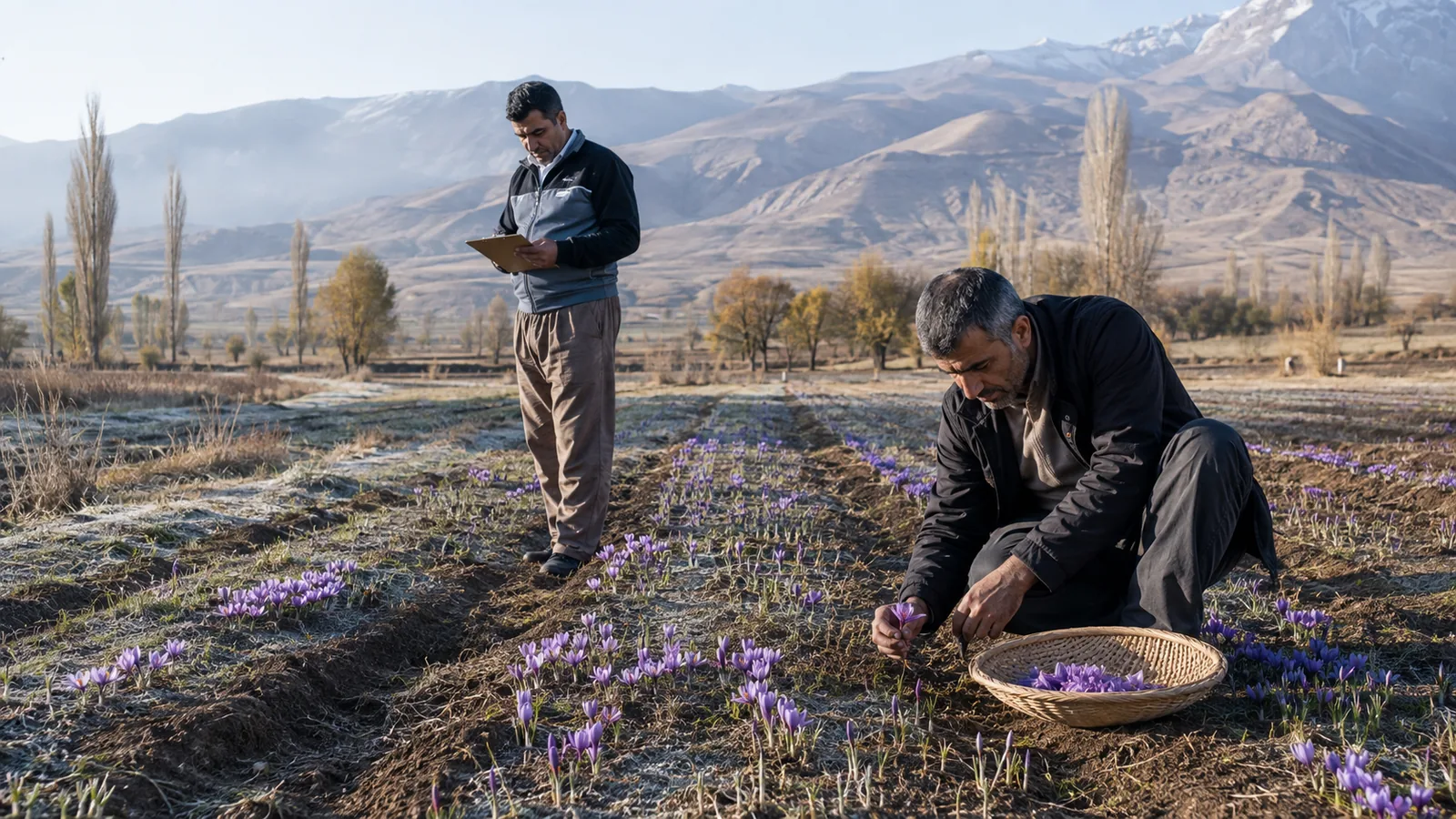
Saffron cultivation was reported on 161 hectares of agricultural land in Hamadan province as part of a wider effort to develop crops suited to tighter water supplies. The figure is a historical provincial snapshot, not a statement of Hamadan’s present saffron area.
What the 161-hectare report established
Mansour Rezvani Jalal, then head of the Hamadan Agricultural Jihad Organization, said saffron had been planted across 161 hectares in the province. He placed it within a programme to improve cropping patterns and raise the value produced from limited water.
The announcement did not provide a crop year, district breakdown, production total or average yield for those 161 hectares. It should therefore be preserved as an area report rather than turned into an estimate of how much saffron Hamadan produced.
How saffron cultivation had expanded
An earlier Iranian Agricultural News Agency report from February 2016 recorded more than 63 hectares of saffron in Hamadan. It identified Malayer as the leading county at the time, with 23 hectares, and reported an average of 3.8 kilograms per hectare.
Those earlier numbers help show the scale of the later 161-hectare announcement. They do not prove a continuous growth rate, because planted area can change and the two reports may use different survey dates or inclusion rules.
Why saffron was included in the crop plan
Rezvani Jalal described lower-water crops as a way to improve resource use and diversify farm income. Saffron is often considered for this role because its irrigation calendar and water demand differ from many summer crops. It also produces a compact, high-value dried product.
“Lower water” does not mean “no water.” Corm establishment, the first autumn irrigation, flowering conditions and spring leaf growth still require sound soil and water management. A farmer needs to compare the whole crop cycle, local water quality and the likely market before replacing an established crop.
Hamadan conditions vary from field to field
Cold winters and a pronounced seasonal cycle can suit saffron in parts of Hamadan, but province-wide suitability should not be assumed. Drainage, planting depth, frost pockets, summer soil conditions and access to healthy corms can differ considerably between districts and elevations.
A 161-hectare total says how much land was reported under the crop. It does not say that every hectare performed equally or that the crop was the best choice for every holding.
Saffron was one of several medicinal and aromatic crops
The report also named Damask rose, coriander and fennel. These crops were presented as part of Hamadan’s underused economic capacity in medicinal and aromatic plants, with the potential to support rural work and bring farmers a more valuable product mix.
They are not interchangeable. Each has its own soil, labour, machinery, processing and buyer requirements. A useful diversification plan matches a crop to a specific farm and to a realistic route from harvest to sale.
The growth of Damask rose offered a parallel
According to Rezvani Jalal, modern Damask rose cultivation began in Hamadan in the Iranian year 1383 on 55 hectares and later exceeded 180 hectares. The example was used to show how a small specialist crop can expand when planting knowledge and infrastructure develop together.
For saffron, the equivalent infrastructure includes dependable corm supply, grower training, rapid flower collection, clean stigma separation, controlled drying, grading, packaging and access to buyers. Expanding hectares without those services can simply move the bottleneck from the field to the processing room.
Employment depends on the full value chain
Saffron creates concentrated seasonal work during picking and separation. Longer-lasting local value is more likely when the province also retains skilled drying, quality control, packaging and sales activity. That is the practical link between specialist crops and the report’s goals of employment and a more resilient regional economy.
Neither planted area nor a promising market guarantees farm income. Labour cost, yield, rejected material, wholesale price and the ability to sell a documented grade all influence the result.
Recent projects should not be confused with the old total
Hamadan’s saffron sector has continued to develop, but newer project figures describe particular operations. For example, an official September 2025 report described a private farm expanding from 22 to 50 hectares, including 30 hectares planned under contract cultivation.
That project is evidence of continued investment, not a replacement provincial census. It should not be added to the historical 161 hectares or used to calculate a current Hamadan total.
What farmers would need before expanding
A responsible decision starts with soil drainage, water availability and quality, corm health, likely labour supply and a processing plan. The buyer and quality specification should be understood before planting, not after the first large harvest arrives.
Small pilot plots can reveal local flowering, disease and handling conditions without committing a whole farm. Recording irrigation, bloom dates, labour hours, dried yield and quality by lot then gives a grower evidence for a measured expansion.
How to read the Hamadan figure today
The 161-hectare record is useful evidence that saffron had moved beyond isolated trial plots in Hamadan. It also captures the policy thinking of its period: use less water-intensive crop options, build medicinal-plant infrastructure and create more work around processing and sale.
Its limits are equally important. The article does not establish present area, present output or guaranteed profitability. Those questions require current provincial statistics and farm-level evidence. What remains sound is the emphasis on infrastructure and careful crop choice rather than expansion for its own sake.

![Exporting Saffron to Turkey + Price Guide [Complete 0 to 100]](https://img.rowhanisaffron.com/20260827003933/saffron-export-turkey-quality-inspection.webp)



