


Zarand saffron production was reported at 170 hectares and about 800 kilograms in the archived season, placing the county first in Kerman province. Later official provincial reports continued to identify Zarand as Kerman’s leading saffron area, although their dated figures should not be mistaken for a current 2026 total.
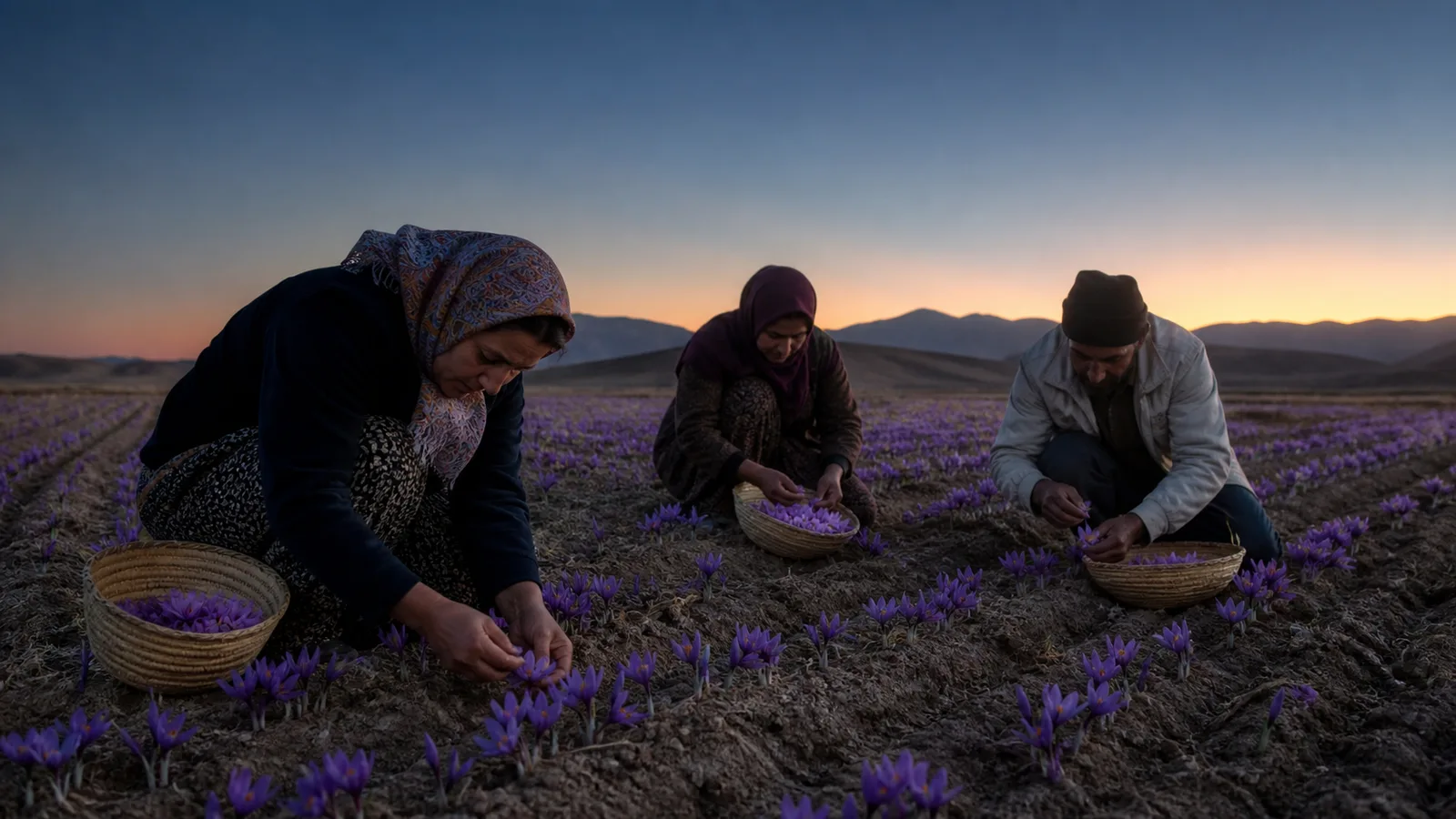
The exact title—“Zarand ranks first in saffron production in Kerman province”—has substantial and rising search visibility, including current impressions for official Kerman production information and a comparison with Rafsanjan. It remains unchanged. The ranking below is tied to the years and official reports cited; it is not an unsupported live leaderboard.
What the original Zarand production report said
Reza Karami, identified as governor of Zarand, announced the county’s first-place position while the saffron harvest was beginning. He said 170 hectares in Dashtkhak, Sarbanan and Hatkena were planted with saffron.
The report gave an average dried-saffron harvest of four to five kilograms per hectare and forecast approximately 800 kilograms for the season. Dividing 800 kilograms by 170 hectares gives about 4.7 kilograms per hectare, so the forecast is internally consistent with the stated range.
The text does not give a publication year for those figures or say how much of the 170 hectares was mature and bearing. The 800 kilograms was a forecast, not a final weighed result.
What later official Kerman reports recorded
Dated reports from the Iranian Agricultural News Agency, reporting statements from Kerman agricultural officials, show how the figures changed:
- 3 February 2020: an IANA report said Zarand’s area had grown from 340 to 380 hectares and reported a 1,200-kilogram harvest, with the largest area in Dashtkhak and Sarbanan.
- 5 December 2020: another official provincial account described Zarand as Kerman’s saffron capital and holder of the province’s highest area and production. It reported 410 hectares and forecast 1,200 kilograms in Zarand, within a provincial total of 1,600 hectares and 5,100 kilograms.
- 28 September 2021: an IANA update reported 390 hectares, of which 350 were bearing, and again placed Zarand first in the province by area.
The 380-, 410- and 390-hectare figures are not interchangeable. They refer to different reporting dates and may reflect annual changes or definitions. Together, they support the historical leadership claim; none is a substitute for a current agricultural census.
How Rafsanjan compared in the same provincial record
Rafsanjan is also a Kerman saffron-producing county. An IANA report dated 7 October 2020 forecast 75 kilograms from 25 hectares in Rafsanjan, particularly in suitable mountain areas and places with fresh water and soil.
That historical 25-hectare figure was far below the 380–410 hectares reported for Zarand around the same period. It explains why official Kerman sources described Zarand, rather than Rafsanjan, as the provincial leader. It does not establish the counties’ present-day areas.
Where Zarand’s saffron was grown
The original article names Dashtkhak, Sarbanan and Hatkena. Later official reports use Dashtkhak, Sarbanan, Jorjafak and Hatkan for the main saffron areas. The English spellings vary because the names are transliterated from Persian; Hatkena and Hatkan appear to refer to the same local name, but the archived form is retained here.
Seyyed Ali Amiri, identified as director of Agricultural Jihad in Zarand, said farmers welcomed saffron because its corms require relatively little water. He reported that planted area had increased by 10 hectares during that year.
The later official sources also connect expansion with lower summer irrigation demand and economic value. Saffron still needs suitable soil, healthy corms and correctly timed water; “low water” does not mean a field can succeed without a water plan.
What 12,000 people per day probably meant
The translation says the harvest created work for “12,000 people per day.” Agricultural employment is often reported in person-days: one person working for one day. Without the Persian unit or payroll records, the defensible reading is approximately 12,000 person-days across the harvest season, not 12,000 permanent jobs or necessarily 12,000 workers every day.
Amiri said harvest in Dashtkhak, Sarbanan and Hatkan would continue until the end of November. Labour is concentrated because flowers must be collected during a short bloom and their stigmas separated promptly.
Why flowers were picked before sunrise
The article treats pre-sunrise picking as a distinctive characteristic of Zarand saffron. Cool early-morning harvest can keep flowers closed and reduce exposure to heat before separation. It also lets processors begin the day’s work sooner.
Amiri attributed Zarand saffron’s aroma and high quality to harvesting before sunrise and said some product was sent to other provinces each year. Early picking can support careful handling, but it does not by itself prove a grade. Corms, field conditions, separation, drying, storage and the tested lot all affect final quality.
The health claims need a separate standard of evidence
The archived text says saffron reduces “blood disorders,” regulates heart rate, treats mental disorders and depression, and inhibits the growth of liver and kidney cancer cells. It cites no study, preparation, dose or human population for those statements.
Clinical trials and reviews have investigated standardised saffron preparations for depressive symptoms. A 2024 systematic review of neurological and psychiatric trials reported promising results but also describes specific interventions and study settings; it does not turn culinary saffron into a replacement for professional care.
Laboratory findings involving cancer cells are not evidence that saffron prevents or treats liver or kidney cancer in people. “Blood disorders” is too broad to be a meaningful medical claim, and heart-rate disorders require diagnosis. No one should delay medical or mental-health care because of the claims in this agricultural report.
What the ranking establishes
The archived 170-hectare report and the later 2019–2021 official accounts consistently place Zarand at the front of Kerman’s saffron sector for their respective periods. They also show why a year matters: reported area moved from 170 hectares in the older account to roughly 380–410 hectares in later ones.
Zarand’s strongest documented story is regional production rooted in Dashtkhak and neighbouring districts, with concentrated seasonal labour and early-morning harvest. A current claim about first place should still be checked against the newest complete provincial figures before it is used in a contract, investment decision or official comparison.

![Exporting Saffron to Turkey + Price Guide [Complete 0 to 100]](https://img.rowhanisaffron.com/20260827003933/saffron-export-turkey-quality-inspection.webp)



