


The production of 50 kg of saffron in Lorestan province was announced in an earlier report by Ishaq Taheri Moghaddam, then identified as head of the Lorestan Agricultural Jihad Organization. He also described 100 hectares of scattered cultivation, progress in local corm supply and laboratory values for colour, aroma and taste. These are historical figures, not a current production forecast.
What the 50-kilogram figure represents
Taheri Moghaddam estimated total provincial saffron production at 50 kilograms. The source did not state the crop year, whether the weight was fully dried saffron, how farms reported their harvests or whether the estimate covered every producing district.
Those missing details matter when comparing one season with another. A production total is meaningful only when the reporting boundary, year, moisture basis and collection method remain consistent.
Lorestan’s reported 100 hectares
The same official put the area under saffron at 100 hectares. He said the fields were scattered, so he could not name one common cultivation centre within the province.
The production and area figures should not be divided into a provincial yield without knowing how much of the 100 hectares was mature and productive in that season. Newly planted land, young fields and established fields can contribute very different amounts.
The claim that Lorestan is an origin of saffron
Taheri Moghaddam said Lorestan was an origin of saffron and that documents supported the statement. The article did not identify those documents, their dates or whether “origin” meant ancient cultivation, trade, local varieties or the domestication of Crocus sativus.
The claim is therefore preserved as his historical position, not converted into a settled botanical conclusion. A stronger account would name the archaeological, textual or botanical sources and explain exactly what each one establishes.
Why farmers were interested in the crop
The official described saffron as relatively undemanding in water and suitable for expansion across a larger share of Lorestan’s agricultural land. Saffron does use water differently from many summer crops because much of its active cycle falls in cooler months.
Low water demand does not mean no water requirement. Timely moisture around sprouting and flowering, well-drained soil and protection from prolonged waterlogging all affect establishment and yield. Suitability still needs to be checked field by field.
Expansion was a programme, not a guarantee
The article said saffron cultivation had begun expanding in Lorestan over the preceding few years and that the agricultural organisation planned further growth. The phrase “past few years” belongs to the original report and should not be read relative to the present.
Expansion is useful only when growers have healthy corms, appropriate land, harvest labour, drying capacity and a realistic route to market. Allocating land without those pieces can increase planted area without producing a durable crop.
Research and plant-production support
Taheri Moghaddam credited cooperation between a research centre and the organisation’s Deputy of Plant Production for the work in Lorestan. The report did not describe their trials, extension programme or farm-selection method.
Good provincial support would record corm source and size, planting date, soil and water conditions, field age, flowering, dry yield and quality results. That evidence would show which local practices deserve to be expanded.
“Profitable” depends on the whole farm budget
The source called saffron a profitable and economic product for the province. That may have been the programme’s objective, but profitability varies with corm and land costs, labour, water, losses, drying, grade, packaging and the price actually received.
A gross sales estimate is not net farm income. Growers need a multi-year budget because establishment costs come early while field performance and replacement needs change as the planting ages.
Progress toward local corm self-sufficiency
Taheri Moghaddam said Lorestan had reached the threshold of self-sufficiency in producing saffron “onions.” The correct botanical term is corms. Local multiplication can reduce dependence on distant supply and make source records easier to maintain.
Quantity alone is not enough. Corm lots should be healthy, traceable, appropriately sized and handled carefully between lifting and planting. Multiplying infected or badly damaged material locally would spread a problem rather than solve one.
The reported colour, aroma and taste values
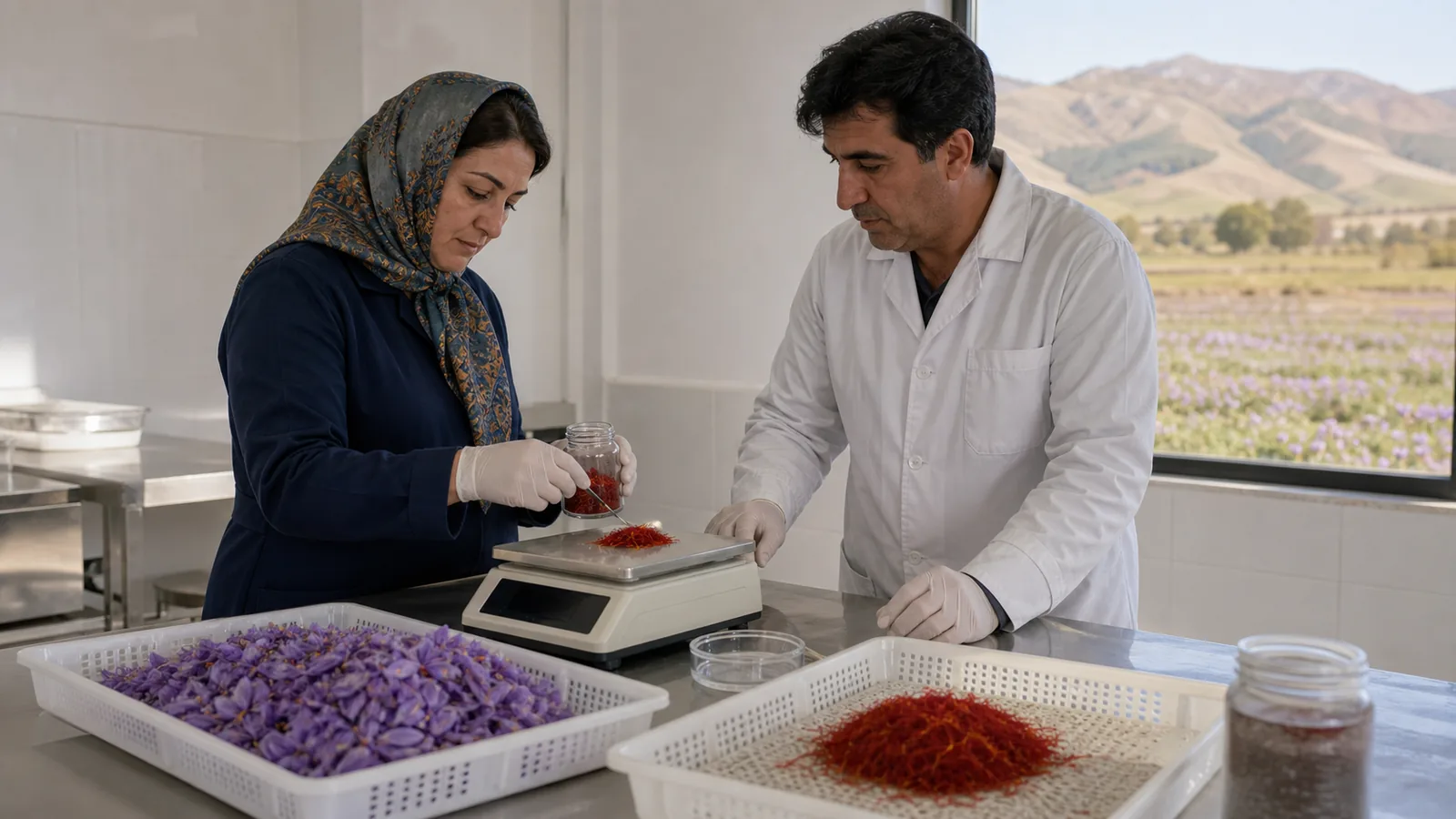
The official compared Lorestan saffron with national figures. He gave colour as 277 units in Lorestan versus 220 nationally, aroma as 33 versus 22, and taste as 100 versus 85. He presented these results as evidence that the province’s saffron was superior.
The values resemble measurements used in saffron grading, but the article gives no laboratory, sample count, harvest year, test method or variability. They should remain attributed results. One set of measurements cannot establish that every Lorestan batch is better than every batch from another province.
What recognised saffron tests measure
ISO 3632 applies to dried saffron in filament, cut-filament and powder forms. The FAO/WHO Codex standards register lists CXS 351-2022 for dried floral parts of saffron; that standard identifies picrocrocin with taste strength, safranal with aroma strength and crocin with colouring strength.
These named measures provide context for the three qualities in the report. They do not prove that its numbers were generated under the current standard. A valid comparison needs the version of the method, preparation, instrument conditions and representative sampling.
A high colour number is not the complete quality story
Colouring strength matters, but saffron quality also involves identity, purity, moisture, foreign matter, floral waste, aroma, taste and safe handling. Visual redness alone cannot establish grade, and a laboratory number should be tied to the tested batch.
Storage and drying can change what reaches the customer. Light, heat, moisture and oxygen can reduce quality after harvest even when the stigmas began with strong laboratory results.
Authenticity requires more than routine grading
FAO’s work with Ferdowsi University of Mashhad on saffron authenticity notes that international trade commonly refers to ISO 3632, while basic tests may not detect every sophisticated adulteration or capture subtle quality differences.
That distinction protects buyers and producers. Grade testing can describe important characteristics, while origin and authenticity claims may need traceability and additional validated methods.
What a current Lorestan production record should include
An updated provincial account would separate newly planted from productive hectares and provide the crop year, dry production, farm count, district distribution and yield range. Quality figures should identify the laboratory, sampling plan, standard and grade.
It would also track locally produced corms, disease losses, training, drying facilities and sale outcomes. Those details would show whether the earlier programme produced lasting capacity rather than a one-season headline.
Reading the earlier announcement accurately
Production of 50 kg of saffron in Lorestan province records a stage in the crop’s provincial development: 100 scattered hectares, a 50-kilogram estimate, work with research and plant-production teams, near self-sufficiency in corms and promising laboratory values.
The figures are worth retaining because they define the report. Their age and missing methods should be equally visible. Lorestan’s strongest case will come from dated field records, transparent laboratory testing and consistently good saffron—not from treating an earlier estimate as a permanent fact.

![Exporting Saffron to Turkey + Price Guide [Complete 0 to 100]](https://img.rowhanisaffron.com/20260827003933/saffron-export-turkey-quality-inspection.webp)



