


The headline “13% of agricultural production in Khorasan province is saffron” refers to economic value, not 13 percent of the province’s physical crop volume. In the earlier statement behind the article, Khorasan Razavi governor Mohammad Hossein Forouzan Mehr said saffron accounted for 13 percent of the value of provincial agricultural products and linked saffron’s value in Khorasan Razavi to water scarcity, employment and exports.
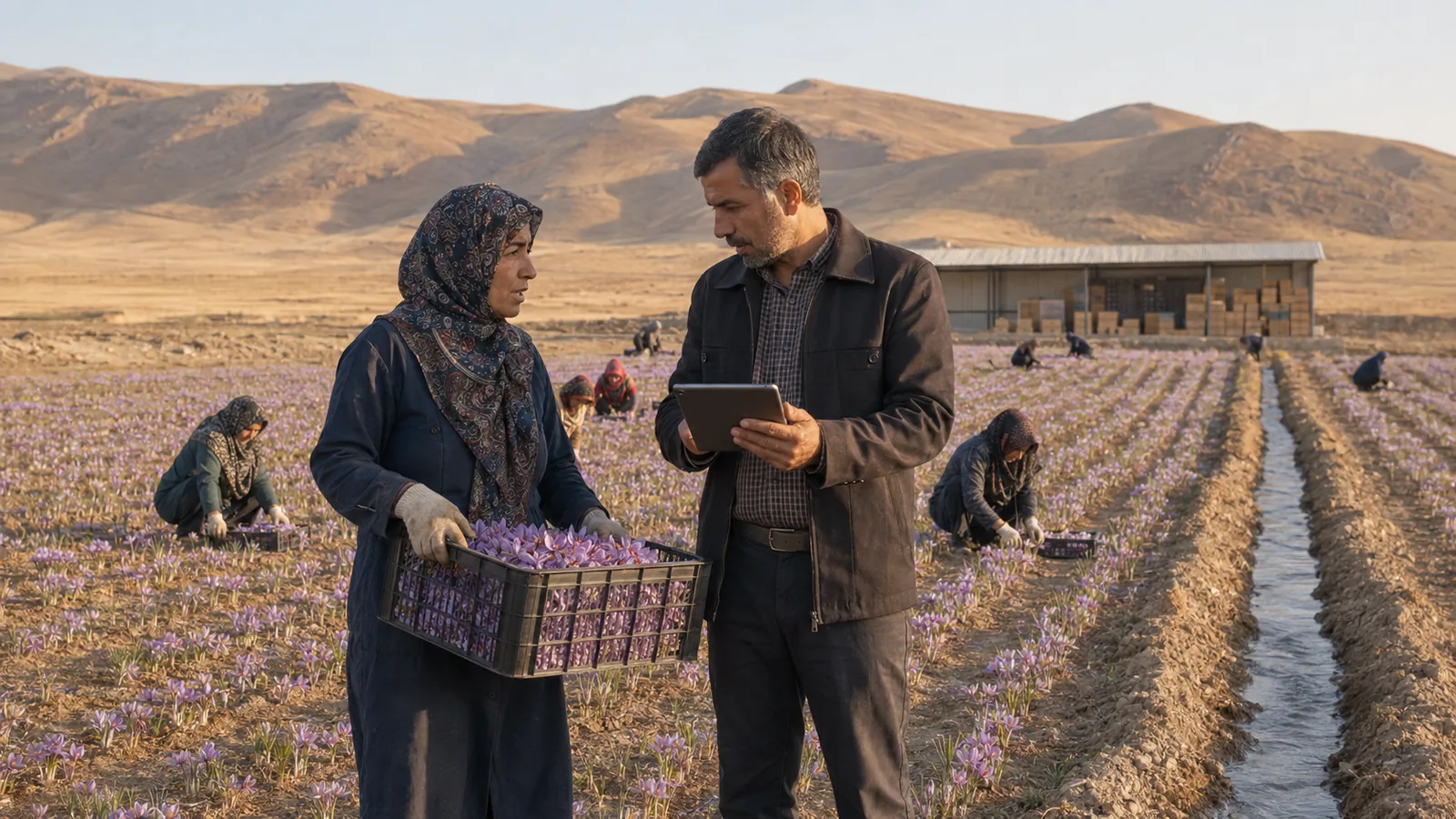
What the 13 percent actually measures
Forouzan Mehr described saffron’s share of the value of Khorasan Razavi’s agricultural products. A value share reflects prices as well as production, so it cannot be read as a share of hectares, tonnes or farm output by weight.
The source did not state the year, total agricultural value, price basis or calculation method. The 13 percent is best treated as a historic economic indicator from the governor’s report rather than a current provincial statistic.
The province’s water constraint shaped the argument
Explaining Khorasan Razavi’s geography, Forouzan Mehr said 75 percent of the province was desert. He also referred to 37 plains used for water supply and said only three had a positive balance. The translated source used the word “yield,” but the context points to groundwater or water balance, not crop yield.
Those figures framed his call for crops with lower water needs. They were not accompanied by a hydrological report or date, so they should not be turned into a present-day water assessment.
Why saffron was treated as a lower-water priority
Saffron’s active cycle falls largely in cooler months, and the crop does not require the same summer irrigation pattern as many alternatives. The FAO account of Gonabad’s qanat-based saffron system describes severe water scarcity in Khorasan Razavi and notes saffron’s relatively modest water demand.
That advantage is relative. Corm establishment, sprouting and flowering still depend on suitable moisture and timing. A water-saving strategy should measure total seasonal use, groundwater impact and yield rather than assuming every saffron field is automatically sustainable.
Suitable cultivation is not uniform across Khorasan Razavi
The governor presented expansion as a provincial priority, but land within the province differs in climate, soil, elevation and water conditions. A peer-reviewed habitat-suitability study for Khorasan Razavi saffron used field observations and environmental models to identify favourable areas rather than treating the whole province alike.
That is the safer planning approach. Expansion should follow field evidence, healthy corm supply, labour capacity and a viable market, not the headline percentage alone.
The reported 23 percent employment figure
Forouzan Mehr also said the strategic saffron sector accounted for 23 percent of the province’s employees. The translation does not identify whether this meant agricultural workers, seasonal jobs, households involved in production or another denominator.
The statement is retained because it was central to the report, but its scope is unresolved. A usable employment statistic would define the worker group, distinguish full-time from seasonal work and explain whether planting, harvesting, processing and trade were all included.
A proposed National Saffron Organization
The governor proposed establishing a National Saffron Organization focused on Khorasan Razavi. His proposal appears to have aimed at coordinating a sector spread across farms, processors, traders and public bodies.
The article does not say whether the organisation was created, what authority it would have or how producers would be represented. The proposal should therefore remain a historical recommendation, not be presented as a current institution.
Supply centres and a connected chain
Forouzan Mehr also called for saffron supply centres covering production, distribution and consumption. A well-designed centre could improve aggregation, grading, traceability and market information, but centralisation alone does not guarantee fair terms for growers.
Records need to follow each batch from producer and harvest through drying, testing, packing and sale. Clear ownership and transparent fees are as important as the physical building.
What “conversion industries” means here
The source promoted development of industries that process saffron into other products. It mentioned food, pharmaceutical and medical sectors as possible uses.
Food applications, extracts, packaging and other value-added products can create new markets. Pharmaceutical or medical use requires appropriate evidence, formulation, manufacturing controls and regulatory approval; the crop’s commercial potential is not proof that a product treats a condition.
Branding, standards and packaging
Forouzan Mehr listed branding, product standardisation and suitable, varied packaging among the strategies for competing internationally. These elements solve different problems. A brand identifies the seller; standards define measurable requirements; packaging protects the saffron and gives buyers usable information.
Variety should not come at the expense of clarity. Packages need accurate origin, net quantity, batch identification, storage information and responsible business details, with claims that match the tested product.
Quality must be demonstrated batch by batch
The governor described Khorasan Razavi as a centre of saffron production and praised the province’s quality. Reputation matters, but origin alone cannot certify every batch.
Flower handling, stigma separation, drying, moisture control, storage and adulteration safeguards affect what reaches the buyer. Representative sampling and recognised tests make a quality claim verifiable.
Training from planting through harvest
The report said measures had been taken to expand cultivation and provide training for planting and harvest stages. The original repeats “harvesting,” likely because of translation; a useful programme would cover the intervening crop-care period as well.
Training should address field selection, corm grading, planting depth and density, irrigation, nutrition, weeds, pests, flower picking, stigma separation, drying, storage and records. It works best when advisers can follow the same fields across seasons.
The first-six-month export figures
Forouzan Mehr reported that 39 tonnes of saffron worth 56 million US dollars were exported in the first six months of “this year.” Because the article does not supply the year, neither figure describes the current market.
The source also ended with an incomplete reference to an export exemption. It did not identify the tax, duty, rule or period involved, so no legal conclusion can safely be drawn from that fragment.
Why export value and farm value can differ
An export total measures goods crossing the border at a reported value. It does not reveal how revenue was divided among growers, aggregators, processors, packers and exporters.
Increasing export value can help the province, but farmer outcomes also depend on grade transparency, bargaining power, payment terms, harvest costs and losses. Those measures belong beside tonnes and dollars in a complete sector report.
Current value-chain work supports the same broad priorities
A 2025 FAO programme on Iran’s saffron value chain brought together farmers, processors, cooperatives, traders and experts around production practice, post-harvest handling, safety, traceability, marketing and digital branding. It also identified water scarcity and global competition as continuing pressures.
This does not validate every old percentage. It does show that the governor’s broad themes—water, training, standards, value-chain organisation and market trust—remain practical areas of work.
How to read the earlier Khorasan report
“13% of agricultural production in Khorasan province is saffron” captured the economic importance assigned to the crop in one earlier provincial statement. Its 13 percent value share, 23 percent employment claim and 39-tonne export figure are all meaningful parts of that record.
They also need dates, denominators and methods before anyone uses them as current statistics. The durable lesson is that saffron’s value in Khorasan Razavi depends on careful water management, suitable fields, skilled production, verifiable quality and a supply chain that returns value to the people doing the work.

![Exporting Saffron to Turkey + Price Guide [Complete 0 to 100]](https://img.rowhanisaffron.com/20260827003933/saffron-export-turkey-quality-inspection.webp)



