


The storage time of Iranian saffron flowers increased to as much as 15 days in an earlier controlled research project using modified-atmosphere packaging and low-temperature storage. That result concerned a tested packaging system, not ordinary flowers kept in a bag or refrigerator, and it should not be treated as a universal home-storage promise.
Who announced the saffron-flower project
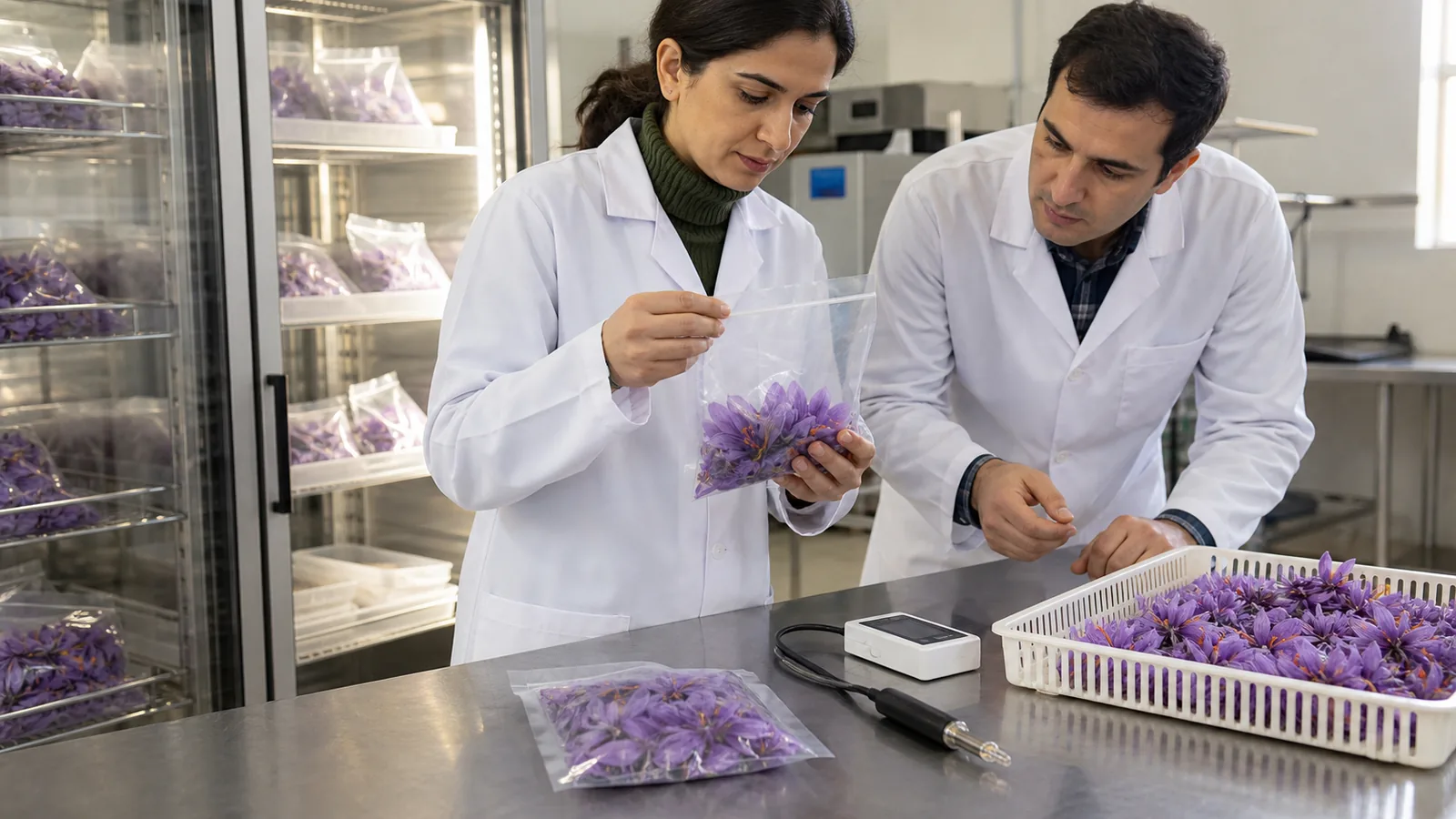
Mehdi Karimi, identified in the original report as head of the Khorasan Razavi Agricultural and Natural Resources Research Center, said the flower-preservation project was under way. Food-industry researchers in the centre’s Agricultural Technical and Engineering Research Department carried out the work.
Karimi described it as a first for that research group and said the technique extended shelf life to 15 days while seeking to preserve physical and quality characteristics.
What modified-atmosphere packaging does
Fresh flowers continue to respire after picking. In a sealed package, they consume oxygen, release carbon dioxide and water vapour, and can wilt or deteriorate if the package, gas mixture and temperature are poorly matched.
Modified-atmosphere packaging changes the gases surrounding the product and uses a film with known barrier properties. It is not the same as simply removing air, sealing an ordinary plastic bag or adding a gas without measuring the result.
The conditions behind the 15-day result
A published study of modified-atmosphere packaging for saffron flowers tested polymer pouches with a mixture of 50 percent carbon dioxide, 5 percent oxygen and 45 percent nitrogen. Samples and controls were held at 0°C and 15°C for 15 days.
Researchers checked the package gases every three days and measured product yield, flower and stigma physical properties and chemical properties after the stigmas were dried. The result belongs to that protocol. Changing the film, temperature, gas mixture, flower condition or sanitation can change the usable storage period.
Temperature remains part of the packaging system
A gas mixture cannot compensate for a broken cold chain. Respiration, moisture movement and microbial growth respond strongly to temperature, so packages need controlled cooling from soon after harvest through transport and receipt.
The 15°C test was part of the experiment, not a recommendation that all saffron flowers can safely wait for 15 days at that temperature. Anyone applying the work commercially would need the full results, validated limits and food-safety controls.
Why fresh saffron flowers deteriorate quickly
Saffron flowers are delicate, moist and easily compressed. Warm piles can trap heat, while condensation and damaged petals create conditions in which appearance and microbial quality may decline.
Harvest timing also matters. Flowers collected into clean, shallow, ventilated containers and moved promptly avoid some of the crushing and heating that occurs in deep sacks or tightly packed loads.
Crocin, picrocrocin and safranal in the report
Karimi referred to crocin, picrocrocin and safranal remaining under optimal conditions at levels comparable with freshly picked flowers. The translated sentence is incomplete, so it is safer to read it as the project’s quality objective rather than a quantified result.
These compounds are associated with the colour, taste and aroma of the dried saffron spice. Their measurement after stigma separation and drying helps show whether delayed processing has affected the material that becomes saffron.
Physical appearance is only one quality measure
The project aimed to preserve the flowers’ quality and physical characteristics. Useful physical checks include weight loss, wilting, petal condition and the length or condition of fresh stigmas.
A flower can still look acceptable while its handling history or microbial condition is poor. Conversely, slight petal damage does not by itself reveal the chemistry of the separated and dried stigmas. Commercial validation needs both kinds of evidence.
Microbial safety cannot be assumed from shelf life
The published research addressed microbial properties as well as quantity and quality. That is essential because extending visual life is not enough if yeasts, moulds or harmful bacteria rise to unacceptable levels.
Clean harvest containers, hygienic workers and surfaces, rapid cooling, package integrity and a validated time-temperature limit all belong to the process. Modified atmosphere is one control within a system, not a substitute for sanitation.
Storage delays stigma separation
Most saffron production separates the red stigmas from the flower soon after harvest and then dries them under controlled conditions. Holding intact flowers can give processors more time during a harvest peak, but every delayed day shifts work rather than removing it.
The decision should compare labour scheduling and reduced congestion with refrigeration, packaging, monitoring and possible quality losses. A 15-day technical possibility does not mean the longest delay is the best commercial choice.
The proposed fresh-flower export market
Karimi said another goal was to create an export opportunity for the saffron flower as a cut flower. The project was described in the source as part of a national-production programme supporting Iranian work and capital.
Fresh-flower export is a different business from dried saffron. It requires buyers who value the whole flower, rapid logistics, cold-chain capacity, suitable packaging and compliance with destination plant-health, food or floriculture rules.
Why freight economics matter
Whole flowers contain far more water and plant material than the dried red stigmas ultimately sold as saffron. They are bulkier, more fragile and more perishable than the spice.
An export trial should therefore record saleable flowers, package weight, cooling energy, freight, rejection, remaining stigma quality and customer value. Technical shelf life is only one part of commercial feasibility.
What “freshly picked” should mean in a trial
A fair comparison needs a control sampled at harvest and stored samples tested at defined intervals. Flower maturity, time of picking, field temperature, transport delay and damage should be similar across groups.
Without that design, a stored lot can appear better or worse because it started differently. The published project measured at three-day intervals, which is more informative than comparing only day one and day 15.
Post-harvest quality continues after the flower stage
Once stigmas are separated, drying and storage influence the colour, flavour and aroma that reach the customer. FAO’s current saffron-quality work in Iran includes practical guidance intended to preserve those characteristics after harvest alongside improved authenticity testing.
A strong flower-storage protocol must connect to that later chain. Extending flower life has limited value if separation is unhygienic, drying is uneven or dried saffron is exposed to heat, light or moisture.
The research was still continuing
Karimi said the project would continue at the Khorasan Razavi Agricultural and Natural Resources Research Center. The original announcement did not provide final adoption figures, commercial shipments, costs or a protocol approved for routine industry use.
Those missing outcomes should remain open questions. A research result can be promising without yet proving that the system is economical or scalable across the harvest chain.
How to use the 15-day claim responsibly
The storage time of Iranian saffron flowers increased under a specific experimental combination of modified atmosphere, packaging material and temperature. It did not establish one shelf life for every saffron flower or every storage method.
For growers and processors, the practical lesson is to shorten uncontrolled delays and validate any planned storage system with package-gas, temperature, physical-quality and microbial measurements. For buyers, a shelf-life statement should come with the tested conditions, not stand alone as a marketing number.

![Exporting Saffron to Turkey + Price Guide [Complete 0 to 100]](https://img.rowhanisaffron.com/20260827003933/saffron-export-turkey-quality-inspection.webp)



