


A production forecast of 6 tons of saffron in Sabzevar city was based on 1,500 cultivated hectares and an expected average yield of 4 kilograms per hectare. The figures come from an earlier local announcement and describe a forecast, not a confirmed final harvest.
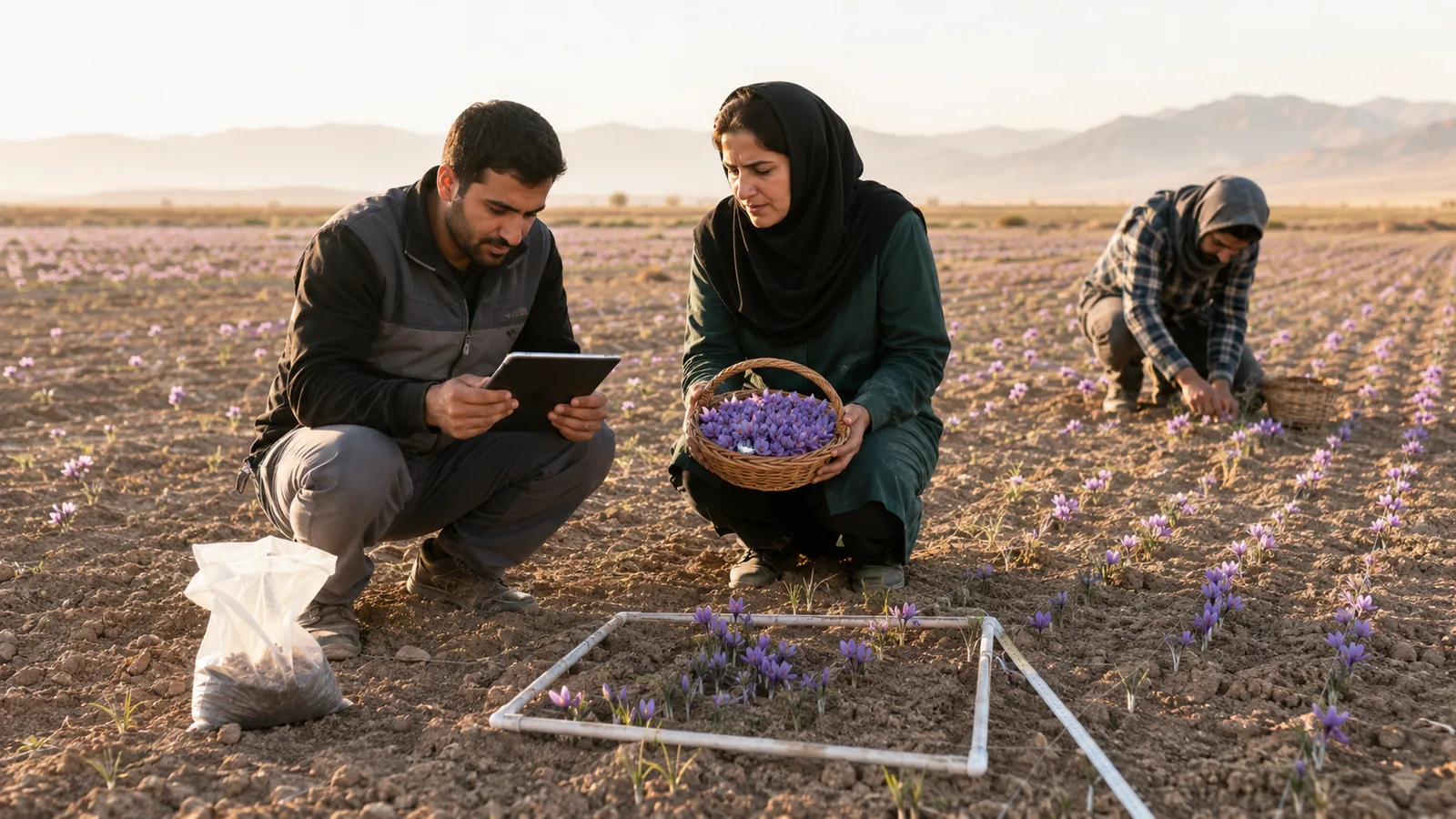
How Sabzevar’s six-ton forecast was calculated
Mohammad Javad Izadian, identified as director of Sabzevar Agricultural Jihad, said the city had 1,500 hectares planted with saffron. Multiplying that area by the forecast yield of 4 kilograms per hectare produces 6,000 kilograms, or 6 metric tonnes.
The arithmetic is internally consistent. What the announcement does not provide is the share of the area that was mature and productive, the sampling method behind the yield estimate or the final quantity eventually collected. Those details are needed before the number can be treated as a production result.
The expected increase was 20 percent
Izadian forecast a 20 percent rise in saffron production compared with the previous year. He linked the improvement to the appropriate distribution of rainfall during the preceding season.
If both years used the same definitions, a six-ton crop following a 20 percent increase would imply a previous total of about five tonnes. That is a calculation from the published percentage, not a separately reported official figure. Differences in mature area, reporting boundaries or field sampling could change the comparison.
Flowering was delayed by about ten days
The report also described suitable cold and warm conditions at the beginning of autumn and said they had delayed saffron flowering by roughly ten days. Temperature can influence flower emergence, but “suitable” is not a precise agronomic measurement. A useful field record would include daily soil and air temperatures, irrigation date, altitude and observations from comparable plots.
A later bloom shifts the short picking window. Growers must adjust labour, basket collection, stigma separation and drying schedules so flowers are handled promptly when emergence begins.
Why a forecast can differ from the final harvest
Saffron yield varies among fields and years. Corm size and health, planting density, field age, irrigation timing, soil fertility, salinity, weeds, rodents, frost and the speed of flower collection all matter. A district average can also hide large differences between mature plots and newly planted land.
That is why the six-ton figure should remain labelled a forecast. Final reporting would ideally state the harvested dry-stigma weight, productive hectares, number of sampled farms and whether damaged or lower-grade material was included.
Could the average reach 6 kilograms per hectare?
Morteza Saeedi Shahri, head of horticulture in the Plant Production Department of Sabzevar Agricultural Jihad, said that ideal establishment, observance of technical practices and suitable climatic conditions could raise average yield to at least 6 kilograms per hectare.
That was a potential target, not the basis of the six-ton forecast. If the entire stated 1,500 hectares produced 6 kilograms per hectare, the mathematical total would be 9 tonnes. Actual production would depend on how much land was bearing, how evenly farms performed and whether the assumed conditions occurred.
Corm strength affects the following season
After flowering, saffron leaves continue supporting the development of replacement corms below ground. Management during that period can influence the planting material that carries the crop into the next cycle. Cutting green foliage too early, compacted soil, poor drainage or unbalanced nutrition can weaken that process.
Research indexed by FAO AGRIS shows that mother-corm size and nutrient treatments can affect replacement-corm and flower-yield components. The saffron corm and nutrient study record also makes clear that its results came from defined experimental treatments; they are not a universal recipe for every Sabzevar field.
The historical nitrogen advice needs local diagnosis
Saeedi Shahri advised growers to apply 50 to 100 kilograms of nitrogen fertilizer per hectare in two applications alongside the second irrigation. He presented the advice as a way to strengthen corms and improve the following year’s average yield.
That rate should be preserved as part of the historical announcement, not copied blindly. “Kilograms of nitrogen” may mean the nutrient itself or a quantity of a particular fertilizer product, and those are very different amounts. Soil texture, organic matter, irrigation water, field age, previous manure and the product’s nitrogen percentage all affect an appropriate rate. Excess nitrogen can waste money and encourage unbalanced growth, so a current soil test and local agronomist should guide any application.
Micronutrient spraying was also recommended
The announcement advised several sprays with suitable micronutrients up to the first half of March. It did not identify the nutrients, product concentration, deficiency diagnosis, spray interval or weather conditions.
Those omissions are important because a foliar product only addresses a need when the element, formulation and dose suit the crop and field. A recent Iranian experiment indexed by FAO AGRIS assessed iron and zinc after testing the soil and used defined concentrations, timing and a control. Readers can review the iron and zinc foliar-application study; its six-year-old Lorestan research field is not automatically equivalent to a Sabzevar farm.
What growers should record before comparing yields
A practical field record should separate total planted area from productive area and note field age, corm source and density, irrigation dates, rainfall, fertilizer products and nutrient rates, foliar applications, flower weight and final dry-stigma weight. Recording labour and drying losses helps explain why two fields with similar flowering can produce different saleable totals.
Quality belongs beside quantity. Moisture control, clean separation, careful drying and protective storage affect whether the harvested spice retains its colour, aroma and condition after the field work is complete.
How to read the Sabzevar figures today
The earlier announcement presents a clear forecast model: 1,500 hectares multiplied by 4 kilograms per hectare equals 6 tonnes, with production expected to be 20 percent above the prior year and flowering reported about ten days late. It also records a higher 6-kilogram-per-hectare aspiration and specific nitrogen and micronutrient advice.
Its value is historical and explanatory. Because no crop year, final harvest, sampling method, fertilizer formulation or soil data were supplied, the numbers should not be presented as Sabzevar’s current output or as instructions for a field today.

![Exporting Saffron to Turkey + Price Guide [Complete 0 to 100]](https://img.rowhanisaffron.com/20260827003933/saffron-export-turkey-quality-inspection.webp)



