


Production of 11 tons of dry saffron this year in Neishabour city was reported after the cultivated area reached 3,400 hectares. The announcement described a 37 percent increase and an average yield of 3.5 kilograms per productive hectare; because its crop year is not identified, the figures are a historical snapshot rather than current statistics.
What the Neishabour production announcement recorded
Engineer Seyed Gholamreza Nabavi-Namaghi, then described as deputy head of the organization and director of Neishabour Agricultural Jihad, put the city’s share of that year’s crop at about 11 tonnes of dry saffron. He attributed the total to a 37 percent rise in production.
If 11 tonnes represented a 37 percent increase under the same reporting method, the preceding figure would have been roughly 8 tonnes. That is a mathematical estimate, not another total stated in the announcement, and should not be used without the original year and final harvest records.
Productive and young fields were counted separately
The total saffron area was reported as 3,400 hectares: 3,100 hectares described as fertile or productive, and 300 hectares classed as young and not yet productive. This separation makes the production arithmetic easier to understand.
At the announced average of 3.5 kilograms per productive hectare, 3,100 hectares would yield 10,850 kilograms. Rounded to the nearest tonne, that is about 11 tonnes. Applying the average to all 3,400 planted hectares would give a misleading result because the young plots were not bearing at the same stage.
Where saffron was concentrated around Neishabour
Nabavi-Namaghi said cultivation was concentrated mainly in the central parts of the county, Miyan Jalgeh and Zabrkhan. The source did not split hectares or harvest weight among those areas, so it cannot show which locality had the highest yield.
A useful modern comparison would report productive area and dry-stigma weight for each district. Total area alone does not reveal field performance, and a smaller mature area may out-yield a larger area containing many new plots.
The average was 3.5 kilograms per hectare
The announcement linked the 3.5-kilogram average with favourable climate in the crop year. Weather can influence flowering and harvest, but yield is also shaped by field age, corm size and density, irrigation, soil, nutrition, pests, flower-picking speed and post-harvest losses.
Research shows how strongly year and production system can alter the result. A six-year Iranian study indexed by FAO AGRIS reported large differences among crop years and between dryland and irrigated conditions. The six-year saffron-yield study record is useful context, but it was conducted around Khorramabad and does not replace Neishabour field data.
Some farms reportedly reached 10 to 12 kilograms
Nabavi-Namaghi said model projects, research into improved planting and efficient use of inputs and facilities had helped some growers reach 10 to 12 kilograms of saffron per hectare when they followed expert guidance.
Those high farm results should not be treated as a guaranteed district average. To interpret them, readers would need to know the age and size of the plots, whether the number covered a single season, the dry-weight measurement, corm density, irrigation and the number of farms sampled. Demonstration plots can identify useful practices, but broad adoption still requires local validation and cost analysis.
What local support for growers included
The city’s Agricultural Jihad support was described as supplying required chemical and micronutrient fertilizers, offering technical advice, providing heaters for saffron drying, developing farms and carrying out model projects. The announcement also referred to research on better planting methods and more efficient use of inputs.
Each measure addresses a different constraint. Nutrition needs soil and plant diagnosis; field development needs suitable land and healthy corms; and training matters during the short picking, separation and drying window. A list of inputs is not evidence that every farm should receive the same product or rate.
Drying equipment affects saleable quality
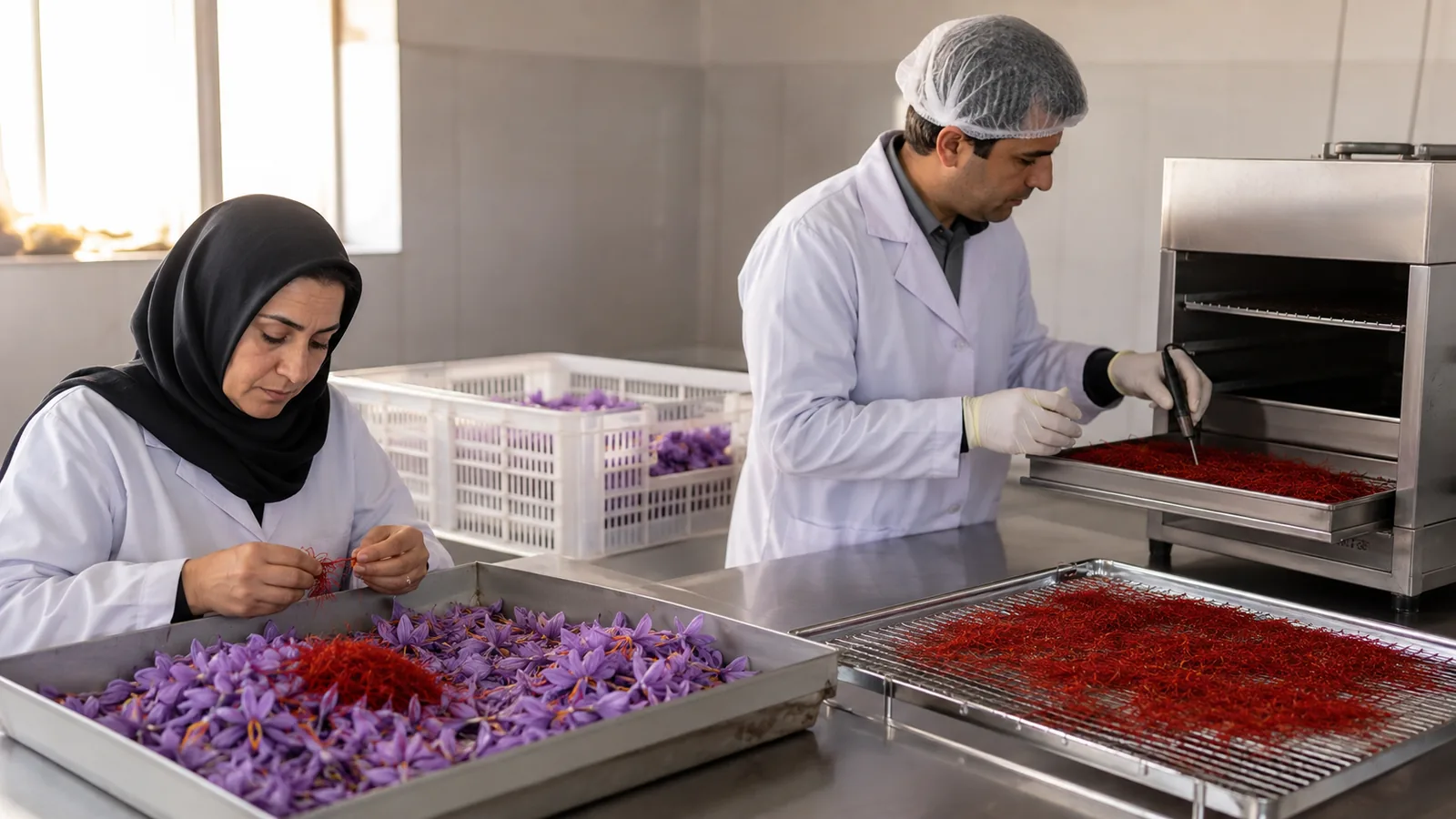
Calling the product “dry saffron” is important because production is measured after flowers are picked, the red stigmas are separated and most moisture is removed. Poor control at this stage can reduce colour, aroma, cleanliness and storage stability even when the field yield is strong.
A controlled Iranian experiment indexed by FAO AGRIS compared traditional, oven, microwave and freezing-assisted drying methods and measured moisture and key quality compounds. Its saffron drying-method study record shows why a “heater” is not enough information: temperature, time, layer thickness, airflow and final moisture all need control.
Employment was expressed as more than 500,000 people per day
The report said cultivation created direct and indirect employment of more than 500,000 “people per day.” In agricultural reporting, wording like this often refers to accumulated person-days of work across a season, not half a million different people employed each day. The original unit is ambiguous, so this article does not convert it into a worker count.
It nevertheless points to the labour concentrated around picking, transport, stigma separation, drying, packing and supporting services. A reliable employment statistic would define the period, distinguish direct from indirect work and state whether seasonal workers were counted more than once.
The stated farm income was 434 billion rials
Nabavi-Namaghi put farmers’ gross income at 434 billion rials. Gross income is revenue before corms, irrigation, fertilizer, labour, drying, packaging, finance and other costs. It is not the same as profit.
The source does not state the farm-gate price, grade mix, exchange rate or calculation date. Dividing the amount by kilograms could produce an implied average price, but doing so would risk combining rounded figures and different sales periods. The 434-billion-rial number is best retained as an attributed historical estimate.
“Less water” does not mean effortless production
The announcement described saffron’s turquoise-purple flowers and said the crop’s characteristics offered lower water demand, higher income and less management, which encouraged farmers in Neishabour. Those benefits are conditional. Saffron can fit water-constrained farming systems, but it still needs suitable irrigation timing, careful establishment and intensive seasonal labour.
Income depends on yield, grade, price and costs, while management shifts rather than disappears. Growers face corm health, weeds, rodents, picking labour, rapid stigma separation, drying control and storage. A favourable comparison with another crop should therefore use whole-season water, labour and net-return records.
How to use the 11-ton figure responsibly
The report’s core numbers fit together: 3,100 productive hectares at an average 3.5 kilograms per hectare produce about 10.85 tonnes, reasonably rounded to 11 tonnes, while 300 young hectares bring the planted total to 3,400. It also records a 37 percent increase, a 434-billion-rial gross-income estimate, an ambiguous 500,000-person-day employment figure and exceptional 10–12-kilogram farm yields.
Without a named crop year or final statistical release, none should be presented as Neishabour’s current position. Their lasting value is to show how a regional production claim can be checked: separate productive from young land, reconcile area with average yield, distinguish revenue from profit, and keep exceptional plots apart from the district average.

![Exporting Saffron to Turkey + Price Guide [Complete 0 to 100]](https://img.rowhanisaffron.com/20260827003933/saffron-export-turkey-quality-inspection.webp)



