


The headline “Discovery of 118,000 saffron genes in Iran” carries a precise number, but the original announcement stored on this page did not name a genetics study, sequencing method or dataset that supports it. Saffron genomics is real and important; the 118,000 figure should be treated as an unverified historical headline, not a settled gene count.
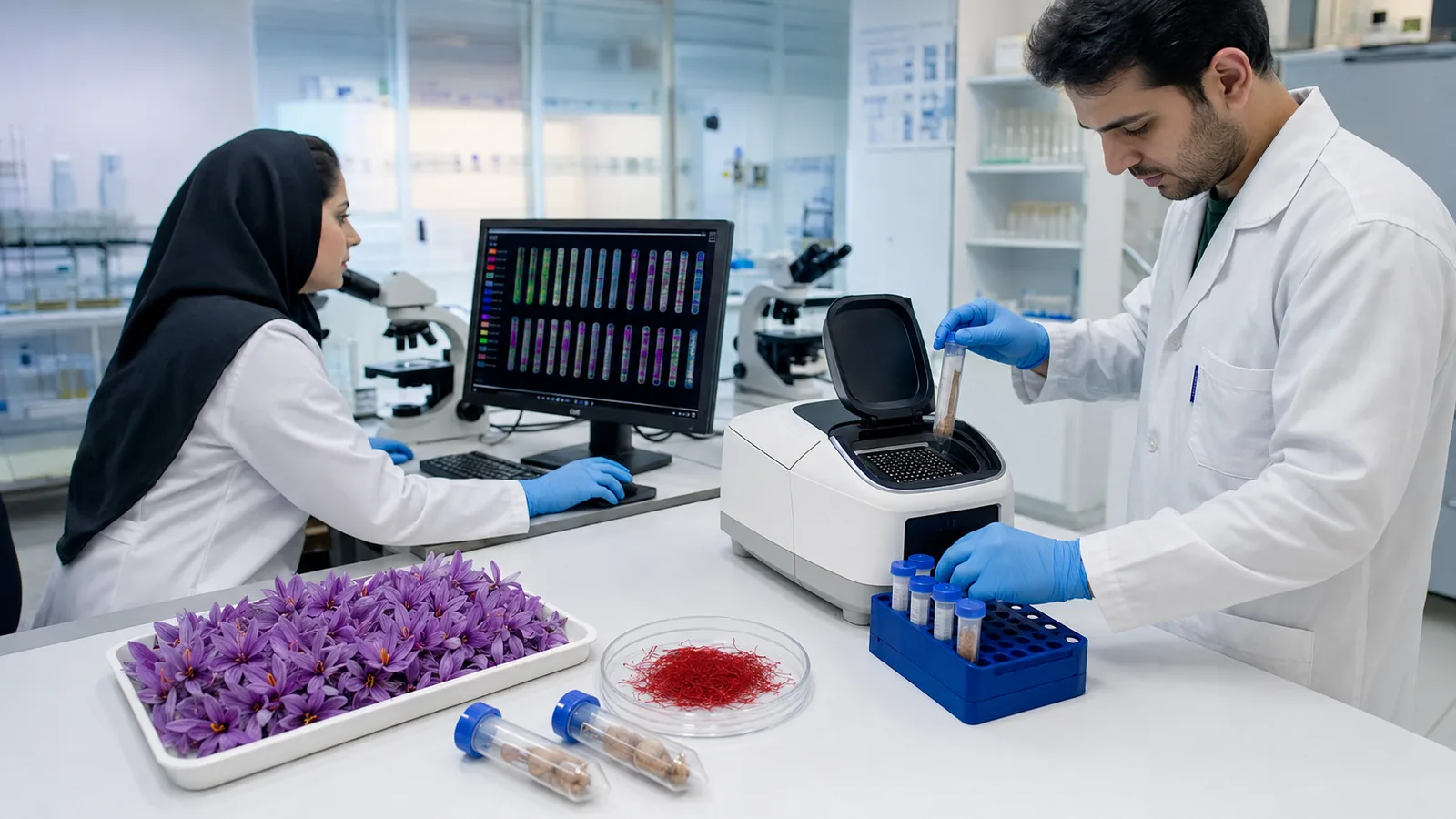
What can be verified about the 118,000 claim
The original body text attributes a broader agricultural-investment speech to Gholamhossein Sarban. It discusses saffron, medicinal plants, greenhouses, fertilizer, sesame oil and farm machinery, but it never states that 118,000 genes were discovered or explains what was counted.
That missing connection matters. In plant research, a number may describe raw sequencing reads, assembled transcripts, “unigenes,” predicted protein-coding genes or other genomic features. Those terms are related, but they are not interchangeable. Without a cited paper or database record, relabelling any one of them as 118,000 genes would create false precision.
A gene is not the same as a sequencing read or transcript
A sequencing read is a short piece of sequence produced by an instrument. Researchers assemble overlapping reads into longer sequences. A transcript is an RNA copy expressed from DNA, and one gene can produce more than one transcript through alternative splicing. A “unigene” is an assembly-derived representation intended to group related transcript evidence; it is not automatically a one-to-one catalogue of genes.
Predicted protein-coding genes are produced by another analytical step in which software and evidence identify likely gene structures in an assembled genome or transcriptome. Counts can change when an assembly improves, duplicated sequences are resolved or annotation rules change. A large number alone therefore says little about the quality or completeness of a study.
What published saffron transcriptome research counted
A 2020 full-length transcriptome study reported 31,755 high-confidence predictions of protein-coding genes. The researchers used long-read sequencing to examine the evolution of pathways involved in saffron’s crocin, picrocrocin and safranal. Readers can check the methods and stated count in the PubMed record for the full-length saffron transcriptome study.
Another published analysis reported more than 100,000 unique transcripts rather than genes. That difference illustrates why the noun attached to a figure is essential. Transcript counts can exceed gene counts because of biological variation, alternative RNA forms and the way an assembly is constructed.
Saffron has an unusually complex genetic background
Cultivated saffron, Crocus sativus, is sterile and triploid: it carries three sets of chromosomes and is propagated through corms rather than seed. Cytogenetic work describes eight chromosome triplets, or 24 chromosomes in total. The PubMed record on saffron’s chromosome structure and origin explains why this biology made classical breeding and genome analysis unusually difficult.
Triploidy also complicates assembly. Similar copies may be collapsed together or separated as distinct sequences, depending on the data and algorithm. A credible gene count therefore needs an assembly version, annotation method and public accession, not only a press-release number.
Chromosome-level research has moved the field forward
More recent work has assembled the saffron genome at chromosome level and examined how duplication and evolutionary change contributed to crocin biosynthesis. The 2024 Crocus genome study indexed by PubMed connects genomic structure with carotenoid and apocarotenoid pathways.
This does not retrospectively prove the 118,000 figure. It gives researchers a stronger reference against which sequences and predicted genes can be mapped, compared and revised.
Why saffron genetics matters to growers and buyers
Genomics can help researchers investigate flowering, corm development, stress response and the biochemical pathways that create saffron’s colour, aroma and bitterness. Those traits influence agronomy and quality, but moving from a sequence association to a useful field practice takes validation.
Saffron’s sterility limits conventional crossing, so genetic knowledge does not translate into a new commercial variety as simply as it might in a seed-propagated crop. Researchers may instead use genomic evidence to understand clonal material, expression patterns, disease response and the timing of compound formation.
What Gholamhossein Sarban’s announcement actually covered
Sarban was introducing foreign-investment opportunities in the agricultural sector of Khorasan Razavi. He said saffron could have a position in drug production and, apart from saffron, referred to 13,000 medicinal plants in the province whose production could attract investment. The statement supplied no botanical inventory or investment study for that number, so it remains an attributed claim.
He also said the province had many agricultural capacities that needed attention and follow-up. Greenhouses were presented as profitable production sites because of the province’s many sunny hours, suitable climate and pool of specialised graduates. Profitability, however, depends on crop choice, energy, water, capital, market access and management; it cannot be inferred from sunshine alone.
Fertilizer, edible oil and machinery were separate proposals
The same announcement mentioned phosphate and compost fertilizer production in the province. It also argued that locally produced sesame could reduce dependence on imported edible oil and create a profitable processing opportunity. No cost, production volume or market analysis accompanied those proposals.
Sarban further announced that 20 direct-sowing machines had been produced through reverse engineering. He presented such manufacturing as a way to move agriculture beyond traditional practice. That is a mechanisation claim, not evidence for a saffron gene discovery, and it should remain separate from the genetics discussion.
Drug research is not the same as proving a treatment
Identifying genes or plant compounds may support laboratory research and ingredient standardisation. It does not show that saffron eliminates disease, nor does it establish a medicine’s safety, dose or effectiveness. Those questions require controlled studies, regulatory review and product-specific evidence.
The earlier meta description claimed that the reported discovery made it possible to produce drugs “to eliminate diseases.” That conclusion was not supported by the stored article and has not been carried forward.
How to assess a future saffron-genomics announcement
A dependable report should name the research institution and authors, distinguish genome from transcriptome sequencing, define exactly what was counted, provide the plant material and tissue sampled, identify the assembly and annotation version, and link to a paper or public sequence accession. Independent peer review and reproducible methods are more informative than the size of the headline number.
Until a source for the original 118,000 figure is recovered, the accurate conclusion is narrow: saffron has been the subject of substantial genomic and transcriptomic research, while this page’s historical announcement does not substantiate its own title count. Keeping that distinction visible protects readers from an attractive but unsupported interpretation.

![Exporting Saffron to Turkey + Price Guide [Complete 0 to 100]](https://img.rowhanisaffron.com/20260827003933/saffron-export-turkey-quality-inspection.webp)



