


Harvesting more than 100 kg of saffron in Chaharmahal and Bakhtiari marked a notable provincial crop in the report preserved here: 129 kilograms from 43 hectares of productive saffron fields. The figures describe one harvest period, so they are best read as a dated regional snapshot rather than a current forecast.
What the Chaharmahal and Bakhtiari harvest report said
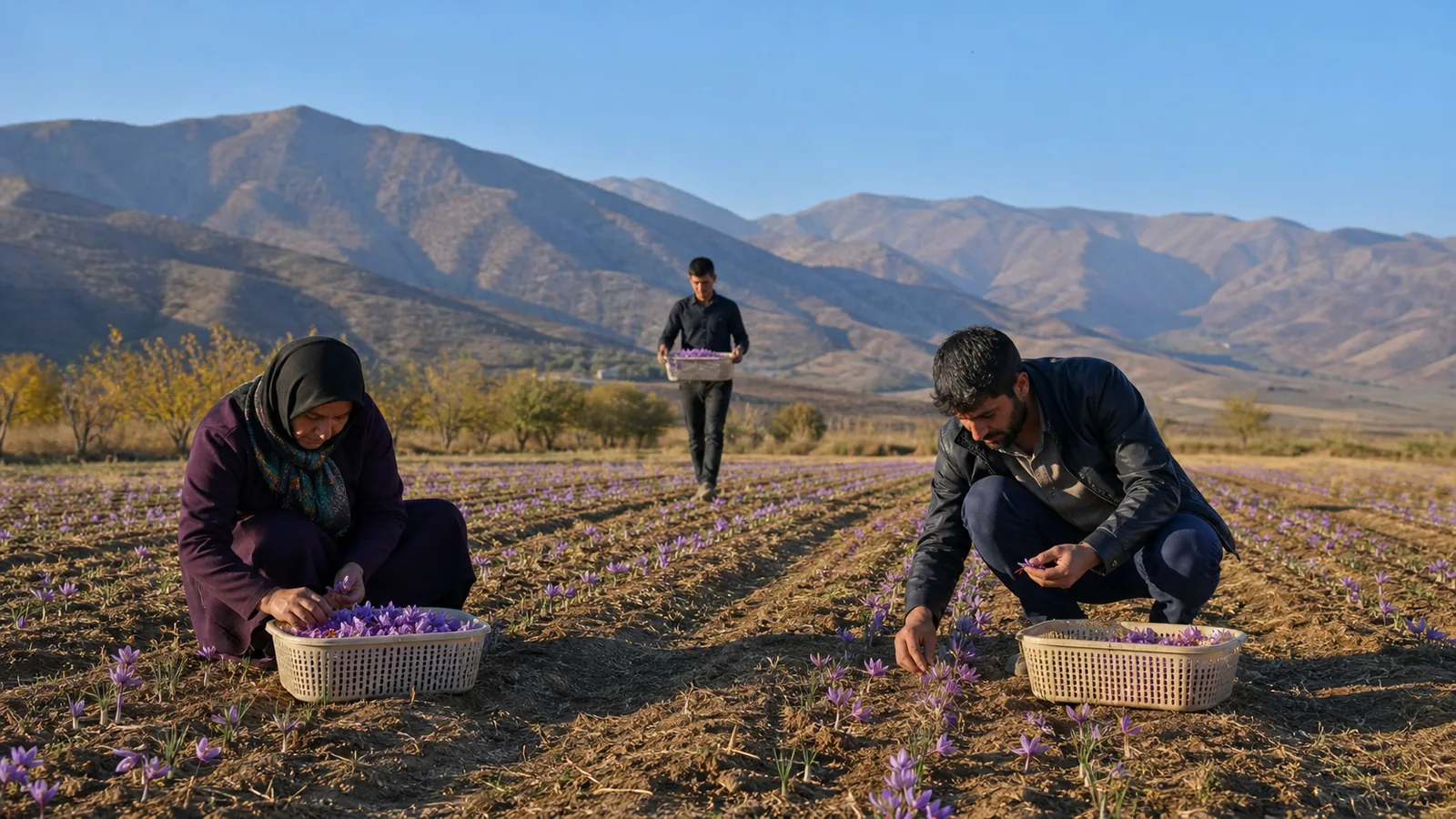
Mansouri, identified as the horticulture director of the Chaharmahal and Bakhtiari Agricultural Jihad Organization, announced that farmers had harvested 129 kilograms of dried saffron in the province that year. The productive area was reported as 43 hectares.
Dividing the reported crop by the productive area gives an implied average of about 3 kilograms per hectare. That calculation helps readers understand the scale of the announcement, but it is not a province-wide yield benchmark for another season. Weather, field age, corm density, irrigation, soil, harvest timing and drying losses can all change the result.
Why the report separates productive and non-productive land
The province had 52 hectares under saffron cultivation in total. Of that area, 43 hectares were described as productive and 9 hectares as non-productive, or not yet bearing a commercial crop.
That distinction matters. Newly established plots do not necessarily produce at the same level as mature fields, and the area planted is not automatically the area harvested. Combining the two figures would understate the yield of established fields and make year-to-year comparisons misleading.
Shahrekord and Farsan led the cultivated area
According to Mansouri, Shahrekord and Farsan had the largest areas of saffron cultivation in Chaharmahal and Bakhtiari. The original announcement did not provide a separate hectare or kilogram total for either county, so it cannot support a claim that one produced more saffron than the other.
County-level information would be needed to compare productivity properly. A larger planted area can produce a larger total crop while still having a lower yield per hectare, and the reverse can also be true.
The province’s mountain setting
The report placed the crop within a mountainous province on Iran’s central plateau. It gave Chaharmahal and Bakhtiari an area of 16,421 square kilometres, about one percent of Iran’s total area, and described it as the country’s 22nd-largest province by size.
It also located the province between 31°09′ and 32°38′ north latitude and 49°30′ and 51°26′ east longitude. These geographic details provide context; they do not by themselves establish that every part of the province is suitable for saffron. Elevation, slope, frost exposure, drainage, water quality and the timing of autumn temperatures can vary considerably within a mountainous region.
Why saffron can interest farms beyond Khorasan
Saffron is closely associated with the Khorasan provinces, yet the crop is also grown in other parts of Iran where local conditions and farm economics are suitable. Its dormant summer period and seasonal irrigation pattern can make it relevant in water-constrained areas, but “low water use” should never be read as “no water needed.” Establishment, flowering and corm development still depend on sound irrigation and soil management.
The FAO description of Iran’s qanat-based saffron system explains how the crop forms part of a wider relationship among scarce water, local knowledge, biodiversity and rural livelihoods. That example is based in Gonabad, not Chaharmahal and Bakhtiari, so it offers national context rather than evidence for the province’s reported harvest.
Yield cannot be judged from one total alone
A harvest total answers one question: how much dried saffron was collected in the stated area and season. It does not reveal why that amount was achieved. A useful assessment would also need the age of each field, kilograms and health of planted corms, planting depth and density, irrigation schedule, fertilizer and soil analysis, weed and rodent pressure, flower-picking speed and the conversion from fresh flowers to dried stigmas.
Even the calculated average of roughly 3 kilograms per productive hectare can conceal wide differences between farms. One high-performing plot and several weaker plots may produce the same provincial average as a group of similar fields.
Irrigation affects both output and efficiency
Water management should be assessed by more than the volume applied. Timing and application method influence how much water reaches the root zone and how efficiently the field turns it into dry stigma yield. A three-season Iranian study indexed by FAO AGRIS compared basin, furrow, drip and sprinkler systems and measured both yield and water-use efficiency. Its results underline why an irrigation method tested in one climate should not be copied into another province without local evaluation; readers can review the saffron irrigation and quality study record.
Harvest labour and drying still shape the final product
The provincial figure refers to saffron after an unusually labour-intensive chain. Flowers must be picked promptly, stigmas separated cleanly and the material dried under controlled conditions. Delays, contamination or excessive heat can reduce saleable quality even when the field produces plenty of flowers.
For that reason, expansion from 43 productive hectares to a larger mature area would require more than corms and land. Farms also need enough seasonal labour, hygienic separation and drying capacity, moisture-protective packaging, traceability and a buyer for the resulting grade.
How to compare this harvest with a later season
A responsible comparison should use the same definitions on both sides. Check whether “cultivated area” means all planted land or only productive fields, whether kilograms refer to dry stigmas, whether the reporting period is a crop year or calendar year, and whether the figure is an estimate or a final collection total.
The original report did not identify its crop year, field survey method or quality grades. It should therefore be cited as an earlier announcement from the provincial horticulture director, not as today’s production level.
What the 129-kilogram figure shows
Within those limits, the announcement documents an established saffron sector in Chaharmahal and Bakhtiari: 52 hectares planted, 43 hectares productive, 9 hectares not yet productive and 129 kilograms harvested, with the largest cultivation areas in Shahrekord and Farsan.
The most useful lesson is not that one number guarantees future performance. It is that regional saffron statistics become meaningful when harvest weight, productive area and development-stage land are reported separately. Those are the figures farmers, buyers and planners need in order to see whether cultivation is actually maturing into a reliable crop.

![Exporting Saffron to Turkey + Price Guide [Complete 0 to 100]](https://img.rowhanisaffron.com/20260827003933/saffron-export-turkey-quality-inspection.webp)



