


Kermanshah saffron cultivation had reportedly reached 42 hectares when a provincial official announced technical and financial support for farmers who wanted to expand it. The archived plan treated saffron as a lower-water crop suited to parts of the province, but it gives no year, budget, harvest volume or evidence that funding was available without conditions.
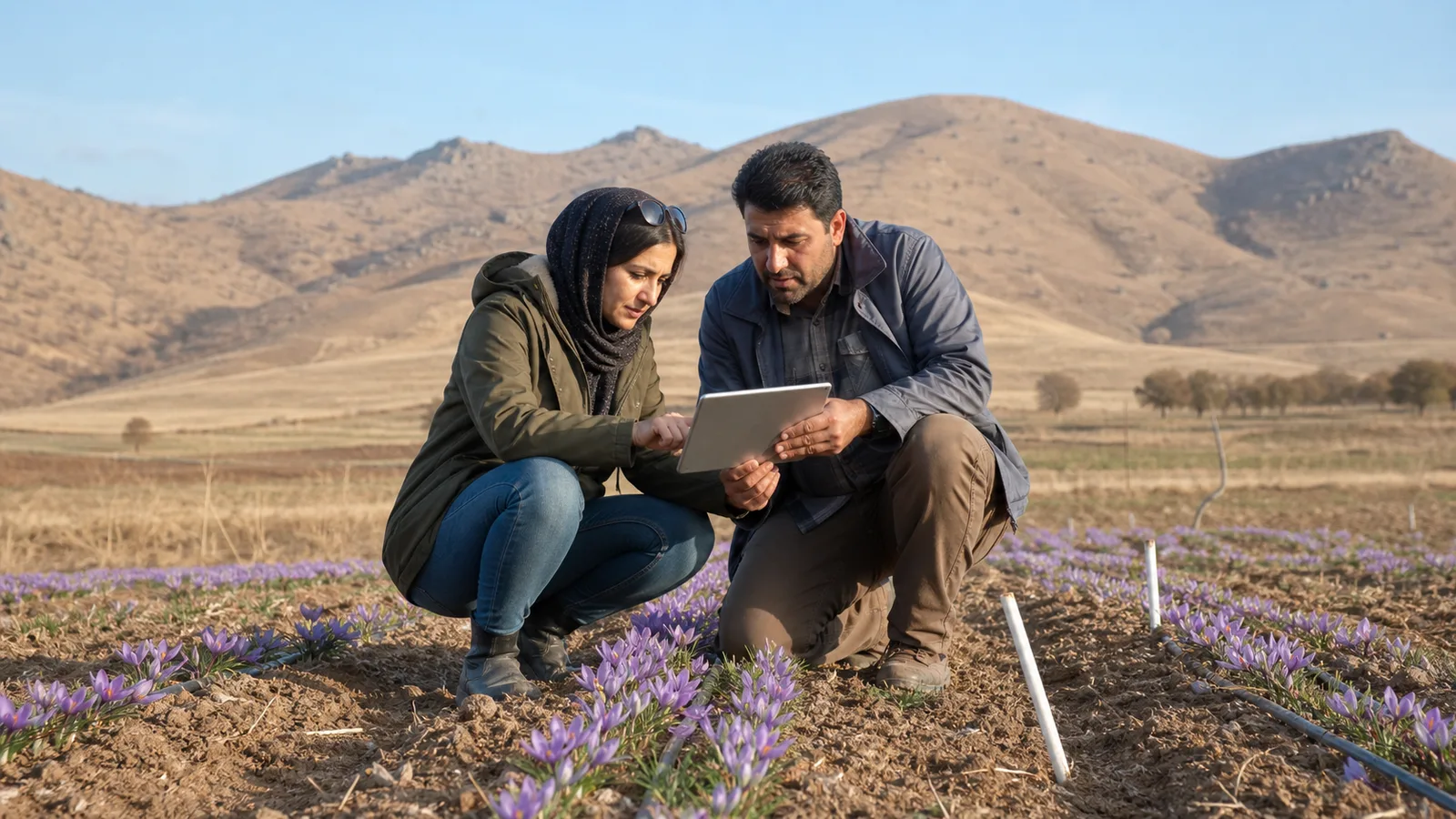
The old English title—“Increasing saffron cultivation from Kermanshah agricultural jihad programs”—describes an historical Agricultural Jihad programme, not a current application notice. Farmers should confirm present eligibility and terms directly with the relevant authority before making an investment.
What the Kermanshah saffron cultivation plan promised
Engineer Ali Ashraf Mansouri, then identified as head of the Kermanshah Agricultural Jihad Organization, said farmers choosing saffron would receive technical support and access to credit facilities. The translation says there were “no restrictions” on paying facilities that year.
In this context, “facilities” is best read as finance or loans, not buildings or equipment. “No restrictions” should not be read as unconditional approval for every applicant. The article does not state the lender, interest or fee, repayment period, collateral, maximum amount, eligible locations or selection process.
The useful commitment is the combination of technical and financial support. Credit without agronomic assessment can finance an unsuitable field; advice without affordable capital may leave a viable plan unbuilt.
How large was the programme?
Mansouri said the province’s saffron area had reached 42 hectares under development plans. The figure establishes the scale reported at that point, but not current area or output.
The article does not separate young fields from mature flowering fields, identify the participating counties, or state dried stigma yield. Saffron area can expand before production rises because newly planted fields and established fields do not perform identically.
A meaningful programme record would pair hectares with field age, corm source and size, irrigation, flower weight, dried-saffron yield, quality results, labour and farm-gate price. Those measures show whether expansion created a durable crop rather than a larger planted number.
Why saffron was considered for Kermanshah
Mansouri linked farmer interest to the province’s production potential and saffron’s relatively limited need for water. Saffron’s active season falls largely in cooler months, and the plant is dormant through much of summer. That can make its seasonal water pattern attractive where summer irrigation is constrained.
The UN Food and Agriculture Organization’s description of Gonabad’s qanat-based saffron system likewise notes that saffron does not require large quantities of water and has supported farming under severe water scarcity.
That does not make every Kermanshah field suitable. Winter cold, drainage, soil texture, salinity, reliable pre-flowering water, corm health and access to harvest labour all need local assessment. “Low water” is a comparative feature, not permission to plant without an irrigation plan.
The French laboratory quality claim
The archived report says specialised laboratories in France found saffron from Kermanshah comparable in quality to “the best saffron” and calls the results satisfactory. It does not name a laboratory, sample origin, harvest year, test method, comparison lot or numerical result.
Without that information, the statement cannot establish that all Kermanshah saffron has a particular grade. Quality varies by field, harvest timing, separation, drying, storage and lot. A regional reputation cannot replace testing of the product being sold.
What should be measured in a saffron lot
The Codex Standard for Dried Floral Parts—Saffron gives an international reference for product identity, styles, quality classes, extraneous matter, floral waste, moisture, contaminants, hygiene and labelling.
For a claim of comparable quality, a report should identify the sampled lot and publish the relevant measurements. Colouring strength, aroma- and bitterness-related characteristics are useful, but authenticity, cleanliness, moisture and correct labelling also matter. Results belong to the tested sample, not automatically to an entire province.
Technical support farmers actually need
- Site screening: soil, drainage, water quantity and quality, winter conditions and field history.
- Planting material: clean corms of suitable size from a traceable source.
- Field plan: density, planting depth, nutrition, weed control, irrigation timing and a realistic field-life strategy.
- Harvest plan: enough labour to pick flowers and separate stigmas promptly during the short season.
- Post-harvest control: hygienic handling, consistent drying, protected storage, lot records and appropriate testing.
- Market plan: likely grade, buyer requirements, packaging, costs and a conservative selling-price assumption.
These are the practical links between a loan and a saleable crop. They also give the supporting organisation evidence to learn which locations and methods work best.
A safer expansion sequence
Mansouri hoped Kermanshah would increase both production and area in later years. Area should not be the first measure of success. A safer sequence is to screen the site, start at a manageable scale, record results for several seasons and expand only when the field and market evidence support it.
The 42-hectare report remains a useful snapshot of an early provincial programme. Its strongest lesson is that public support should join finance to technical guidance. Its weakest claims—the unrestricted funding language and unnamed French laboratory comparison—need documentation before anyone treats them as current fact.

![Exporting Saffron to Turkey + Price Guide [Complete 0 to 100]](https://img.rowhanisaffron.com/20260827003933/saffron-export-turkey-quality-inspection.webp)



