


The phrase “saffron cultivation area of Kermanshah province to 500 hectares” is best understood as a historical development target, not a verified acreage in the original body text. That body mixed in a separate South Khorasan report, so the two provinces and their figures need to be disentangled.
What the Kermanshah acreage evidence shows
Provincial reports published around the same period document Kermanshah’s gradual movement towards the 500-hectare scale. An agricultural-agency report dated December 2020 put the planted area at 422 hectares, including 120 hectares added that year, with most production coming from 302 hectares. It also reported 1,700 kilograms of saffron and an average yield of 4 kilograms per hectare. The 2020 Kermanshah production report preserves those dated figures.
A later announcement said the province had achieved a 60-hectare planting expansion and recorded 417 hectares under saffron. It also noted distribution of 120 tonnes of corms and projected more than 1,700 kilograms from that season. Readers can see the original wording in the 2021 Kermanshah cultivation report.
Why 500 hectares should be labelled a target
Another dated statement placed Kermanshah’s saffron area at 450 hectares while discussing investment and expansion. That Kermanshah investment report supports the direction of travel, but none of these sources makes 500 hectares a timeless current total.
Area statistics change as new fields are established, old fields are renewed or taken out of production, and administrative records are updated. “Planted,” “productive” and “planned expansion” must also remain separate. The title’s 500 hectares is therefore most useful as a milestone in a development programme.
The 14,600-hectare statement belongs to South Khorasan
The old body attributed a 14,600-hectare figure to Gholamreza Haderbadi, whose surname also appeared as Hadrabadi. It then identified him as head of the Jihad Agricultural Organization of South Khorasan and said Qaen had the largest saffron harvest.
Those details do not describe Kermanshah. South Khorasan is a much larger established saffron region, and attaching its acreage, officials or processing capacity to Kermanshah would be a factual error. The information is retained here only to explain the source mismatch.
Processing licences in the old text were also South Khorasan data
The same passage listed 17 establishment licences with a stated capacity of 62 tonnes, seven operating licences with a capacity of 22 tonnes and active units with capacity of 19 tonnes for saffron processing and packaging. Its final sentence referred to drought and depletion of qanat water affecting South Khorasan growers.
The grammar around “active units” does not provide a reliable unit count, and capacity is not the same as actual throughput. These numbers should not be moved into a Kermanshah business profile without the original licensing dataset, dates and province-specific records.
Land selection comes before acreage expansion
The agronomic guidance embedded in the South Khorasan passage still contains useful principles. It called for training in selecting land and identifying suitable areas, preparing fields according to technical principles and renewing older saffron plots.
For Kermanshah, reaching any area target safely would require local assessment of drainage, winter cold, autumn temperatures, irrigation water, soil salinity, slope, machinery access and labour. A hectare added on paper is not necessarily a productive hectare.
Healthy corms matter more than a simple weight threshold
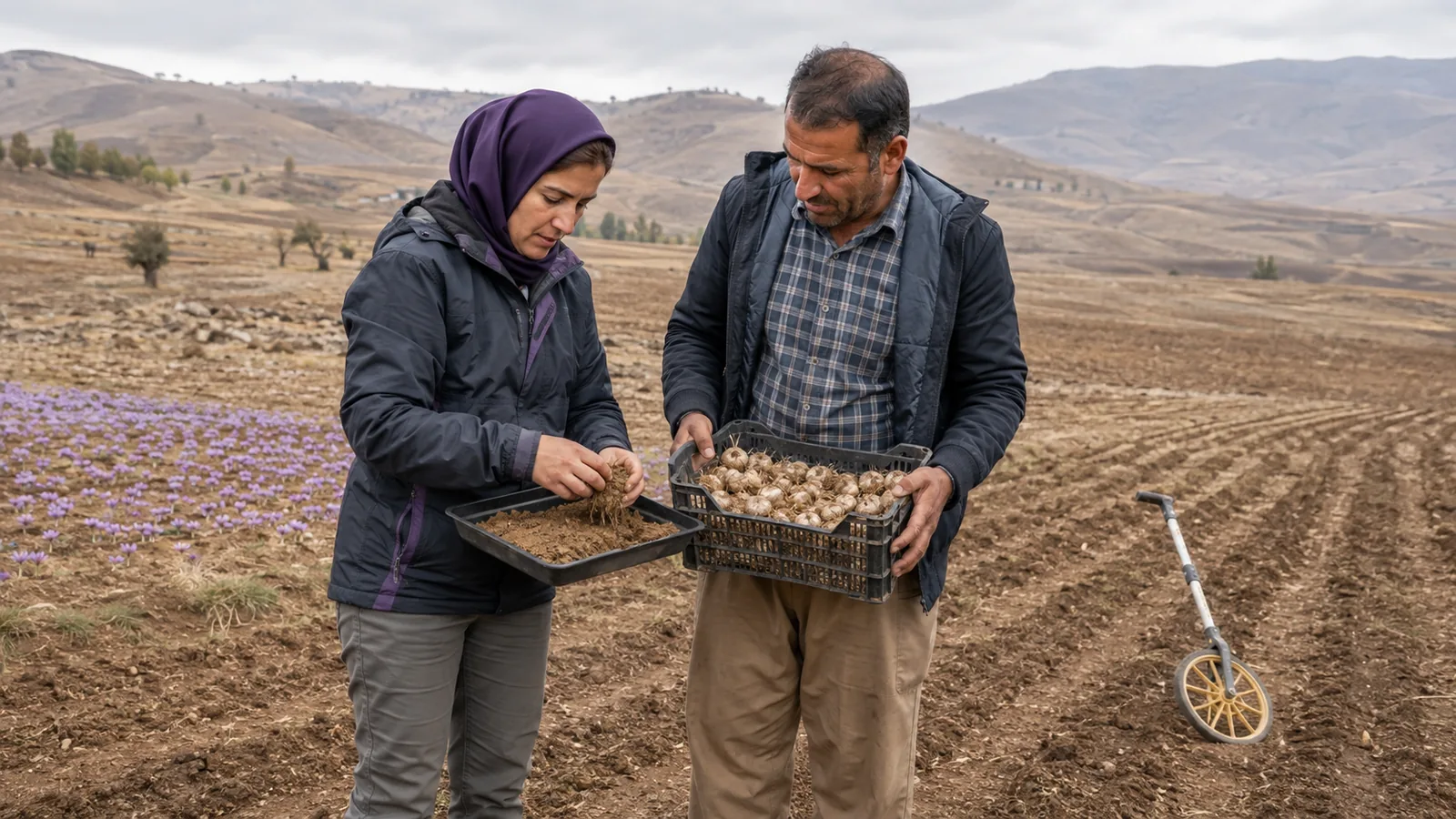
The source recommended high-quality, healthy saffron “onions,” meaning corms, weighing more than 8 grams, and linked that selection with faster flowering. Corm weight can influence establishment and early performance, but health, uniformity and freedom from damage or disease also matter.
The greater risk in a rapid expansion programme is distributing untraceable planting material. Source farm, field health, inspection, cleaning, size grade and storage conditions should travel with each batch. The historical 8-gram threshold remains recorded, but it is not presented as a guarantee of yield or a universal flowering schedule.
Organic matter and nutrition need field evidence
Haderbadi’s guidance included proper nutrition and organic fertilizers such as vermicompost and well-rotted animal manure, with the aim of increasing soil organic matter. These inputs can improve soil properties when suitable, yet type and rate must reflect a soil test, nutrient balance and manure quality.
Uncomposted material, excessive application or contaminated manure can create weed, salt, hygiene or nutrient problems. “Organic” does not remove the need for analysis, correct timing and responsible handling.
Harvesting, processing and packaging determine quality
The old text correctly connected land and corm decisions with harvesting, processing and packaging. Flowers need prompt collection; stigmas need clean separation and controlled drying; dried saffron needs moisture-protective, traceable packaging. An acreage target that expands faster than labour and processing capacity can reduce saleable quality.
This is also why licensed capacity should be interpreted carefully. A plant’s nominal tonnes do not show whether farmers can reach it promptly during peak flowering, what quality controls operate or how much product it actually handles.
Water limits belong in both provincial stories
Drought and declining qanat water were specifically described as South Khorasan problems, but water balance is relevant to Kermanshah expansion too. Saffron is often described as a lower-water crop, yet establishment and reliable production still need water at the right times.
A sound development decision compares whole-season water, likely yield, labour, market access and net return with alternative crops. It should not infer suitability from a provincial total alone.
How to read the 500-hectare headline
The defensible account is straightforward: Kermanshah reports moved through acreage figures in the low 400s and towards 450 hectares during an expansion period, making 500 hectares a plausible target or milestone. The old body, however, accidentally paired that subject with 14,600-hectare, Qaen, licensing and qanat details from South Khorasan.
Keeping the provinces separate preserves what the page was trying to communicate without multiplying the error. Any future “current area” update should cite a dated Kermanshah record and state whether it measures planted land, productive land or planned additions.

![Exporting Saffron to Turkey + Price Guide [Complete 0 to 100]](https://img.rowhanisaffron.com/20260827003933/saffron-export-turkey-quality-inspection.webp)



