


The prediction of harvesting more than 200 kg of saffron from Semnan farms was built from two matching figures: 68 hectares under cultivation and an expected average of about 3 kilograms per hectare. The resulting 204-kilogram forecast belongs to an earlier provincial announcement, not a current harvest report.
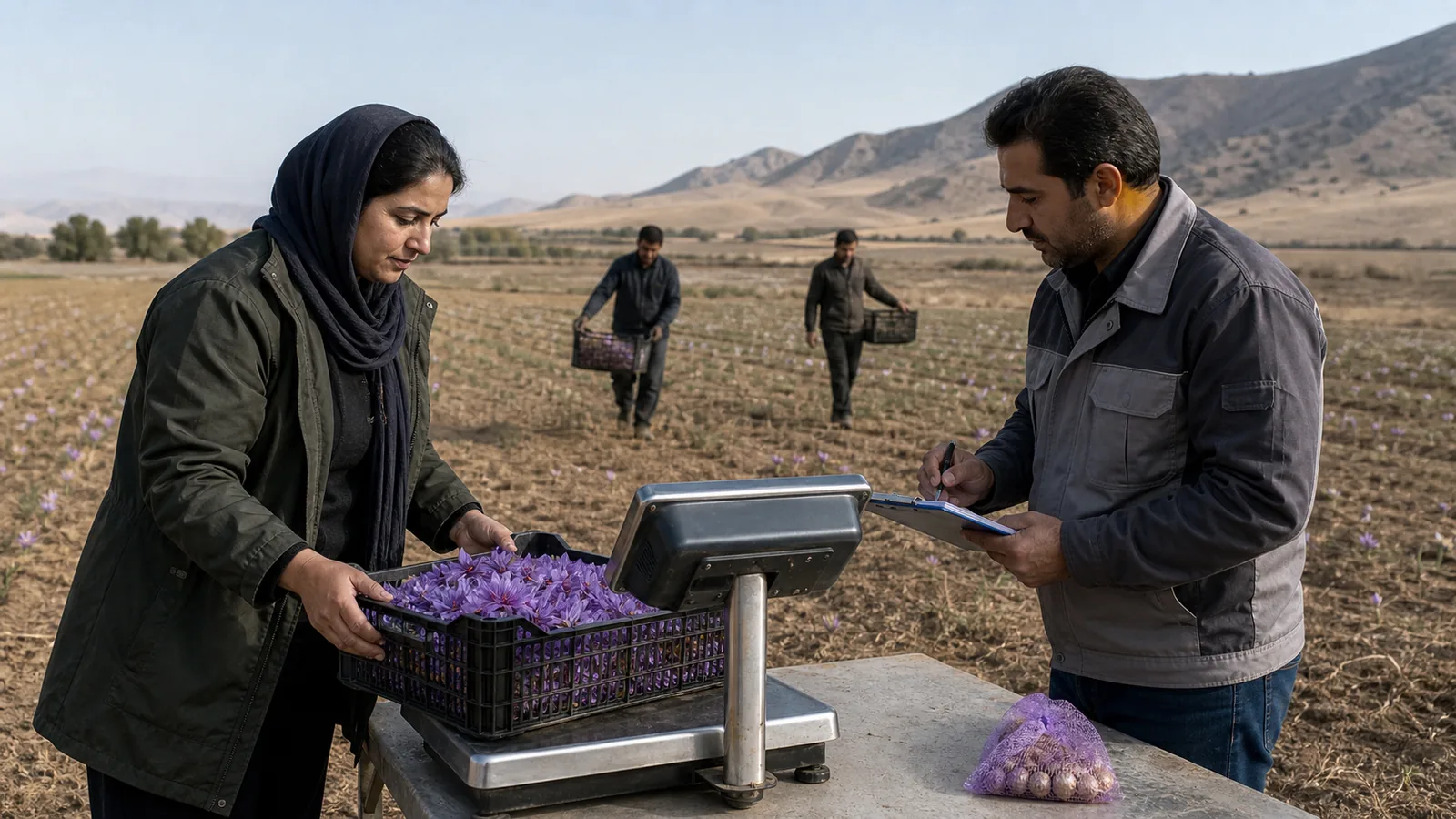
How Semnan’s 204-kilogram forecast was calculated
The Horticulture Department of the Jihad Agricultural Organization of Semnan Province announced an expected crop of 204 kilograms. Lotfollah Rezaei said harvesting had begun in mid-November across 68 hectares and would continue for roughly one month.
At an estimated 3 kilograms per hectare, 68 hectares produce exactly 204 kilograms. The arithmetic is clear, but the source does not identify the crop year, the share of mature fields, the sampling method or the final amount eventually dried and recorded.
Shahroud held most of the cultivated area
Rezaei reported that Shahroud had about 40 hectares under saffron, the largest area in the province. That was nearly three-fifths of the stated 68-hectare total. The announcement did not give Shahroud’s separate production or yield, so the area figure cannot establish how much of the provincial crop came from the city.
A proper regional comparison would separate planted and productive hectares and report dry-stigma weight for each locality. New fields, older fields and changes in corm density can all affect the provincial average.
A month-long harvest still contains a short daily window
The reported season lasted about a month, but individual fields do not flower evenly throughout that period. Flowers are usually collected in repeated rounds, and the labour requirement rises sharply on peak days. Prompt transport, stigma separation and controlled drying are part of the harvest outcome, not separate details.
A forecast based on field area can therefore miss losses caused by labour shortages or delayed processing. Final production should mean dried saffron of known moisture and condition, not the weight of flowers picked.
The claim that all saffron originated in Iran needs context
Rezaei referred to Iran’s leading place in world saffron production and stated that all saffron originated in Iran. Iran’s production and cultural history are unquestionably central to the modern saffron trade, but the biological origin of cultivated Crocus sativus has been debated.
A genome-wide study concluded that cultivated saffron is an autotriploid derived from Crocus cartwrightianus material near Athens. The PubMed record for the saffron-origin study provides the methods and conclusion. That evidence means the historical statement should remain attributed to Rezaei rather than presented as settled botanical fact.
Why saffron corm movement was controlled
The announcement opposed exporting saffron corms from Iran to countries named as Pakistan, India and Afghanistan. It also said movement between Iranian provinces required an official request from the destination province and final approval by the province of origin, following instructions from specialised offices of the Ministry of Agricultural Jihad.
Such controls can serve more than an economic objective. Saffron is propagated vegetatively, so corms are planting material and may carry soil or plant pests if sourcing, inspection and handling are poor. The International Plant Protection Convention’s adopted phytosanitary standards treat bulbs, tubers, corms and other plants for planting as pathways that can require pest-risk measures.
What approval should establish before corms move
An approval system is useful only when it verifies the material. A practical record should identify the source farm, variety or clone where known, field health, corm size, cleaning and grading, destination, transport date and any inspection or treatment. Loose soil and damaged or diseased corms raise avoidable risks.
The historical announcement did not describe those technical criteria or provide the underlying instruction. This article therefore records the stated request-and-approval process without claiming that the same procedure or wording remains in force today.
Water scarcity was part of the development case
The final part of the source is grammatically incomplete, but it links saffron’s place in Semnan’s cultivation pattern with water shortage and says the province was suitable for expanding the crop. The defensible reading is that saffron was being considered as a lower-water-value crop, not that cultivation was immune to water scarcity.
FAO’s account of Iran’s qanat-based saffron farming system describes how the crop can support livelihoods where water is scarce. That example is from Gonabad and does not prove suitability for every Semnan field; local soil, water quality, elevation, frost and irrigation timing still need assessment.
Three kilograms per hectare is an average, not a promise
The forecast average combines all fields into one number. Field age, healthy corm weight, planting density, irrigation, weather, salinity, weeds, rodents and the timing of harvest can move individual results above or below it. Post-harvest handling then determines how much clean dry spice remains saleable.
Because 68 multiplied by 3 gives the announced 204 kilograms exactly, the total appears to be a projection derived from the assumed average. A later report of the final dry weight would be needed to judge forecast accuracy.
Expansion requires more than available land
Rezaei described Semnan as capable of expanding saffron cultivation. A responsible expansion decision would first examine water balance, soil drainage and salinity, corm health, access to seasonal pickers, hygienic separation and drying capacity, storage, market demand and likely net return.
Moving corms into a new area without traceability or a realistic processing plan can transfer pest risk and create a crop that cannot be harvested at peak flowering. Productive hectares and quality matter more than planted-area growth on its own.
How to use the Semnan forecast today
The preserved announcement documents a coherent estimate: 204 kilograms from 68 hectares at about 3 kilograms per hectare, a mid-November start, a harvest period of roughly one month and 40 hectares concentrated in Shahroud. It also records provincial corm-movement approvals, opposition to corm exports and a water-scarcity rationale for crop development.
Its date, final output and underlying regulations are missing, so these points should not be presented as current statistics or rules. The safest use is as a historical account whose arithmetic can be checked, whose original claims remain visible and whose origin and plant-health statements are interpreted in light of stronger evidence.

![Exporting Saffron to Turkey + Price Guide [Complete 0 to 100]](https://img.rowhanisaffron.com/20260827003933/saffron-export-turkey-quality-inspection.webp)



