


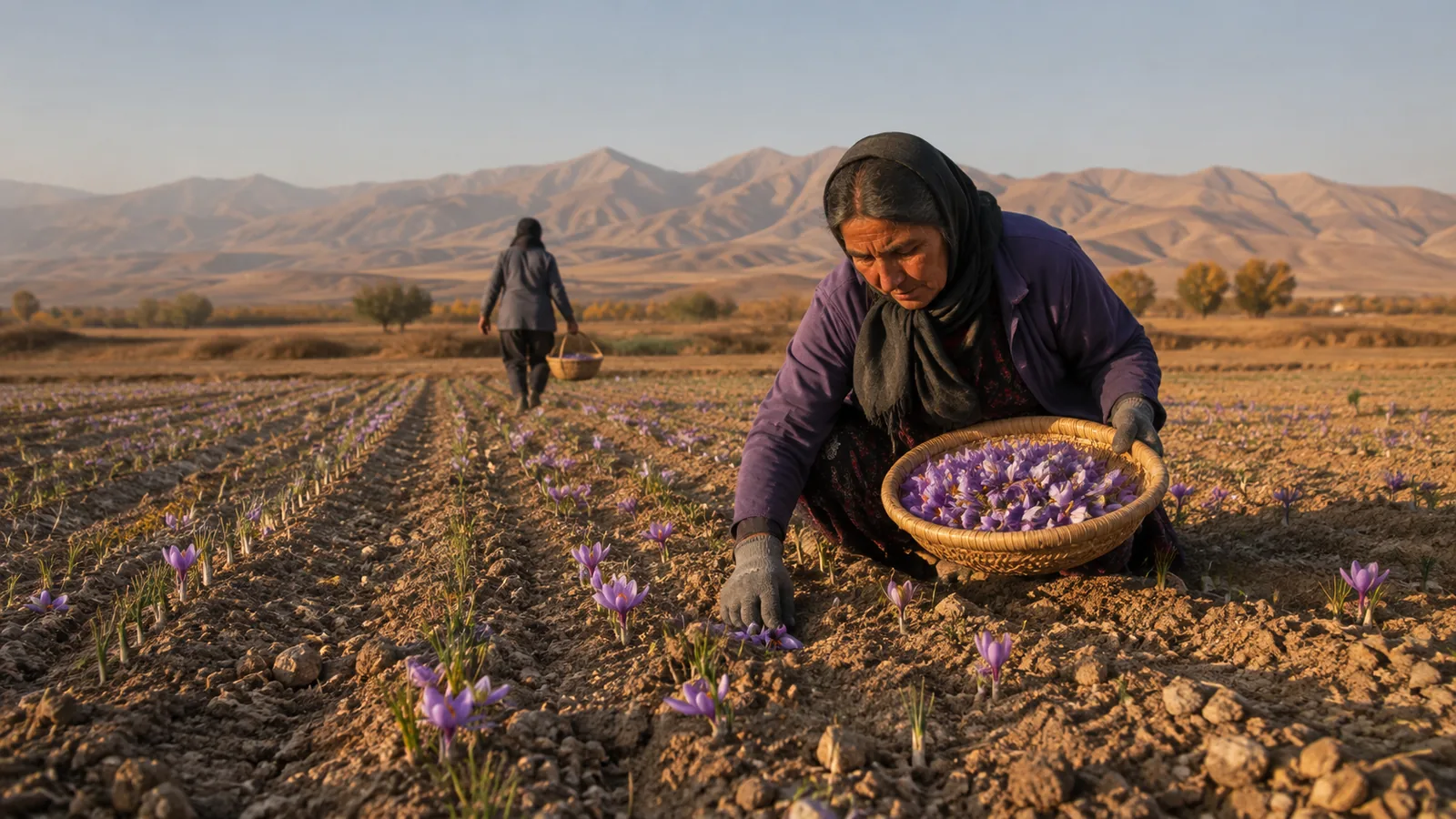
Saffron harvest in Neishabour had ended when a local agricultural official reported the season’s cultivated area, farm support and first-year yield expectations. The figures are useful as a dated snapshot, but several need their original period and units before they can be compared with a later season.
What the Neishabour harvest announcement reported
Seyed Gholamreza Nabavi Namaghi, identified in the source as Neishabour’s director of Jihad-e-Agriculture and a deputy head of the organization, announced that picking had finished on the city’s saffron farms. The report did not give a harvest year, publication date or total weight of dried saffron, so “end of harvest” should be read as the close of that particular local season rather than a permanent production figure.
Its main land-use figure was 3,100 hectares under saffron. Of that total, 2,800 hectares were described as productive fields and 300 hectares as young or not yet productive. That distinction matters: newly established saffron fields can flower in their first season, but their early yield should not be treated as the mature yield of the whole planted area.
Where the reported saffron fields were located
The announcement placed much of the cultivation in Neishabour’s central areas and referred to the plain and Zabarkhan. It did not break the 3,100 hectares down by district, village or farm, and it did not say how the productive and young hectares were distributed.
That missing detail limits what can be inferred from the total. Soil, irrigation access, corm age, field age and management can vary within one county. A citywide planted-area figure describes scale; it does not show that every field had the same yield or reached harvest on the same day.
The employment and income figures need a time basis
The original text associated Neishabour saffron with direct and indirect employment stated as “more than 495 thousand per day,” and gave farmers’ gross income as 254 billion rials. The employment wording is incomplete in English and may refer to person-days, but the source did not define the unit. The income figure likewise lacks a named crop year, price basis and indication of whether it covers gross sales before costs.
Both numbers should therefore stay attached to the historical announcement, not be presented as current employment or profit. Gross income is not net farm income: corms, labour, irrigation, nutrition, drying, packaging and transport all carry costs, while the selling price can change across grades and seasons.
What support growers were said to receive
Nabavi Namaghi listed chemical and micronutrient fertilizers, technical advice and heaters for drying saffron among the support supplied by the local agricultural organization. The source also referred awkwardly to the construction of farms and “ideal plans,” which appears to describe model or demonstration-farm work, although it did not explain the programme well enough to state that as fact.
Inputs are most useful when they answer a measured field need. Fertilizer recommendations should follow soil and crop assessment rather than a generic recipe, and drying equipment needs controlled temperature, clean handling and consistent loading. A heater by itself does not establish the colour, aroma, flavour or hygiene of the final spice.
How to read the 800-gram first-year yield
The announcement said that research on planting methods and better use of inputs and facilities, combined with expert guidance, could help a grower harvest about 800 grams of saffron per hectare in the first planting year. This was an expected first-year result, not the reported average for all 3,100 hectares and not a guarantee for a particular farm.
Field age is central to that comparison. The source separated 300 young hectares from 2,800 productive hectares precisely because the two groups were not equivalent. Research surveying growers across the Khorasan provinces also records differences in farm characteristics and corm-size practices, including farms in Neyshabur; its Khorasan saffron-farmer study is a useful reminder that one management figure cannot represent every holding.
Low water demand does not mean no water constraint
The old report called saffron a valuable option because it needs less water than many competing crops and can provide farm income. That relative advantage should not be simplified to “saffron needs little management.” Flower picking, stigma separation and timely drying are concentrated, labour-sensitive jobs, and establishment decisions continue to influence a field for several seasons.
Water also remains a local constraint. A study based on interviews with 100 farmers in the Rokh and Neishabour plains examined how water-price and quantity policies could change cropping patterns. The Neishabour irrigation-management record found that water-saving scenarios had to be considered at farm level. In other words, saffron can fit a lower-water strategy, but irrigation planning still has to reflect the basin and the field.
Harvest completion is only the start of quality control
Once the flowers are picked, the red stigmas must be separated cleanly and dried without avoidable delay. Storage then needs protection from moisture, light, contamination and strong surrounding odours. Those steps determine whether the work in the field becomes a stable, saleable spice.
A local announcement can describe support and harvest completion, but commercial quality requires measurement. The Codex standards register includes the international standard for dried floral parts of saffron and the analytical framework used to assess the product. No laboratory results accompanied the Neishabour report, so it should not be used to assign a grade to that harvest.
What a complete seasonal record would add
For a meaningful comparison, a follow-up report would name the crop year and reporting date, harvested dry weight, productive area, young-field area and yield by field age. It would also define the employment unit, state the period behind the 254-billion-rial gross-income figure and distinguish gross sales from production costs.
District-level area, irrigation source, corm size and health, drying method and tested quality results would make the account more useful to growers. Recording those items consistently would allow readers to see whether cultivation expanded, whether mature-field yield changed and whether technical support improved the finished spice.
How to understand this Neishabour season
The announcement documented a substantial local saffron sector: 3,100 planted hectares, including 2,800 productive hectares and 300 young hectares, with cultivation concentrated around central Neishabour, the plain and Zabarkhan. It also recorded fertilizer and micronutrient supply, technical advice, drying heaters and an expected first-year yield of about 800 grams per hectare.
Its employment and income numbers remain part of that record, but their missing units and dates prevent a present-day comparison. Read carefully, the report is most valuable as a historical harvest snapshot and a checklist of the information a stronger future season report should provide.

![Exporting Saffron to Turkey + Price Guide [Complete 0 to 100]](https://img.rowhanisaffron.com/20260827003933/saffron-export-turkey-quality-inspection.webp)



