


Yazd is the third largest producer of saffron in Iran is a historical ranking, not a description of the province today. The report behind that title counted about 600 hectares and three tonnes of annual production, with much of the activity in Tabas, Dastgerdan and Dehuk. Those places were then within the Yazd figures. Tabas was transferred to South Khorasan in 2013, so later province totals cover a different area.
That boundary change is the key to reading Yazd saffron production accurately. It also explains why a newer official figure can show a similar quantity of saffron from more land but assign Yazd a lower national rank.
A dated ranking, not a current league table
The original account placed Yazd third after Khorasan Razavi and South Khorasan. It reported 600 hectares under saffron, producing about three tonnes a year. Saffron cultivation in the stated districts had expanded from the 1390–91 crop year (2011–12), supported by a dry climate and farmers looking for a crop with a comparatively modest irrigation demand.
There is an important geographical detail. On 24 Dey 1391 (13 January 2013), Iran’s Cabinet approved the separation of Tabas County from Yazd and its transfer to South Khorasan. The published Cabinet resolution names the change explicitly. Dastgerdan and Dehuk were part of the same Tabas area. Figures that include them therefore cannot be compared directly with statistics for present-day Yazd province.
What newer official figures say
In December 2019, the head of Yazd’s Agricultural Jihad Organization reported 2,760 kilograms of saffron and said the cultivated area was expected to reach 850 hectares after a 104-hectare expansion. That report ranked Yazd sixth nationally and identified Bahabad, Bafq, Mehriz and Abarkuh as the principal areas. Bahabad alone accounted for 400 hectares. These are dated official figures reported by IANA, not a permanent ranking.
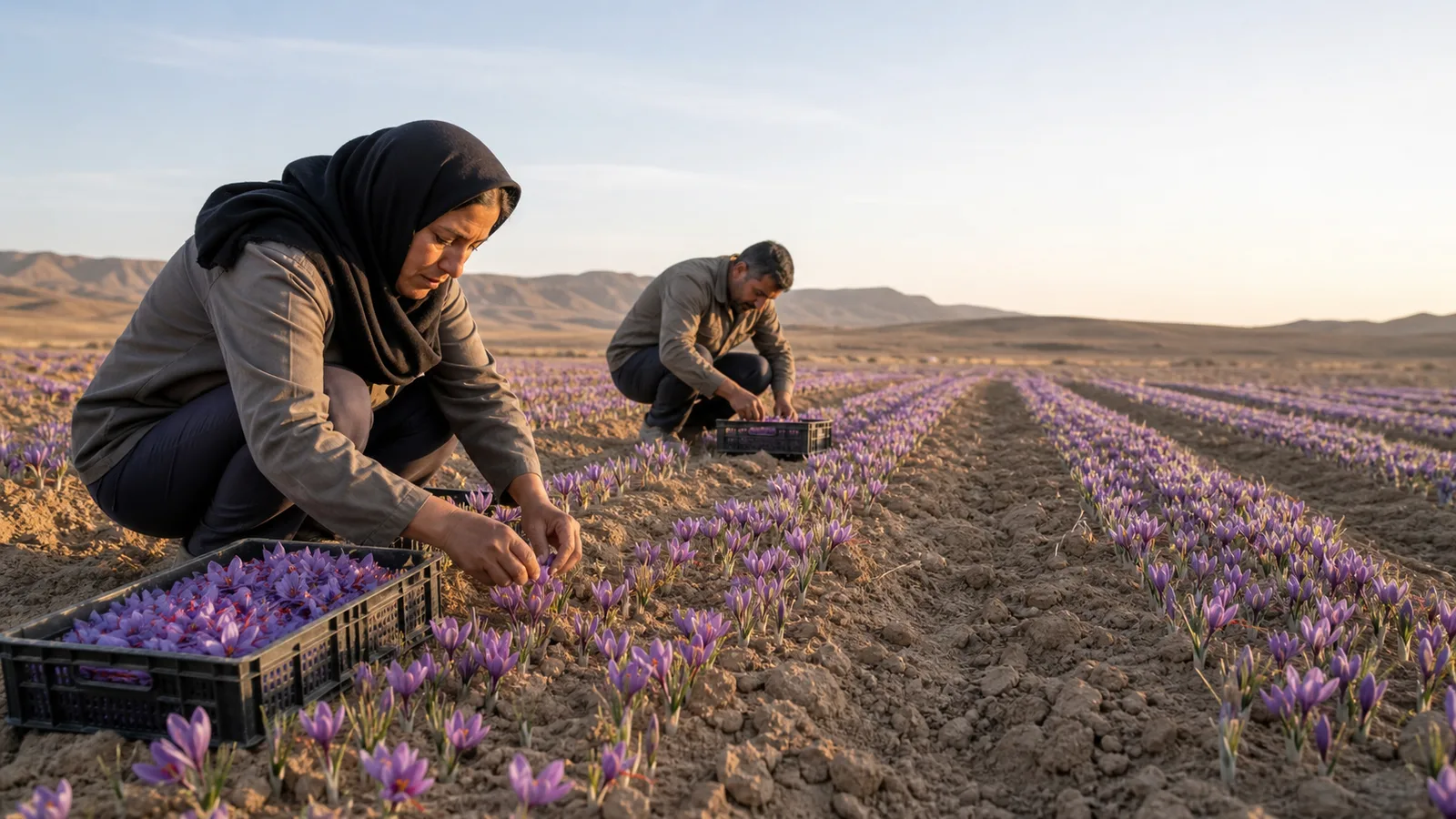
A further provincial update in November 2023 estimated a harvest of about 4,000 kilograms from 750 hectares of bearing fields, with an average yield of 5 to 5.5 kilograms of dried stigmas per hectare. It said picking began in early Aban and continued to mid-Azar—roughly late October to early December. The same 2023 agricultural report recommended picking flowers early in the morning and drying them promptly to protect quality.
These reports should be read by year. They describe different crop seasons and, in the older case, different provincial boundaries. Without a complete, same-year national dataset, it would be misleading to turn any one of them into a current 2026 ranking.
Where saffron fits among Yazd’s main crops
Yazd lies on Iran’s central plateau, beside the country’s desert regions, and covers roughly 75,000 square kilometres. Older descriptions called it the country’s fourth-largest province; that label came from the period when the much larger Tabas area was included and should not be read as a current administrative ranking.
Agriculture here operates under severe water constraints. Saffron is one of several high-value crops suited to that reality. Provincial agricultural reporting also identifies pistachios, pomegranates, apricots, medicinal plants and greenhouse produce among Yazd’s main crops. In a 2019 overview, horticulture occupied 71% of the province’s cultivated agricultural land, while a 2023 provincial account said water shortages kept a substantial share of cultivable land out of production.
Saffron is often described as a low-water crop, but that does not mean it needs no water or succeeds anywhere. A field’s soil, drainage, corm health, irrigation timing, summer heat and autumn conditions all affect yield. The crop’s value also depends on what happens immediately after picking: flowers must be handled cleanly, stigmas separated without delay and the product dried and stored correctly.
Harvest, processing and the value that leaves the farm
The historical account said the harvest ran from the second half of November through December. The newer 2023 report gives an earlier window, from early Aban to mid-Azar. Local climate and the particular season can shift flowering, so these dates are better understood as reported harvest windows than fixed rules.
In the older Tabas-centred supply chain, some flowers were processed locally and the rest were sent as fresh flowers to neighbouring provinces. Selling flowers quickly may solve an immediate handling problem, but it also moves drying, grading, packaging and part of the product’s value outside the producing area.
The problems identified in that account remain practical questions for any growing region:
- Price volatility: a short harvest period can leave growers exposed to sudden market changes.
- Limited local packaging: without suitable processing and packing, more value is captured farther along the supply chain.
- Reliable planting material: healthy, high-quality corms matter because poor or diseased stock can affect a field for several seasons.
Modern drying, hygienic handling and traceable packaging can improve consistency, but they do not replace careful field management. Nor does a larger planted area guarantee a larger crop: only bearing fields contribute to that season’s harvest, and yields vary by field and year.
What can safely be said about saffron and health
Saffron has a long history of culinary and traditional use, including descriptions as an appetite stimulant or calming ingredient. Clinical research has examined saffron extracts and supplements for several conditions, but an agricultural production article should not turn preliminary findings into treatment claims.
A 2021 systematic review found that saffron supplementation was associated with modest changes in some cardiovascular risk measures, including blood pressure, but the authors also noted substantial differences among trials (Nutrients, DOI: 10.3390/nu13082736). A separate review of laboratory, animal and human research discussed possible effects on memory and neurological conditions while stressing the need for stronger clinical evidence (BMC Complementary Medicine and Therapies, DOI: 10.1186/s12906-020-03102-3).
Claims that saffron prevents cancer or heart disease are not established by those studies. Laboratory or animal results are not proof of prevention in people, and saffron supplements should not replace medical care. Anyone considering a concentrated supplement—especially during pregnancy, while taking medication or while managing a health condition—should ask a qualified clinician first.
The clearest reading of Yazd’s saffron story
The “third-largest” title preserves a genuine historical report, but the number needs its date and geography. The older three-tonne, 600-hectare account included Tabas, Dastgerdan and Dehuk. After Tabas moved to South Khorasan, official Yazd reports focused on Bahabad, Bafq, Mehriz and Abarkuh; they placed the province sixth in 2019 and estimated about four tonnes from 750 hectares of bearing fields in 2023.
What remains consistent is the reason saffron matters in Yazd: it offers a high-value option in a dry province, provided growers can secure healthy corms, manage scarce water, harvest quickly and keep more processing and packaging close to the farm.

![Exporting Saffron to Turkey + Price Guide [Complete 0 to 100]](https://img.rowhanisaffron.com/20260827003933/saffron-export-turkey-quality-inspection.webp)



